



EDITORIAL: Uber, Lyft continue to hammer Southern Nevada cab companies
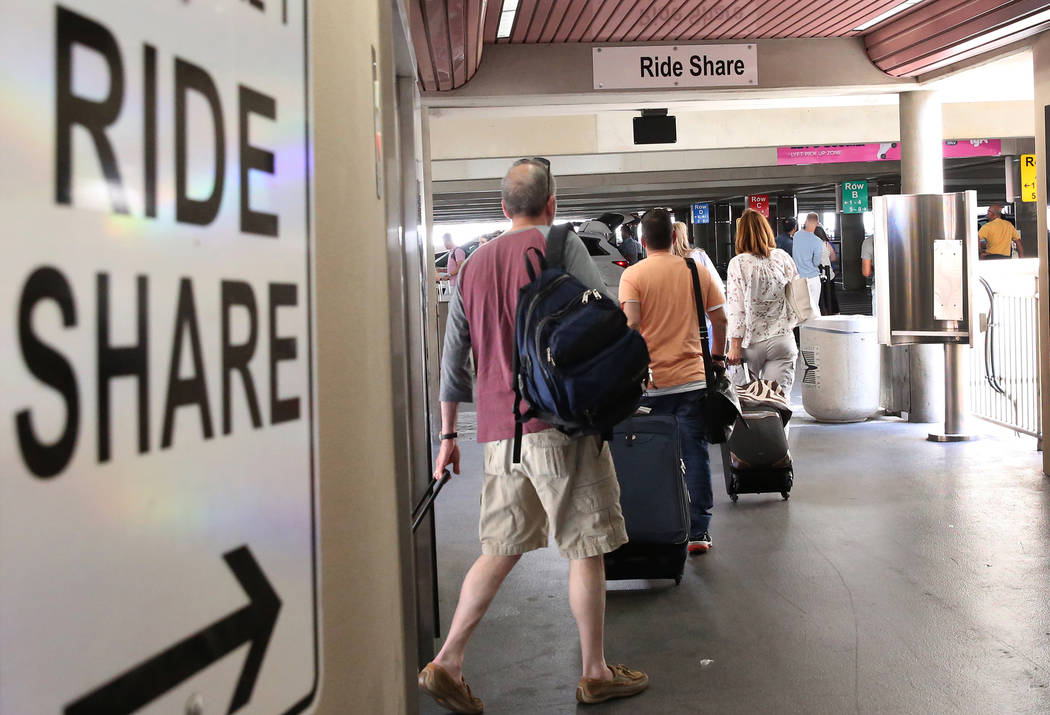


Local taxi companies continue to bleed customers thanks to ride-hailing services such as Uber and Lyft — and members of the cabbie cartel appear comfortable with sealing their own fate.
Taxi trips in Southern Nevada were down 13.56 percent in 2017 compared with the previous year, according to the Nevada Taxicab Authority. Revenues for the region’s 16 cab companies followed a similar trajectory, falling 13.7 percent to $323 million.
The numbers are even gloomier for the industry if you go back to 2015. In the past two years, local cab revenues are off 24 percent, and ridership has plummeted by nearly 28 percent.
“It was obviously a tough year,” said Brent Bell, a local transportation executive, “but I think we’re working hard to turn things around. We’re working hard to make taxi driving a better job and attract drivers back to the industry.”
That may be helpful in some ancillary way, but what good is it to attract drivers if there are no customers? And on that score, the cab bosses remain mired in a time warp.
Stan Olsen, who chairs the authority board, continues to embrace protectionism and rent-seeking, arguing the industry can flourish again if state lawmakers would oblige by crippling Uber and Lyft with additional insurance and licensing regulations. This is a tired old refrain that betrays an antiquated mindset.
At the same time, the Review-Journal’s Art Marroquin reports that regulators are caught up in a debate over whether to loosen the rules regarding “long-hauling” to allow cabbies to vary routes based on traffic volume, rather than simply mandating they take the most direct path to a fare’s destination.
This is like worrying about a hangnail when you’re scheduled for open-heart surgery.
Note that Uber and Lyft users don’t have to worry about drivers who pad their fares by taking unsuspecting riders on longer-than-necessary routes. When a customer summons a ride-hailing service on a smartphone app, the cost is made abundantly clear and remains the same regardless of how a driver gets from Point A to Point B.
And there’s the rub. Companies such as Uber and Lyft are burying the taxi companies because they offer a superior combination of price, convenience and service. Meanwhile, the cab industry remains wedded to the past, operating under a self-imposed regulatory regime that dates back a half-century and hinders its ability to evolve.
It may indeed be too late to save the cab industry. But if Mr. Bell and his cohorts have any chance of stemming their rapid decline, they must do more than just tinker with the regulatory status quo. The must demand to be freed from the government shackles and allowed to compete — not just with Uber and Lyft, but among themselves — on issues such as pricing and service.
Absent that, the old adage about the Titanic and the deck chairs leaps to mind.


