Formula One team owner demonstrated that adversity can be overcome



Life is all about change and adapting to change, even if we don't ask for it or plan it ourselves.
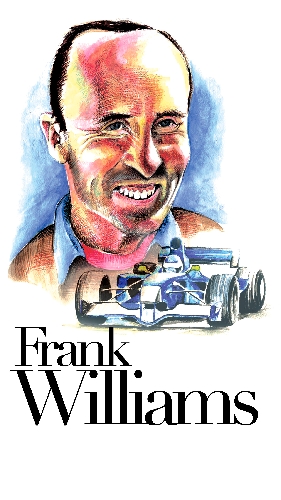
Frank Williams certainly never planned or asked for the kind of change he experienced on March 6, 1986, but he has adapted and even thrived on it.
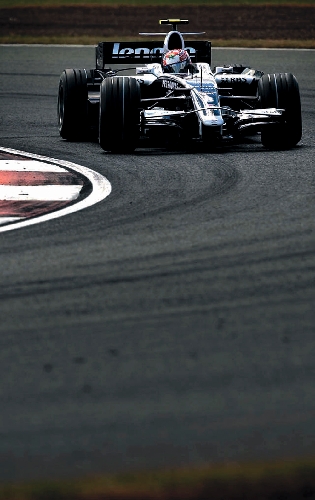
On that day, the man who had become a formidable player in Formula One, the world's premier auto racing series, was at the Paul Ricard circuit in the south of France. He was there to check on the progress of his team drivers Nigel Mansell and Nelson Piquet as they tested his latest FW11 race car.
Returning to his private jet parked at the nearby Nice airport, the usually fast-driving Williams lost control of his rental car on a twisty secondary highway. The vehicle somersaulted off the road, landing on its roof. Although an associate riding with him was uninjured, the resulting near-fatal injuries to Williams left the one-time marathon runner a quadriplegic.
You might think that this sort of catastrophic, life-altering event would have been exactly that. But Williams seemed to treat it as only a minor annoyance. Within four months, the wheelchair-bound head of one of the most successful race teams in the world was back at work. That year, his Honda-powered thoroughbreds won nine of 16 events, with Williams capturing both the Constructor's Cup as well as the 1986 World Championship for driver Nelson Piquet.
Those who know Williams express little surprise that the tenacious Englishman would re-establish himself so rapidly, or even regain his ultraactive preaccident pace.
From his earliest beginnings (he was born in 1942), Williams has focused on little else but the world of motorsports. Growing up largely alone from age 8 in a Scottish boarding school gave Francis Owen Garbett Williams plenty of time and solace to think about his one overriding passion. After graduating from college, he tried his hand at racing, working his way up to the open-wheel Formula Three ranks. But, by the age of 24, having secured only a single victory among several mostly nonfinishes, he retired from active competition.
Instead of racing, Williams became a broker of racing cars and racing parts. The job not only kept him involved in the sport, but his multilingual skills (fluency in French and Italian, plus a passing knowledge of German) came in handy in his dealings with European prospects.
Dabbling on the fringes of the racing world and mingling with numerous racing personnel eventually led Williams to manage Piers Courage, an up-and-coming Grand Prix driver. However, Courage was killed at the Dutch Grand Prix in 1970. Williams continued to knock around racing, usually in a state of perpetual impoverishment, for a number of years, eventually starting his own badly underfinanced team in 1976.
With the assistance of race-car designer Patrick Head, and with funding derived from wealthy members of the Saudi Arabian royal family, Frank Williams launched a concerted and carefully planned assault on the Formula One crown.
In 1979, in the team's second full year of competition, driver Clay Regazzoni scored Williams' first victory with teammate Alan Jones winning four of the final six races of the season. If the Saudis were looking for a return on their investment. Frank Williams was providing it, and then some.
The following year proved to be even more successful, with Jones securing the World Championship and Williams winning the constructor's title.
From 1980-'97, Williams captured the Constructor's Cup a record nine times, employing a number of Formula One's top driving stars, including Carlos Reutemann, Keke Rosberg, Ricardo Patrese, Alain Prost, Ayrton Senna, Damon Hill and Jacques Villeneuve.
The success Frank Williams achieved immediately following his 1986 crash was overshadowed by two significant setbacks. The first occurred when Honda, supplier of race engines to the Williams team, announced that it was switching teams.
Undaunted, Williams convinced the French automaker Renault to go racing with him, which it did for the 1989 season. Three years later, his Renault-powered Williams team was back on top, winning the overall championship in convincing style, just as it had done with Honda.
The other and more tragic setback occurred in 1994. Williams hired three-time world champion Ayrton Senna to drive for him that year, but in only his third outing (the Italian Grand Prix), the 34-year-old Brazilian crashed into a barrier and was killed. Incredibly, instead of attributing Senna's death to the inherent risks of racing, the Italian authorities pointed fingers at Williams' technical director Patrick Head and his chief designer for a steering malfunction. The affair hung like a dark cloud over the team with Head eventually being found guilty of manslaughter. By that time -- 13 years later in 2007 -- the statute of limitations had run out, preventing any penalty.
After two more championship seasons (1996-'97), the Williams team has had few podium finishes to its credit, despite employing some of the best drivers and changing engine suppliers several times. But with the doggedly persistent Williams firmly and resolutely in control, never count out the team as a contender for the Formula One championship. Whether its running a competitive Formula One operation or dealing with life's inevitable curve balls, Frank Williams continues to gun for the top.
Malcolm Gunn is a feature writer with Wheelbase Media. He can be reached on the Web at www.shiftweekly.com by using the contact link. Wheelbase supplies automotive news and features to newspapers across North America.