Hyundai poses competition


Do you remember Hyundai's original mission to deliver affordable transportation to the North American masses? With the 2010 Genesis Coupe's arrival, you can now add fun-to-drive, downright-sexy automobiles, as well.
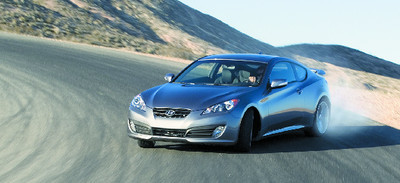
Until recently it would have been improbable and perhaps inappropriate for Hyundai to orchestrate a press introduction at an actual race track. But the Korean automaker chose the twisty confines of the 200-acre Spring Mountain Motorsports Ranch, located in Pahrump, to give a group of auto writers the chance to drive the wheels off its brand-new rear-wheel-drive two-door.
Never mind that Hyundai's big and bold Genesis sedan is brashly challenging such luxury heavyweights as Lexus and Mercedes-Benz. Hyundai seems equally determined to keep the competition off-stride with the coupe derivative. Both cars employ the same rear-wheel-drive architecture, but the Genesis cousins share little else, other than the name.
The Coupe takes over Hyundai's sporty car reigns from the smaller front-wheel-drive Tiburon that retired in 2008. However, while the Tib's role was as an entry-level compact for the younger set, the Genesis takes aim at enthusiasts of every stripe, including the hard-core "tuner" crowd plus anyone seeking a competent, sophisticated city and country road machine.
The good-looking Coupe certainly looks the part, appearing as a cross between the luxury-focused Infiniti G37 and Honda's Accord tourer, with a dollop of Mitsubishi Eclipse tossed in for good measure. The lines are crisp and taut, the wind-cheating roofline is fastback smooth and the stance is perfectly low and squat.
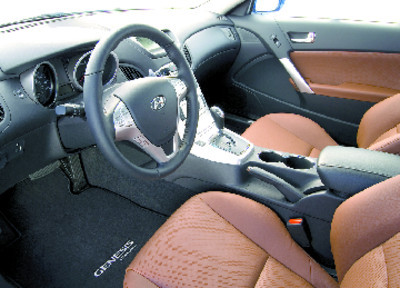
The interior also earns high marks. The front seats are especially supportive, while leaving just enough wiggle room so as not to feel too constraining. The Coupe's generous width means there's no cramped and crowded feeling in the cabin and both front- and back-seat riders will experience a reasonable degree of separation.
The control panel is cleanly laid-out and quick to master (a rarity in this age of excessive push-buttons and knobs) and the gauges are easy to read and are right where you need them. Unfortunately, the dashboard itself is bland and plasticky, a condition that could easily be corrected should Hyundai choose to employ the Genesis sedan's stitched leather-look dash covering.
The Coupe positively sparkled while navigating the back roads leading to the Spring Mountain facility. The base 210-horsepower 2.0-liter four-cylinder (good for 30 mpg on the highway), which uses a Mitsubishi-supplied turbocharger to help it make power, proved more than respectable around the race track's tight corners, but needed more oomph on the long straightaways. Of course, that was in comparison to the optional 306-horsepower 3.8-liter V-6 that produced impressive strength and healthy exhaust rumble whenever it flexed its muscles.
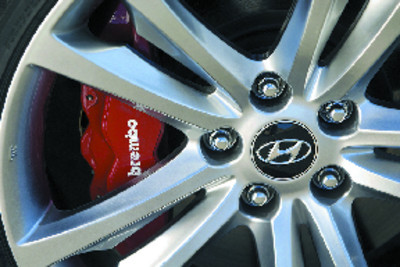
Most Coupe versions tested were fitted with the optional Track package that included stiffer suspension components, beefy Brembo-brand brakes and 19-inch alloy wheels (18s are standard).
Either powerplant comes with a six-speed manual transmission (standard on Track versions) that's precise, but feels overly notchy between shifts (BMW and Honda/Acura still hold the edge in smoothness here). The 2.0 can be optioned with a five-speed automatic, while a six-speed automatic is available on the 3.8. Paddle shifters on the steering wheel are included with either selection.
Both Coupe versions contain plenty of standard equipment, while up-level content such as a power driver's seat, premium sound system, power sunroof and a navigation system are extra-cost add-ons.
The big question is, has Hyundai really and truly come of age as a builder of vehicles that offer more than a low sticker price?
With the Genesis models leading the charge, the answer is yes. The Coupe deserves a look-see from anyone aspiring to pilot an over-achieving sports car that can run with the best in its class, serve up fashion-model good looks and still manage to keep you from being overdrawn at the bank.