NV Energy picks up Ram test
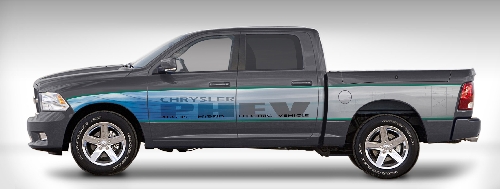




NV Energy recently persuaded Chrysler Group to grant the utility an opportunity to test five new Ram 1500 PHEV plug-in hybrid electric pickup trucks within the state of Nevada during the next three years, before this technology is released for sale to the general public.
The newly reformed Chrysler Group is now jointly owned and managed by Fiat S.p.A. with support from the U.S. federal government. The Department of Energy, under the American Recovery and Reinvestment Act of 2009, provided a $48 million grant to Chrysler Group to develop plug-in-hybrid electric technology for pickup trucks. Chrysler/Fiat has matched this funding with $49.4 million from its own resources.
As part of this research effort, Chrysler Group built 140 plug-in hybrid electric Ram 1500 PHEV pickup trucks for a nationwide evaluation program that will gather data during the next three years. Local drivers will test these vehicles for different applications under all types of climate, terrain, temperature and traffic conditions throughout the country.
Chrysler has been developing hybrid Ram pickup trucks for military and contractor fleet operations since 2002. Early models were originally conceived as diesel-electric hybrid systems with an onboard diesel generator that could provide on-demand electricity for military and construction applications.
The Ram 1500 PHEV is a four-wheel drive Crew Cab model with a 6-foot bed, weighing in at 6,400 pounds. It can seat six passengers, carry a payload of 1,000 pounds and has a towing capacity of 6,000 pounds. Like a standard Ram 1500, the plug-in hybrid truck employs a Hemi V-8 engine with Chrysler's multidisplacement system that can turn off some of the eight cylinders when they are not required, in order to reduce gasoline consumption. Compared to the standard Ram 1500 truck, the PHEV also includes a two-mode full hybrid technology system that improves fuel economy by an additional 54 percent in the city, 16 percent on the highway and 32 percent overall. The vehicle is certifiable as an Advanced Technology, Partial Zero Emission Vehicle that contributes to lowering greenhouse gas emissions.
What really distinguishes the Ram 1500 PHEV from other members of the existing Ram 1500 family is a liquid-cooled lithium-ion battery pack with an energy storage capacity of 12.9 kilowatt-hours. The battery pack can be fully recharged when plugged into a 120-volt AC source after about eight hours or from a 240-volt AC source in about two hours.
The Ram 1500 PHEV battery pack provides electrochemical energy to a pair of 65-kilowatt electric motors. Each motor can develop 87 horsepower for a combined burst of 174 horsepower that can move the 6,400-pound vehicle by electricity alone . Electric-only range varies from six to 20 miles depending on speed and road conditions before the battery-pack energy capacity drops below a certain threshold.
At that point, the Ram 1500 PHEV drive train automatically transitions to a hybrid mode that combines the electric motors with the gasoline engine to sustain a minimum state of charge in the battery pack while continuing to extend the truck's range. Both driving modes utilize power assistance from the hybrid drive train that features an electronically variable transmission and four fixed gears coupled with the two electric motors. Combined electric and gasoline range is 655 miles with a fuel economy rating of 32 miles per gallon after the battery pack is fully charged and the 26-gallon gasoline tank topped off.
Regenerative braking technology also can recapture kinetic energy from the wheels of the vehicle when coasting downhill or slowing to a stop. The electric motors on the drive train become generators and the energy from the spinning wheels is converted back to electricity to partially recharge the battery pack of the vehicle while also slowing the heavy vehicle by using the electromagnetic fields within the motor to supplement the hydraulic braking system.
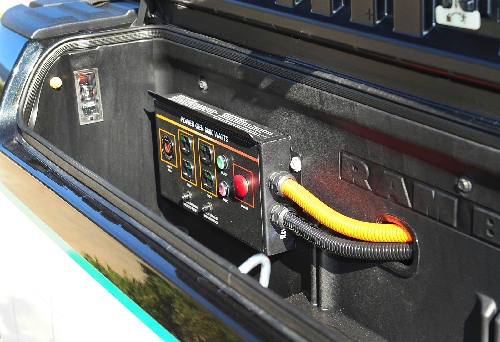
Another innovative feature of the Ram 1500 PHEV battery pack is that it can provide external power generation. Not only can the battery pack be used to drive a dual electric-motor system to supplement the main 5.7-liter Hemi V-8 engine, it also can serve as an auxiliary mobile power source for tools, instruments or electronic equipment through an externally mounted power panel.
This is accomplished by transforming the DC battery pack into an AC power source through an electrical inverter that can provide two standard 120-volt power supply outlets, each rated at 20 amps of electrical current, as well as a single 240-volt power outlet rated at 30 amps. The total power coming out of a power panel is rated at 6.6 kilowatts continuous, so the capacity of the lithium-ion battery pack at 12.9 kilowatt-hours can continue to provide power for at least two hours, depending upon what type of tools or electrical devices are connected. When the battery-pack energy depletes beneath a certain threshold, the gasoline Hemi V-8 engine turns on to spin the two electric motor-generators so that they can recharge the battery pack while keeping power flowing to the outlets.
Applications for the Ram 1500 PHEV in rural Nevada might be to provide mobile power at remote construction sites where there are no power lines, transformers or AC outlets. The availability of mobile electric power also would be useful within all regions of the state for emergency response teams that require auxiliary electrical equipment for medical, communication or firefighting applications.
Data generated from the test project will enable NV Energy and other Chrysler utility partners to develop robust solutions for bidirectional grid interfaces as well as microgrid and smart grid applications.
The truck's battery pack could provide temporary backup electric power to a home or business office when storms have disabled power from the main utility grid.
Nissan and Toyota are both pursuing these types of "vehicle to home" (V2H) and "vehicle to grid" (V2G) applications for their electrified vehicles after the recent earthquake and tidal wave tragedies in Japan that damaged the Fukushima nuclear power plant in that country.
To find out more information about the Ram 1500 PHEV as well as the Chrysler partnership with NVEnergy, visit the Chrysler Group website at http://media.chrysler.com/newsrelease.do?id=11702&mid=70.
Stan Hanel has worked in the electronics industry for more than 30 years and is a long-time member of the Electric Auto Association and the Las Vegas Electric Vehicle Association. Hanel writes and edits for EAA's "Current Events" and LVEVA's "Watts Happening" newsletters. Contact him at stanhanel@aol.com.