Trump narrows gap, trails Clinton by 6 points in latest CNN poll
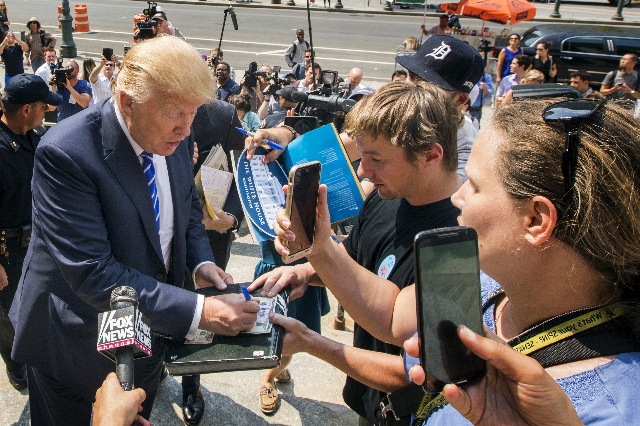
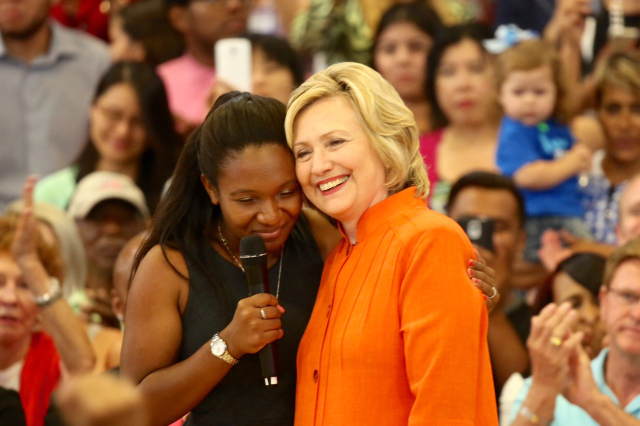


WASHINGTON — Since announcing his campaign in late June, Donald Trump has quickly leapt to the top of the Republican field, leading recent polls nationally, in Iowa and in New Hampshire. And now, for the first time in CNN/ORC polling, his gains among the Republican Party have boosted him enough to be competitive in the general election.
The poll finds Democratic frontrunner Hillary Clinton ahead of Trump by just 6 points, a dramatic tightening since July. Trump is the one of three Republican candidates who have been matched against Clinton multiple times in CNN/ORC polling to significantly whittle the gap between himself and the Democratic frontrunner. He trailed Clinton by 16 points in a July poll, and narrowed that gap by boosting his standing among Republicans and Republican-leaning independents (from 67 percent support in July to 79 percent now), men (from 46 percent in July to 53 percent now) and white voters (from 50 percent to 55 percent).
But Clinton still holds the cards overall in the race for the White House, leading four Republican contenders: She tops Trump and Wisconsin Gov. Scott Walker by 6 points each among registered voters, former Florida Gov. Jeb Bush by 9 points, and businesswoman Carly Fiorina by 10 points.
Clinton maintains this edge in the general election race despite a growing perception that by using a personal email account and server while serving as secretary of state she did something wrong. About 56 percent say so in the new poll, up from 51 percent in March. About 4-in-10 (39 percent) now say she did not do anything wrong by using personal email. Among Democrats, the share saying she did not do anything wrong has dipped from 71percent in March to 63 percent now, and just 37 percent of independents say she did not do wrong by using the personal email system.
And positive impressions of Clinton continue to fade. Among all adults, the new poll finds 44 percent hold a favorable view of her, 53 percent an unfavorable one, her most negative favorability rating since March 2001. A majority of women voters have a positive take on Clinton, 52 percent view her favorably, and her support among women appears to be the foundation for her general election advantages.
But the fading numbers haven't hurt her against some GOP contenders. Clinton has her biggest lead over Fiorina, topping her 53 percent to 43 percent among registered voters. She leads Bush by a nearly identical margin, 52 percent to 43 percent. And Clinton tops both Trump (51 percent to 45 percent) and Walker (52 percent to 46 percent) by 6 points each.
All of those leads are boosted by sizable gender gaps.
Against Bush, Clinton leads 59 percent to 37 percent among women, while Bush holds an advantage among men, 51 percent Bush to 44 percent Clinton. Against Fiorina, the only woman among the major candidates for the Republican Party's presidential nominations, women break 60 percent for Clinton to 39 percent for Fiorina, while men are about evenly divided, 48 percent for Fiorina, 46 percent for Clinton. The largest gender gap — 34 points — comes in a match-up between Clinton and Trump. Women favor Clinton by 23 points, 60 percent to 37 percent, while men break in Trump's favor by 11 points, 53 percent to 42 percent.
At the same time, Clinton's lead in the race for the Democratic nomination for president is narrowing, and the new poll suggests the best way for the former secretary of state to shift the momentum would be for Vice President Joe Biden to decide to sit this one out. Most Democrats, though, say they'd like to see Biden make a run for the White House.
Overall, 47 percent of Democratic and Democratic-leaning voters say they support Clinton for the party's nomination. That's down 9 points since July, and marks the first time her support has dipped below 50 percent in national CNN/ORC polling on the race.
At the same time, Vermont Sen. Bernie Sanders has climbed 10 points since July and holds second place in the race with 29 percent. Biden follows at 14 percent, former Maryland Gov. Martin O'Malley is at 2 percent, former Virginia Sen. Jim Webb has 1 percent and less than 1 percent back former Rhode Island Gov. Lincoln Chafee.
And though support for Clinton's nomination bid has slipped, she is the candidate most trusted by Democrats on four top issues, and remains the candidate to beat in general election match-ups.
Should Biden decide not to make a run for the presidency, his supporters would largely flock to Clinton rather than Sanders, boosting her numbers. With Biden's backers re-allocated to their second choice, Clinton holds 56 percent, Sanders 33 percent, with support for O'Malley, Webb and Chafee unchanged.
Among those Democratic voters who are "extremely enthusiastic" about voting for president next year, it's already essentially a two-person race. Clinton is the choice of 50% of such voters, with Sanders jumping to 38 percent among that group, Biden at 6 percent, and O'Malley at 2 percent.
Still, most Democrats say they do want Biden to make a go of it: 53 percent of Democrats and Democratic-leaning voters say they think Biden should run, 45 percent that he should stay out. Even among those who currently support Clinton, 50 percent say they think Biden should run.
Democratic voters aren't necessarily convinced a Biden presidency would be better than a Clinton one, though: 35 percent say Biden would do a worse job as president than Clinton, 27 percent a better one and 38 percent say there wouldn't be any difference between the two. Those who think Biden should run are more apt to say he'd do a better job than a worse one (41 percent better vs. 18 percent worse) but a sizable 41 percent say there ultimately wouldn't be any difference between the two.
Fewer see Sanders as equivalent to Clinton, more say he'd do a worse job. Overall, 37 percent of Democratic voters think Sanders would do a worse job as president than Clinton, 31 percent that he'd do a better job, and 29 percent that there would be no difference between the two. That shifts among the party's liberal voters, 41 percent of whom think Sanders would do a better job than Clinton, 34 percent think he would do worse than Clinton and 22 percent that there would be no difference.
Sanders has boosted his favorability rating in the last month, 35 percent of adults and 58 percent of Democratic voters have a positive impression of the senator, that's up from 23 percent among adults and 36 percent among Democratic voters since July.
When Democratic voters are asked which candidate they trust to handle the economy, race relations, foreign policy and the income gap between rich and poor Americans, Clinton tops the list each time. Her biggest advantage comes on foreign policy, where 61 percent of registered Democrats say they trust Clinton over the rest of the field. Biden follows at 22 percent, and just 9 percent say Sanders is their top choice here. On the economy, 45 percent say Clinton would best handle it, 26 percent choose Sanders and 21 percent Biden.
Sanders fares best on the income gap, with 34 percent saying he would do the best job handling that issue, 7 points behind Clinton's 41 percent. Though the margin is wider among those with incomes under $50,000 annually, 49 percent of Democratic voters in that group favor Clinton to handle the income gap, 28 percent Sanders.
On race relations, an issue that both top Democrats have addressed directly in interactions with Black Lives Matter activists in recent weeks, Clinton tops Sanders by nearly a 2-to-1 margin, 50 percent choose her while 26 percent say they trust Sanders most, 14 percent Biden. Democratic voters are broadly positive toward the Black Lives Matter movement, 59 percenthave a positive take on it, 17 percent unfavorable, and 24 percent haven't heard enough or don't have an opinion.
The CNN/ORC Poll was conducted by telephone August 13-16 among a random national sample of 1,001 adults. The sample included 897 registered voters, 358 of whom are registered voters who are Democrats or independents who lean toward the Democratic Party. For results among those Democratic voters, the margin of sampling error is plus or minus 5 percentage points. For results among registered voters it is 3.5 points, and among all adults, 3 points.