Legislature to take up alternative revenue plan, sunset taxes


CARSON CITY — Major developments emerged on Monday in the debate over taxes to fund Gov. Brian Sandoval’s $7.3 billion two-year budget, with Assembly Republicans introducing an alternative revenue plan in a late evening floor session.
At the same time, the Senate introduced Senate Bill 483 to extend a package of taxes that are set to expire on June 30, commonly referred to as the sunset taxes that have been used as a bandage to balance the budget since 2009. A continuation of these taxes is part of Sandoval’s spending plan and would bring in about $580 million to the state general fund over two years.
The Senate also met as a Committee of the Whole to further discuss Sandoval’s proposal for a new business license fee that would raise about $250 million a year to fund his many new and expanded public education initiatives. Senate Bill 252 was introduced last week with Sandoval testifying along with three other former governors.
Senate Majority Leader Michael Roberson, R-Henderson, suggesting that he wants to move quickly on the proposal, said it would be the last committee session on Sandoval’s bill.
Three Southern Nevada Democratic state senators have floated their own proposal as well, a bill that would abolish Nevada’s modified business tax for non-financial institutions and impose a new fee based on gross receipts over $25,000. Senate Bill 378 is set for a hearing in the Senate Revenue and Economic Development Committee on Tuesday. The amount of revenue it would raise was not immediately available.
Also on the table are changes to the live entertainment tax and an increase in the cigarette tax from 80 cents to $1.20 a pack.
It is the first time in at least decades that a discussion of taxes, with actual bills detailing the various proposals, have come so early in the Nevada Legislature. It is also the first time in many years that Republicans, from Sandoval to GOP leaders in the Assembly, are proposing tax bills primarily to increase funding to public education.
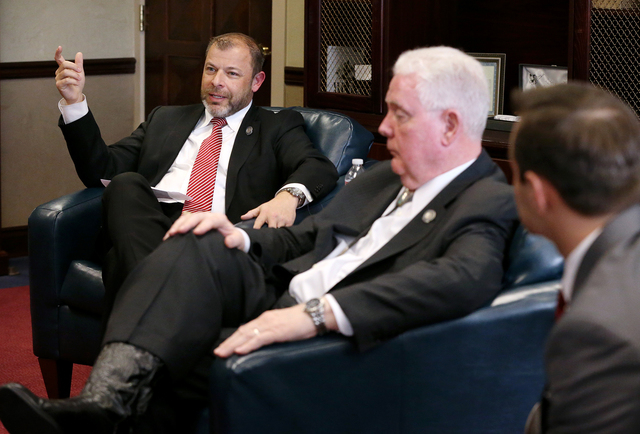
The Assembly Republican measure, Assembly Bill 464, was detailed by Speaker John Hambrick, Majority Leader Paul Anderson and Taxation Chairman Derek Armstrong, all Republicans from Southern Nevada, ahead of its introduction.
The lawmakers said they drafted their proposal, a plan that establishes a flat business license fee and expands and raises the modified business tax, to offer an alternative to Sandoval’s plan. There is no commitment to the bill yet by the Assembly Republican Caucus.
Anderson said a bill had to be drafted and introduced so that the Assembly would have a vehicle to further the tax debate.
The proposal would raise the modified business tax to 1.56 percent from the current 1.17 percent. Businesses with less than $200,000 a year in payroll would not pay the tax. Financial institutions would actually see a rate reduction from the 2 percent they pay now.
The business license fee currently at $200 a year for all businesses would rise to $500 for corporations and $300 for non-corporate businesses.
Along with several other changes, the tax play would bring in $544 million in new revenue and would exceed Sandoval’s 2015-17 budget by just under $62 million.
Anderson said the Legislature is in “a unique, maybe even historic position” of debating how to increase public education funding, not whether funding will increase.
“So our intention with this bill is not to be a competing measure, but just to show a different path to the same end result,” he said. “We need a bill to have a discussion.”
Armstrong said the plan can easily be revised if necessary to balance the revenue needs with the final budget ultimately approved by lawmakers. If the final budget is $100 million less than recommended by Sandoval, for example, the non-corporate business license fee could be reduced to $200 a year and the modified business tax rate could decline to 1.49 percent, he said.
“We’re looking for solutions that are fair and not volatile and reduce the number of carve outs and we feel like this is another good way to introduce something into the conversation,” Armstrong said.
Any tax proposal needs a two-thirds vote in both the Senate and Assembly to win approval. The 25-member Assembly GOP caucus is divided, and some members have already indicated they will not support Sandoval’s business license fee proposal.