Southern Nevada homelessness count set for later this month, first since 2024
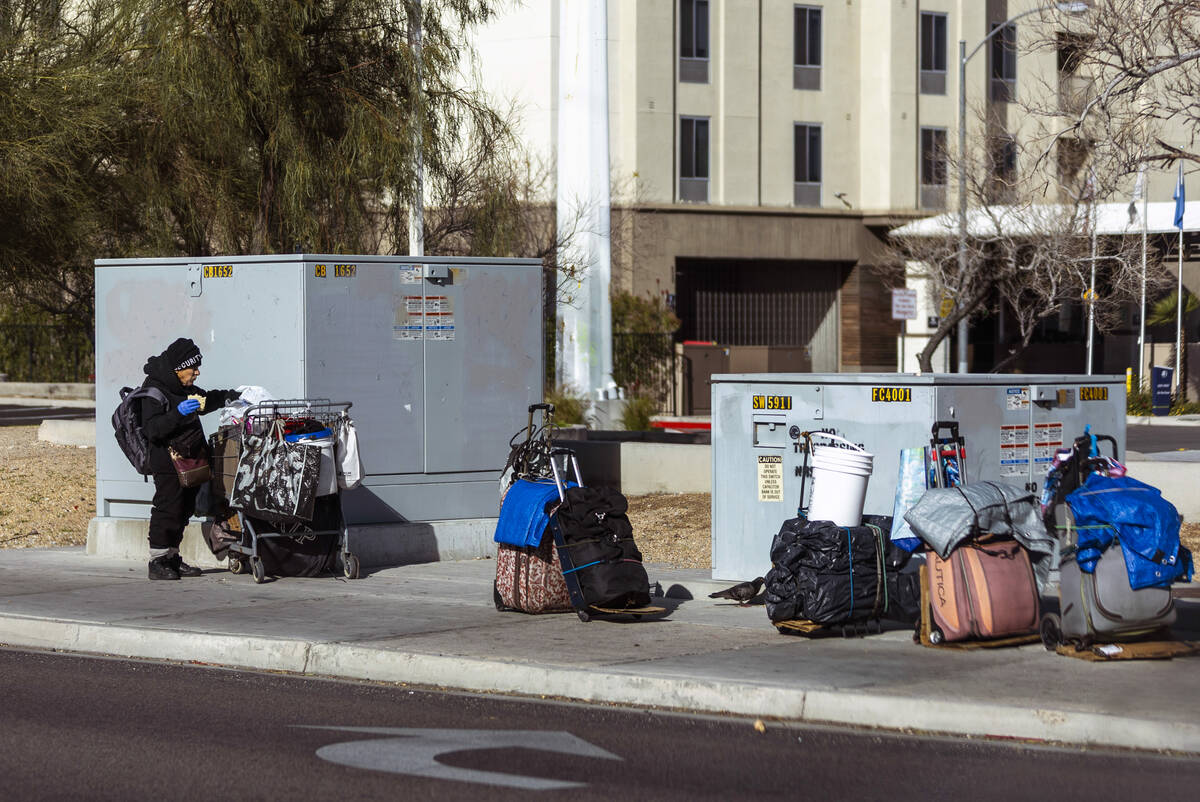




A cadre of volunteers will head out during the predawn hours across Southern Nevada’s streets, storm drains, tunnels and other public spaces homeless people are known to encamp at or linger in later this month.
The task for the couple hundred people on Jan. 29 is laborious: to try to find and count the unsheltered and unsheltered population throughout the valley.
After a one-year pause, the Southern Nevada Homeless Continuum of Care’s Point in Time Count is resuming in 2026.
The daylong census is a prerequisite for multimillion-dollar grants awarded by the U.S. Department of Housing and Urban Development, which help fund the region’s social services.
For Clark County, that could translate to funds between $24 million and $26 million, according to Jamie Sorenson, director for the county’s social services department.
“We’ve got a good group of volunteers and I think the right number of volunteers to conduct a very thorough, minutia count,” he said.
Census returns after a year pause
The continuum of care, which comprises local governments, partner agencies and nonprofits, decided against holding the census in 2025.
A report published months after the 2024 count documented 7,906 sheltered and unsheltered homeless people in Southern Nevada.
That was a 20 percent overall increase compared with the previous year and the highest figure reported in a decade, coinciding with a national trend.
The 4,202 people found outside shelters represented a 7 percent year-over-year increase.
Sheltered people represented a 40 percent increase, which the county described as an indication that an “expansion of shelter access” led to an increase of people benefiting from services.
Anticipating findings
Sorenson said the pause helped the continuum step back to examine its census approach.
HUD, he added, only requires a biannual count.
“Everybody just wanted some time to make sure our method and our process is the one that we wanted,” Sorenson said.
To maintain consistency in compare year-to-year figures, the methodology did not see major changes, he said.
However, procedural changes include uniformed surveys at local shelters and the distribution of bilingual service guides, Sorenson said.
Furthermore, the count will now begin in the “corridor of hope,” where the homeless population is centralized near downtown Las Vegas, to avoid duplicate data, he added.
Sorenson did not want to speculate on what the census will reveal.
“I’m really curious about what we’re going to find with the count on the 29th,” he said.
Sorenson said the continuum wants to examine the effects of Clark County’s camping ban, which took effect in early 2025; a temporary food stamps benefits pause in November; cost of living increases, and decreased funding to rental assistance programs.
The entity also wants to see what roles poverty, substance abuse and mental health play in people’s living situation, he said.
“I’m interested to see if any of those pressures are impacting rates of homelessness,” Sorenson said. “In this count, we want to see what we can draw in terms of reasons they’re homeless.”
He foresees the census returning to a yearly basis as early as 2027.
Preparations ongoing
Volunteers are being trained on the count’s terminology and methodology, and role playing the interactions, Sorenson said.
HELP of Southern Nevada, a nonprofit contracted by the county, has those interactions every day.
“It is our job to meet clients where they’re at and to provide them the best services we can, and to work with them to overcome the barriers that are keeping them homeless,” said Louis Lacey, HELP’s homeless response teams director.
Staffers traverse the valley, offering essentials to keep them afloat, and longer-term social services to anyone who accepts them.
During the census, the nonprofit was tasked with surveying people in storm drains and tunnels, Lacey said.
That day, it will be offering socks, hygiene items and bus passes, he said. They will track any new places they find people to return in later days.
“It’s a huge logistical lift,” Lacey said about the census.
Lacey’s drive is inspired by the fact that he once was a homeless man who was convinced to seek help to get out of the streets.
He also did not want to hypothesize on what the census will reveal, but expressed eagerness to find out.
“There are a lot of homeless folks out there,” Lacey said. “But are there more homeless folks, or are we doing a better job at counting?”
Contact Ricardo Torres-Cortez at rtorres@reviewjournal.com.