



COMMENTARY: Free Venezuelans need to run their own country
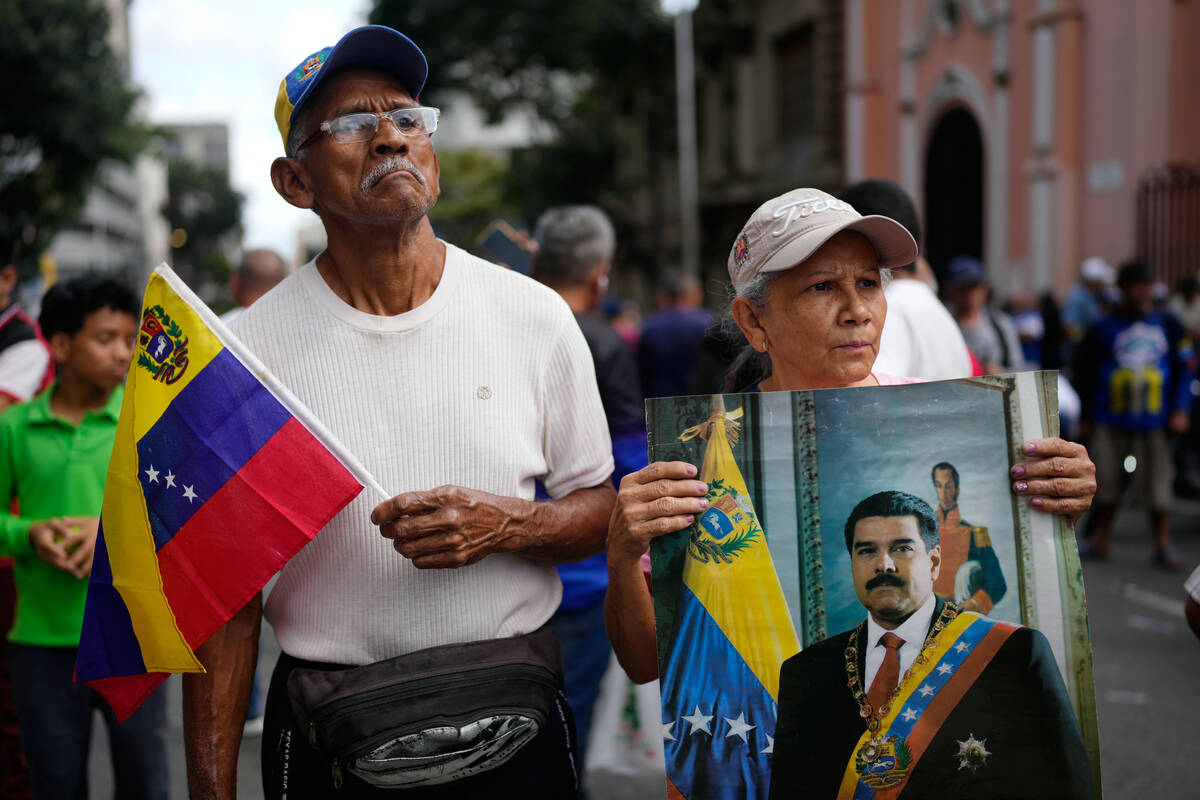


Venezuelan dictator Nicolás Maduro was captured by U.S. military forces and extradited to the United States, where he faces various narco-terrorist charges. While Maduro’s fate will be decided by U.S. courts, Venezuela’s future needs to be decided by its own citizens, not U.S. state builders.
Although the stated motive of the military action was to bring Maduro to justice for crimes against U.S. citizens, President Donald Trump stated that United States would be “in charge” of Venezuela until there is a safe transition of leadership. He also said the United States would be running the country “with a group” and “designating various people.” Among the people mentioned was the Maduro-appointed Vice President Delcy Rodríguez, who Trump said is “essentially willing to do what we think is necessary to make Venezuela great again.”
Trump seems to think that rebuilding Venezuela’s oil industry will make the country great again. He said, “We are going to have our very large United States oil companies go in, spend billions of dollars, fix the badly broken oil infrastructure and start making money for the country.”
Venezuela sits on the world’s largest proven oil reserves. Maduro’s predecessor, Hugo Chavez, nationalized the oil industry as part of his “Bolivarian Socialist” policies. Inept socialist management eventually led to decreased production, which, coupled with a global decrease in oil prices, precipitated Venezuela’s crisis more than a decade ago.
However, even when production and prices were high, in the 2000s, Venezuela’s economy underperformed because of its socialist economic policies. If Venezuela is going to be great again, it needs to do more than increase oil production.
Venezuela was the 13th-most economically free country in the world in 1970, and it had the highest average incomes in Latin America. It needs to re-establish that environment of economic and political freedom to become great again.
Unfortunately, it is not likely that U.S. state-building efforts will succeed in creating that environment.
Economists Samuel Absher and Kevin and Robin Grier have studied the consequences of CIA-sponsored regime changes throughout Latin America. They found that following those changes, countries experienced moderate declines in per-capita income and large declines in democracy, the rule of law, freedom of speech and civil liberties.
What about a full-blown U.S. military occupation and reconstruction? We recently witnessed the failure of such efforts to produce a stable liberal democracy in Afghanistan. Research by economist Christopher Coyne indicates that this is the norm.
Coyne studied all U.S. military occupations in the 20th and early 21st centuries to determine if the countries became sustained liberal democracies after intervention. He set the bar low by defining success as being more liberal-democratic than 2003 Iran. He found only a 28 percent success rate five years after occupation and a 36 percent success rate 20 years after occupation.
Although the prospects for U.S. state-building are bleak, there is a more promising alternative. Venezuelan opposition leader María Corina Machado, who won the 2025 Nobel Peace Prize, backed presidential candidate Edmundo González in the 2024 election that Maduro stole. The United States could recognize González’s government and then allow Venezuelans to chart their course to freedom.
After Maduro’s capture, Machado released a letter saying, “This is the hour of the citizens. … Those of us who elected Edmundo Gonzalez Urrutia as the legitimate president of Venezuela, who must immediately assume his constitutional mandate. … Today, we are ready to assert our mandate and take power. Let us remain vigilant, active and organized until the democratic transition is complete. A transition that needs ALL of us.”
The ideology of freedom, and political parties that support it, is displacing the failed populist-socialist ideology throughout Latin America. Argentina, Bolivia, Chile and Ecuador have all recently elected governments committed to liberalization.
Machado’s letter opens with, “Venezuelans, the time for freedom has come!” The U.S. government should allow Venezuelans to rediscover their liberal economic and political institutions, instead of trying to run their country “for them.”
Benjamin Powell is a senior fellow at the Independent Institute and is the director of the Free Market Institute and a professor of economics in the Rawls College of Business at Texas Tech University. He wrote this for InsideSources.com.


