



Can you keep your core tight while you read this column?


Try these core exercises today and this column will be the first thing you think of when you wake tomorrow morning.
Laura Salcedo is to thank for the pain of muscle fatigue that forces you to roll out of bed instead of sit up like normal. She was gracious enough to share some of her favorites with the Las Vegas Review-Journal.
You may recognize Laura from the photos of many past columns. She is also a trainer and group exercise class instructor. She has been changing bodies for long enough to know what works. Core strength is no joke. It is the foundation of every functional movement both in and out of the gym.
When I refer to the core, I mean all the muscles around the midsection of the body. They are found in the front, on the sides and in the back. Those muscles need to be strong enough to carry you throughout your day. If they are weak or just not used, your body will eventually let you know. With time, the muscles that "cover" for the lazy core can begin to tighten.
Low-back pain often is attributed to a weak core. Low-back rehabilitation will more than likely have a core strengthening element. Bad posture and incorrect movement, including the lifting of heavy loads, are also signs of a weak core.
When training the core, I follow three principles: activation, stabilization and progression.
Activating the core is easy. Brace your stomach to take a punch. That's activated. How long can you hold it? I challenge you to keep a tight core for the rest of the time it takes to read this column. It'll also be a mini lesson in awareness.
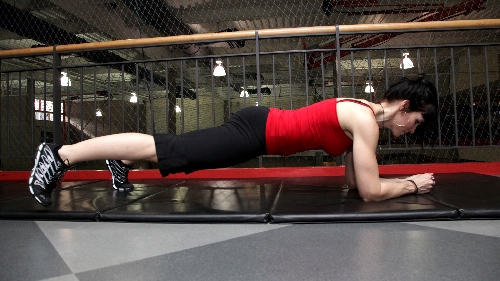
Stabilization is next. What can you do with your tight core? Maybe you can stand on one foot or hold a plank position for 90 seconds.
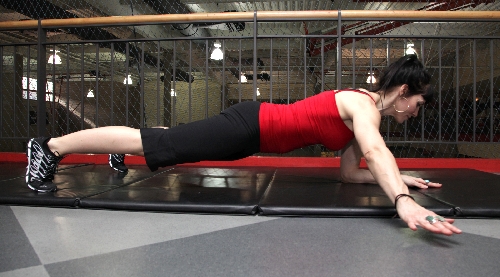
Progressing basic stabilization exercises is next. That is where Laura's torture comes in. Making the plank harder is easy. Just keep adding time. You can also reduce your base. A basic plank uses four points of contact to hold up the body, two feet and two arms. Reducing that base by lifting an arm would definitely make the core work more to hold your body up. Hover planks are just that, an easy progression to make a brutal exercise.
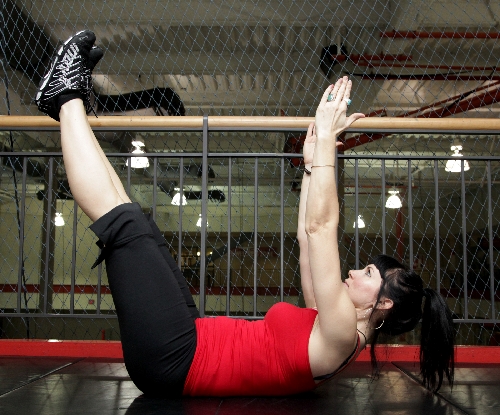
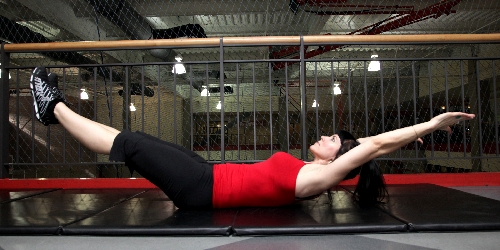
Hollow bodies are another basic core exercise with a slew of progressions to make any core quiver. The basic exercise is shown in today's column. Laura walks you through the progressions of both exercises at www.lvrj.com/health. These exercises and their progression will help develop your core to become strong and stable.
With any core exercise, you should learn to become aware of your body. With that awareness you will see a large skill transfer to other exercises and daily movements. Core exercises will not make you have visible abs. If you want those, find a way to eat less and move more. There's no way around it. The law of thermodynamics applies here. Since fat is stored energy, you reduce it by either eating less and/or moving more.
Speaking of tummies, is your core still tight? Did you forget? If you had to take a punch to the gut right now, would you be ready? The column isn't over yet. You still have to read the exercises. Then you'll want to try them.
Chris Huth is a Las Vegas trainer. He can be reached at 702trainer@gmail.com. Consult your physician before beginning any exercise program.


