



Commercial business for drones could soar


What if you could order food online and have it flown to your home?
In-N-Out, for instance, could affix a bag of burgers to a drone and have an employee fly it to you without ever leaving the restaurant. Someday, this might become a reality, because the 40-year-old drone industry is on its way up.
Unmanned aerial vehicles, or UAVs, have taken over the Mandalay Bay Convention Center this week as the Association For Unmanned Vehicle Systems International meets at the hotel until Thursday. The conference attracted 8,000 attendees and 550 exhibitors at its first Las Vegas meeting.
UAVs could be taking over much more than the Mandalay Bay Convention Center in the future. Most now are sold to the military, but increasing numbers are being adapted for use in law enforcement, and industry experts expect commercial UAV use to dwarf the military drone market.
According to Teal Group Corp., an aerospace and defense industry analyst firm, unmanned aerial vehicles "continue as the most dynamic growth sector of the world aerospace industry this decade."
The group's 2012 market study estimates that global UAV spending will almost double over the next decade, from $6.6 billion annually to $11.4 billion.
"The UAV market will continue to be strong despite cuts in defense spending," said Philip Finnegan, an author of the study. "UAVs have proved their value in Iraq, Afghanistan and Pakistan and will continue to be a high priority for militaries in the United States and worldwide."
Gretchen West, executive vice president of the Association for Unmanned Vehicle Systems International, said commercial UAV applications are endless: FedEx might use drones to drop off packages, or the agriculture market might employ them in crop dusting and crop monitoring. Universities are flying UAVs for research. The Georgia Tech Research Institute, for example, bought a Griffon Aerospace Outlaw.
Civilian drone use is not without controversy. Some claim it's a violation of privacy, and others have expressed security concerns. But, entrepreneurs are seeing an opportunity.
Minnesota-based Recon Robotics, for example, was founded six years ago and since then has grown "dramatically," said president and CEO Alan Bignall.
The company creates micro-robot systems such as its Throwbot, a small device that can be thrown into buildings and is controlled remotely. Recon Robotics has 4,500 robots deployed around the world, including 2,000 with NATO troops in Afghanistan. The drones enable soldiers to scope out a situation without a human ever having to go near danger: the Throwbot, for instance, transmits video to its handheld control unit, much like a remote control car.
Bignall said his company sells mostly to the military, but he agrees that it makes sense to get into the commercial landscape. "We're in business. We have to go where the money is and where people will buy them," he added. "The market, commercially, is huge."
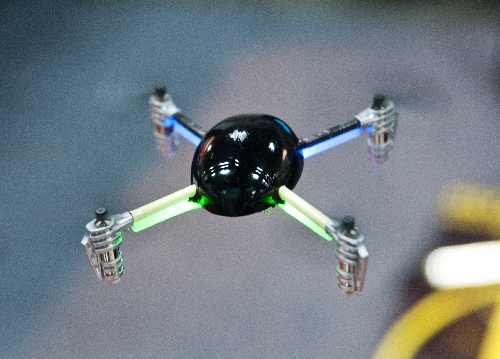
Although small, Rotor Concept's Mini-Q drone could be a product that helps bridge the gap between military and commercial sales. On the market just two weeks, the bagel-size drone can fly as high as 2,000 feet with an operational radius of one mile. For just $129, plus $60 for the optional HD video camera, the drone is a low-cost option for anyone wanting a view from above, said sales manager Patrick Le.
At the show, drones ranged in size from two-person helicopters to a Wall-E-style robot that seemed to be especially adept at climbing stairs. Not all the bots exhibited flew. Some, like the Throwbot, are land- or water-bound.
Of the 550 exhibitors present at the show, three were Las Vegas-based companies: Advance Energy Inc., Battlespace Flight Services and The Drake Group. Patricia McAteer and Jim Carter represented Battlespace Flight Services, which offers maintenance support for the General Atomics MQ-1 Predator UAV used by the U.S. Air Force.
Carter, a corporate quality management representative, said the company has grown 200 percent in six years, primarily through its contract with the Air Force.
"We've been very successful in deployed locations," he said.
Contact reporter Laura Carroll at lcarroll@reviewjournal.com or 702-380-4588.


