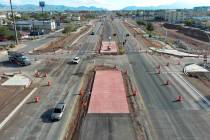
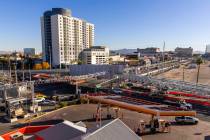
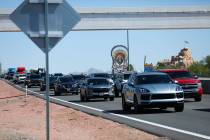
Interstate 11 could become an afterthought
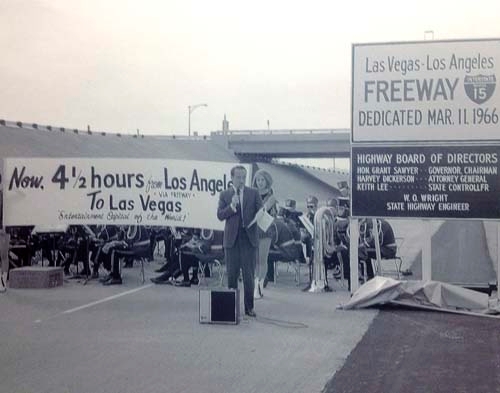



A brass band, two cheerleader types and a banner that says it all: "Now. 4½ hours from Los Angeles via freeway to Las Vegas."
The date was March 11, 1966, and the gathering was to celebrate the opening of Interstate 15.
Everybody has their qualms with our primary link to Southern California: Should it be widened or accompanied by a high-speed rail system? But imagine if it didn't exist. Imagine if tourists were trekking along on two-lane State Route 91?
In a half-century, Nevadans will wonder how us old folks ever weathered a five-hour drive to Phoenix. By then, I'd imagine, Interstate 11 will have been built, widened and maybe even have the company of a bullet train. Then again in 2062, both highways and trains might be obsolete and we could all be zipping about in our flying driverless vehicles.
Someday, a huge banner will cross a new I-11, advertising a four-hour trip to Phoenix. But it won't be a huge banner; it will be a projected image or something.
It will be celebrated as the interstate that finally connects the country's only two adjacent metropolitan areas that had gone without a major freeway link for decades.
Of course the route expected to become an important trade corridor between Mexico and Canada recently received the federal designation as an interstate. And that was a critical decision, but no dollars were attached directly to it. The approval does open additional avenues for funding.
"Connecting two of the largest cities in the Southwest by interstate will create good-paying jobs, increase commerce and significantly boost tourism to our state," Senate Majority Leader Harry Reid, a huge backer of the project, said shortly after the bill was signed. "This is a great day for Nevada."
Digging up enough money to build a bypass south around Boulder City and upgrading U.S. Highway 93 might take years, decades even.
But the two words that might pose the greatest threat to delay Interstate 11 might not only be "funding shortage."
How about "Sierra Club?"
That's not a political statement. I believe the organization's efforts to protect the environment are important, but many government agencies view the group as a pain that costs them tons of money by delaying or forcing the redesign of road projects. What can't be debated is that the Sierra Club is powerful, and it zeroes in on new freeways.
Those of you who were around for the first attempt at widening U.S. Highway 95 between the Spaghetti Bowl and Summerlin Parkway from six lanes to 10 will remember the project was pushed back nearly a year because of a lawsuit filed by the Sierra Club. The lawsuit was filed during the design stages in the early 2000s; the freeway was widened in 2007.
The organization was concerned about the effect additional vehicles, and therefore more exhaust, would have on three nearby schools. The counter argument was that there would be less congestion, less idling and therefore lower emissions. The lawsuit eventually was settled when the Nevada Department of Transportation agreed to place air filtering and emissions monitoring equipment in the schools.
The Sierra Club has long opposed the Boulder City bypass, a significant component of I-11, because it will traverse about 12 miles through untouched desert. The desert bighorn sheep are at the forefront of environmental activists' concerns.
U.S. 93 divides the habitat in the Black Mountains and their water source at the Colorado River, so transportation officials worked to protect the sheep by building crossings over the highway.
Nevada Department of Transportation representatives have already said there will be protections in place for desert creatures, such as the little roadside fences that keep tortoises from ending up underneath a big-rig's tire.
Since the designation of Interstate 11, the local chapter of the Sierra Club has remained mum. Representatives did not return phone messages. South of the Arizona-Nevada border, however, activists immediately expressed concerns.
Sandy Bahr, director of Arizona's chapter, balked at the need for another freeway and said the interstate could potentially destroy sensitive desert animals, add more pollution and encourage additional urban sprawl, according to the Arizona Republic.
"The answer always seems to be another freeway," she told the newspaper. "They think the public should subsidize sprawl. We really question the need of this."
Transportation experts and representatives of business owners and trucking organizations do not question the need to alleviate choke points in Boulder City and at Interstate 40 near Kingman, Ariz. They feared the designation would be pulled from the transportation bill or that a filibuster would derail the project, but they eventually celebrated that I-11 will be an enormous economic boon both to Las Vegas and Phoenix.
As far as money, the universal thought was that transportation folks will worry about that down the road. They should be aware there might be an obstacle before the end of that road in the form of the Sierra Club and other environmental organizations.
The Sierra Club became active in 1900, 66 years before that photo of the Interstate 15 celebration was snapped. It's hard to say whether it fought against the freeway; I couldn't find any records that showed it did. Regardless, conflicts between transportation experts and members of environmental groups have delayed projects before and it could certainly happen again.
If you have a question, tip or tirade, call Adrienne Packer at 702-387-2904, or send an email to roadwarrior@
reviewjournal.com. Include your phone number. Also, you can follow her on Twitter @RJ_RoadWarrior.
■ Through Aug. 31, expect delays on Shadow Lane between Charleston Boulevard and Alta Drive. The work includes street widening, replacement of sewer lines and upgrading of traffic signals and crosswalks.
■ Expect delays on Oakey Boulevard between Rancho and Decatur boulevards through the summer as storm drain work continues.
■ Cashman Drive is closed at Oakey Boulevard through Aug. 2 for storm drain work.
■ Through July 13, Clark Avenue between Sixth Street and Las Vegas Boulevard downtown is closed for building construction.
■ I-15 REMINDER: The closures on northbound I-15 between Lake Mead Boulevard and Cheyenne Avenue are not always posted in a time frame that fits this column. The announcements are sometimes even too late to deliver ample notice via Twitter. If you use that route between 9 p.m. and 5 a.m., please check nevadadot.com before heading out. The closures are posted at the top in red.
GASOLINE PRICES
The average price of gasoline in the Las Vegas Valley on Friday was $3.42 per gallon; the current state average is $3.48; the national average is $3.41.
LAS VEGAS REVIEW-JOURNAL