Mining claim markers blamed for thousands of bird deaths
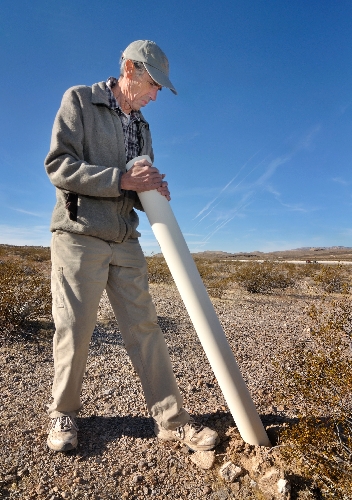





On a hillside along Interstate 15 near Sloan, John Hiatt takes hold of a white plastic pipe and wriggles it free from the rocky ground.
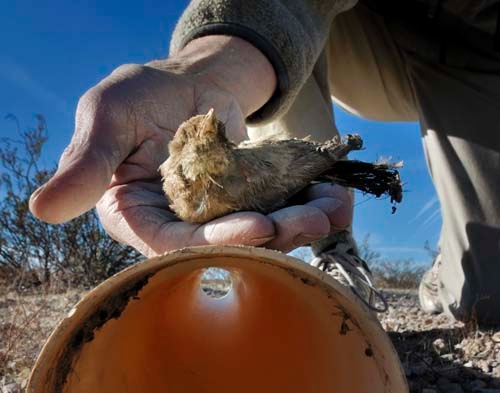
As he lifts the 5-foot length of tube in the air, the dried husk of a dead bird slides from the bottom.
The longtime conservation chairman for the Red Rock Audubon Society turns the tiny corpse over in his hands, quickly identifying it by its rust-colored feathers and the shape of its bill.
It's a Say's Phoebe, he says, a species native to Nevada but unable to avoid a ghastly and unforeseen hazard created by one of the state's iconic industries.
The 4-inch diameter pipe where this bird is found once marked the corner of a mining claim in the hills south of Las Vegas. The Silver State is dotted with scores of these markers -- perhaps as many as a million of them, Hiatt says.
Their yawning mouths point skyward to entice birds that like to nest in burrows and the hollow trunks of trees. The birds go into the pipes but can't get back out because they can't climb the slick interior or spread their wings to fly. Trapped at the bottom, the birds slowly starve to death.
"Basically they're black holes for birds, literally and figuratively," Hiatt says. "Once they're inside, it's a one-way trip."
Hiatt pulls seven hollow pipes from the ground on this Thursday morning , all of them within a half-mile of each other in the hills east of I-15. Three of the claim markers have dead birds inside.
"If you haven't pulled one of these things up and looked inside, you'd never know. It would never occur to you."
Hiatt is exercising his rights under a new state law that allows anyone to remove a plastic tube from a mining claim and lay it on the ground next to where they find it.
The law took effect on Tuesday .
To mark the occasion, the Red Rock Audubon Society held a volunteer "pull-out event" Saturday in the desert north of Pahrump and is encouraging its members to "pull, baby, pull."
The U.S. Bureau of Land Management in Southern Nevada plans to send crews out over the next three months to remove plastic tubes from claim-rich areas near Sandy Valley, Goodsprings, Searchlight, Pahrump and Mesquite.
The bureau regulates mining claims on public land in Nevada, but the state makes the rules for marking the claims.
A CHEAP AND EASY MENACE
Hiatt says claim holders started using 4-inch diameter PVC pipe as markers because it is cheap, lightweight and bright white, making it easy to carry into remote areas and easy to spot from a distance.
Hiatt also sees claims marked with plastic leach lines for septic systems, which are dotted with small holes that pose a risk to birds, small mammals and lizards alike.
"Sometimes you'll find 20 or 30 dead lizards in them all coiled up in one big ball," he says.
The use of uncapped plastic pipes as claim markers has been illegal in Nevada since 1993, but that hasn't stopped the practice.
The fifth PVC pipe Hiatt pulls from the ground on Thursday contains a bird that looks like it has been locked away in its polyvinyl tomb for years. All that's left is a skeleton with a few dusty feathers clinging to the bones.
In rocks at the base of the marker is an old baby food jar. Inside the jar is a folded piece of paper describing the claim. According to the document, the plastic markers were placed in 1996 or later on behalf of a company out of Phoenix called Superstition Mountain Stone.
Once it became apparent that the 1993 law wasn't working, state wildlife officials and Audubon Society members lobbied for legislation that required claim holders to remove plastic pipe markers.
The measure, which passed in 2009 with support from the Nevada Mining Association, gave claim holders two years to take care of the problem. Those two years were up on Tuesday, but tens of thousands of the plastic pipes remain.
A PROBLEM OF UNTOLD SCALE
Even before the new law took effect, Hiatt wasn't shy about pulling out the markers he would encounter on his hikes.
"Whenever I'm out, I pull these things down," he says. "The object is to get rid of these animal traps."
Hiatt figures he's pulled up more than 100 pipes from mining claims across Southern Nevada over the years, and roughly half of them had dead birds inside.
In some cases, the pipes become mass graves.
"I've pulled them up and half a dozen birds have fallen out," Hiatt says.
A biologist from the Nevada Department of Wildlife once pulled 32 bird carcasses from a single tube.
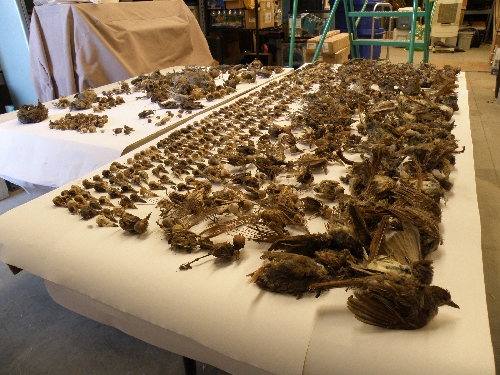
Near Searchlight in 2009, a work crew led by Christy Klinger, another biologist for the state, removed 195 markers and counted 740 dead birds, including 31 in one pipe.
A wide variety of birds are found inside the pipes, including starlings, woodpeckers, kestrels and even Western screech owls.
For whatever reason, the cavity-nesting ash-throated flycatcher seems to turn up dead more than any other bird in Southern Nevada.
Up north, where roughly 85 percent of the state's active mining claims lie, the most frequent victim of hollow-tube markers is the mountain bluebird, Nevada's state bird.
To date, the Department of Wildlife has knocked down at least 10,000 plastic posts and logged about 3,000 "mortalities" statewide, Klinger says. "It's really awful."
There's no way to know for sure how many pipes are still out there, but Klinger and Hiatt say the number is probably in the hundreds of thousands. At least that many birds have been killed as a result, Hiatt says.
The BLM has issued more than 1 million mining claims across the Silver State since 1976. As of last year, nearly 200,000 of those claims remained active.
The last pipe Hiatt pulls from the ground on Thursday dislodges a feathered mass that's curled up so tightly it looks like it has no head.
To identify this unintended victim of mineral exploration in Nevada, Hiatt has to take it home and check it against his bird books.
He calls later with the verdict. It's a rock wren.
Contact reporter Henry Brean at hbrean@reviewjournal.com or 702-383-0350.