Snowmelt will benefit Lake Mead





A good year is quickly turning into an outstanding one on the Colorado River, where the snow keeps falling and water forecasters keep boosting their predictions.
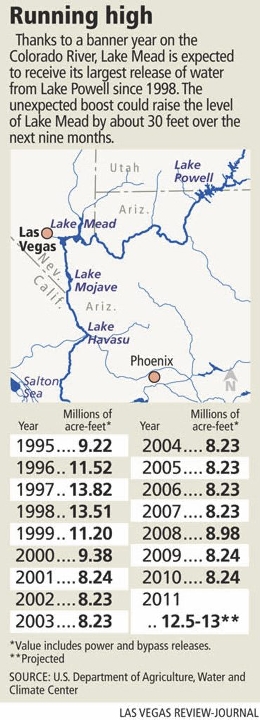
The surface of Lake Mead is now expected to rise about 30 feet over the next nine months, 10 feet more than estimates made one month ago.
The latest projections from the U.S. Bureau of Reclamation call for the Colorado to swell with 11.5 million acre-feet of water between April and July, as the heavy blanket of snow melts from mountain ranges that feed the river system.
That would be 45 percent more water than the average flow over the last century, making this the best year since 1995 and the 15th best since record keeping began in 1909.
"As of Monday, we still hadn't reached the peak of the snowpack. It just keeps growing," said Terry Fulp, deputy director for the bureau's Lower Colorado region. "It's been remarkable."
Bureau officials plan to release new monthly projections for Lake Mead within the next week, and Fulp said it is "almost a certainty" that the reservoir will get a sizeable boost.
"I think it's safe to say it will be upwards of another million acre-feet of water," Fulp said from his office in Boulder City.
The Las Vegas Valley draws about 90 percent of its drinking water supply from Lake Mead. One acre-foot of water is enough to supply two average homes for one year.
Last fall, climate experts were predicting a below-average year on the Colorado thanks to a strong La Niña weather pattern that was expected to produce dry conditions in late winter and spring.
Then the snow started falling and didn't let up.
In early March, forecasters said they expected the river to surpass its average flow by 16 percent. By mid-April, that number had grown to 22 percent. Then, over the course of three days last week, the projection jumped twice more to 39 percent and 45 percent.
Fulp said such a rapid change is unusual but not unheard of, especially on a river system as fickle as the Colorado.
SNOW IN RIGHT PLACES
According to federal water supply forecaster Angus Goodbody, the river is benefiting this year from a lot of snow falling in just the right places, namely at the headwaters of the river's main stem and the mountains that feed its largest tributary, the Green River.
"There's really been a sweet spot for moisture this year. That sweet spot has really been getting it all winter," said Goodbody, who works for the U.S. Department of Agriculture's Natural Resources Conservation Service in Portland, Ore.
Almost all of the Colorado River's flow starts as snow that collects in the mountains of Colorado, Utah and Wyoming from November to late May.
Lake Powell, on the Utah-Arizona border, fills with that water in early summer, rising sometimes by a foot or more a day as the snow starts to melt and water flows downstream.
Under agreements dating to 1922, Lake Powell is required to send a minimum of 8.23 million acre-feet of water downstream to Lake Mead each year.
Last month, bureau officials set this year's release at 11.56 million acre-feet. That figure is expected to be adjusted upward to between 12.5 million and 13 million acre-feet in the coming days. That by far would be the largest release since 1998 and enough to raise Lake Mead to a level not seen in three years.
The extra water is expected to put off for several years at least an unprecedented shortage declaration that would require Nevada and Arizona to cut their river use.
Fulp said this year's release will be so great that the Bureau of Reclamation might have trouble delivering it all downstream by September without bypassing the generators at Lake Powell's Glen Canyon Dam.
Over the past 11 years, the over-appropriated Colorado River has flowed at just 69 percent of average.
As a result, Lake Mead sank to a record low in November before rebounding over the past four months.
The surface of the lake now sits at about 1,096 feet above sea level, 115 feet lower than it was when drought descended over the Colorado in 2000.
Goodbody said even one great year won't be enough to restore the river system to where it was before the drought. "I think it's going to take a number of good years."
TROUBLE FOR TRIBUTARIES
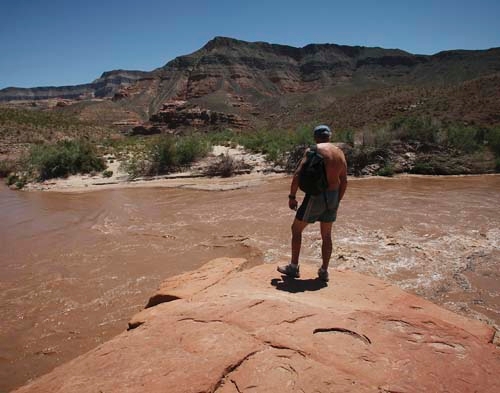
But while the wet winter and spring has been a godsend for water managers, the news isn't all good. Some officials along the Colorado and its tributaries, including the Virgin River in Nevada, are bracing for the possibility of flooding should all that built-up snow melt quickly.
In parts of Colorado and Utah, federal officials are predicting record snow runoff over the next few months, and Fulp said flooding in some areas may be unavoidable.
Federal forecasters expect the Virgin River to see more than four times its normal flow between now and July.
Mesquite spokesman Bryan Dangerfield said that runoff appears to have started.
"It's running pretty furious right now, but it's nowhere near what it was back in December," he said.
Since that flood, which damaged or destroyed seven homes in Beaver Dam, Ariz., Mesquite officials have been shoring up dikes and other structures along the river, which flows out of Utah and empties into the northern tip of Lake Mead.
Officials in Mohave County in Arizona are working with federal agencies on some flood and erosion control projects in the Beaver Dam Wash, which joins the Virgin just east of the Nevada border.
But officials there downplay the risk posed by the coming snowmelt. Nicholas Hont, director of Mohave County's development services department, said he expects little or no impact on county infrastructure in the area.
Dangerfield said the December flood actually helped in Mesquite to some extent by cutting a more definitive channel through certain parts of the city and cleaning out a lot of the river bottom.
"Hopefully," he said, "we'll be ready for whatever Mother Nature throws at us this summer."
Contact reporter Henry Brean at hbrean @reviewjournal.com or 702-383-0350.