



Monorail still running on treacherous financial track
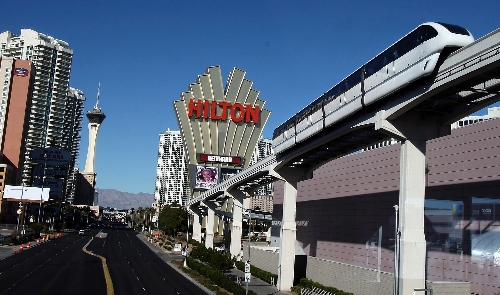


Even as visitor counts and convention attendance began a gradual recovery, the ridership and revenue totals at the Las Vegas Monorail Co. continued to decline at double-digit rates.
The number of people who boarded the train last year fell 13 percent compared with 2009 to 5.2 million, just more than half of what the monorail carried during its first full year of operations in 2005. Ticket sales also declined 13 percent, to $23.2 million.
Advertising, which brought in $2.3 million as recently as 2007, dropped to $190,000.
Due to expenses racked up during the monorail's Chapter 11 bankruptcy case, the net loss ballooned to $23.1 million, compared with the $2 million loss the previous year, according to court filings. However, the number included a $22.5 million depreciation charge, a more than tenfold jump, and court-related expenses of $3.3 million.
After factoring out the two items, the monorail's operating profit of $2.6 million was a 32 percent decline.
The net income numbers do not include the first two weeks of last year, before the bankruptcy filing. Monorail staff had not responded with complete numbers and CEO Curtis Myles had not responded to requests for comment by deadline on Wednesday.
Accountant Bob Beers, a member of the nonprofit monorail's board of directors, attributed the deteriorating results to the general economic woes that have hit Las Vegas.
"You would find the same thing among all the gaming companies and probably most of the other businesses in Clark County," he said.
As the visitor industry starts to rebound, in particular the convention and meetings sector that generates a large portion of the monorail's riders, he foresees improvement for the monorail. One of the days during the International Consumer Electronics Show, he said, ridership was up for the first time compared to the same day the previous year.
"The same hope you see emanating from the Las Vegas Convention and Visitors Authority, Harrah's (Caesars Entertainment Corp.), MGM and the Sand, you see emanating from the monorail," he said. However, predictions about the monorail have fallen short from the beginning a decade ago, when nearly $650 million in bonds were sold to finance construction on the promise that fare revenues could cover the payments. While operations have produced a surplus since the 3.9-mile line started service in 2004, it has never been enough to cover the regular bond payments.
Critics have long complained that the route, running roughly parallel to the Strip from the MGM Grand to the Sahara, was too far out of the way for most visitors.
Monorail management has tried different pricing strategies, some at the urging of a consultant installed by bondholders: lowering prices to attract more people, raising them to generate more revenue per passenger and shifting the emphasis between single tickets and multiride passes. Nothing halted the financial deterioration that the recession had accelerated. Convention traffic suffered.
When reserves finally ran out and the bank representing bondholders sought to tighten its control over the cash flow a year ago, the monorail corporation filed for Chapter 11 protection.
The monorail submitted a reorganization plan in August that would have wiped out 97 percent of the $659.7 million then owed on the bonds. Myles had said in the past that stripping the debt down to a manageable level was a key to ultimately extending the monorail to the airport, a larger source of passengers.
However, the proposed plan promptly provoked a flurry of objections from creditors. Some sought to remove the current management and take control of the line.
Contact reporter Tim O'Reiley at toreiley@reviewjournal.com or 702-387-5290.


