Clinton strikes back
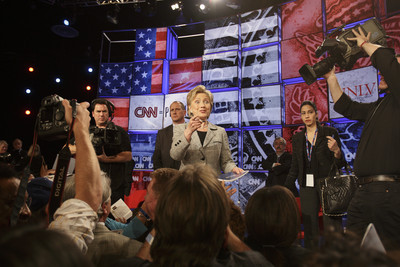
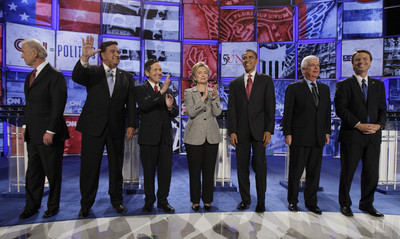
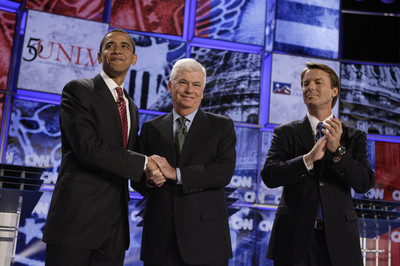
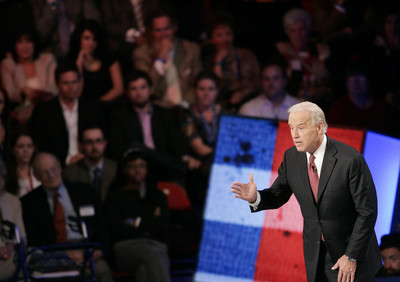



As expected, Sen. Hillary Clinton's rivals once again came out swinging at Thursday night's Democratic debate, but this time, Clinton swung back.
The New York senator didn't waste any time in a Democratic presidential candidates' debate that clearly was set up to be all about her. On the first question, after Sen. Barack Obama of Illinois made a case that Clinton doesn't give "straight answers to tough questions," she fired back.
"He talks a lot about stepping up and taking responsibility and taking strong positions," she said. "But when it came time to step up and decide whether or not he would support universal health care coverage, he chose not to do that." Clinton charged that Obama's health care plan isn't truly universal because it doesn't require people to buy insurance.
Next it was former Sen. John Edwards of North Carolina's turn.
"She says she will bring change to Washington, while she continues to defend a system that does not work, that is broken, that is rigged and is corrupt -- corrupted against the interest of most Americans and corrupted for a very small, very powerful, very well-financed group."
Clinton claimed she had been "personally attacked" and accused Edwards of "throwing mud ... right out of the Republican playbook."
She added, "When Senator Edwards ran (for president) in 2004, he wasn't for universal health care. I'm glad he is now."
Hyped as the single most anticipated night of the long presidential campaign thus far, Thursday marked the first time in history a presidential debate was held in Nevada.
Perhaps appropriately, given the location, the event was high-stakes. The candidates, particularly Clinton, Obama and Edwards, each had something to prove.
Panelist John Roberts of CNN confronted Edwards with issues on which he's changed position. "You were for the Yucca Mountain nuclear repository before you were against it," he said. "You were for the Iraq war before you were against it. ... If it is fair for you to change your position, is it not fair for her to change hers?"
Edwards said it was one thing "for people to learn from their experience and grow and mature and change." What Clinton has been doing, he charged, was trying to take more than one position on the same issue simultaneously.
Later in the debate, Edwards claimed, "There's nothing personal about this," saying it ought to be an issue that "Senator Clinton defends the system, takes money from lobbyists."
Tellingly, the audience booed him. "No, wait a minute," he implored the crowd.
CHANGING THE TONE
Edwards was trying to capitalize on moments in the previous debate, two weeks ago in Philadelphia, when Clinton appeared to get caught trying to have it both ways.
Philadelphia was seen as a turning point in a Democratic contest that for months had appeared static.
Clinton's rivals repeatedly took her to task for not giving decisive answers to questions, and they finally got through to her in the final minutes of the debate, when she talked circles around a question about whether states should allow illegal immigrants to get driver's licenses.
Sen. Chris Dodd of Connecticut voiced strong objections to the idea, and Edwards pounced on her evasiveness. Obama professed to be "confused" about where Clinton stood.
The previously imperturbable Clinton, who preferred to deflect criticism with a laugh or to smooth things over by calling for unity among Democrats, was unmistakably shaken.
The question for Thursday, then, was whether Clinton would continue to bleed, signaling that her perceived inevitability was collapsing, or whether she would find a way to regain the upper hand.
For the first time Thursday night, Clinton descended from her pedestal to find fault with her opponents. Whether that was a sign of strength or weakness will be debated as the night's events are hashed out in the coming weeks.
A logical place to start was with the driver's license issue, which moderator Wolf Blitzer of CNN referred to as "the issue that apparently tripped up Senator Clinton earlier." Did Obama support the idea?
"The problem we have here is not driver's licenses," Obama said. "Undocumented workers do not come here to drive. They're not coming here to go to the In-N-Out Burger." He called it a "wedge issue" intended by Republicans to distract from the larger, federal matter of immigration reform, a strikingly similar qualification to Clinton's answer two weeks ago.
After Blitzer pressed him on it twice, Obama said: "I have already said, I support the notion that we have to deal with public safety and that driver's licenses at the same level can make that happen. But what I also know, Wolf, is that if we keep on getting distracted by this problem, then we are not solving it."
Blitzer said, "This is the kind of question that is sort of available for a yes or no answer. Either you support it or you oppose it."
It wasn't that simple for Edwards, either. He said that in the absence of federal action, he wouldn't support the idea, "but I don't accept the proposition that we're not going to have comprehensive immigration reform. ... And anyone who's on the path to earning American citizenship should be able to have a driver's license."
Dodd repeated his contention that licenses send the wrong signal to those who would come to America illegally.
Clinton, whose campaign earlier this week issued a clarification of her tortured position, conveniently just after the proposal was withdrawn in New York, said simply, "No."
Rep. Dennis Kucinich of Ohio objected to the term "illegal immigrants," saying, "There are no illegal human beings."
Gov. Bill Richardson of New Mexico said that he enacted driver's licenses for illegals four years ago in his state and that it had improved public safety by making drivers better trained and more likely to have insurance.
Edwards again went after Clinton on the issue of trade. He said universal health care didn't pass early in the administration of her husband but the "total disaster" of the North American Free Trade Agreement did because big corporate interests opposed the former but backed the latter. In both cases, the results were against the best interests of Americans, he said.
"We will not change this country if we replace a crowd of corporate Republicans with corporate Democrats," he said.
Clinton returned to her laugh-it-off tactic when asked, "was Ross Perot right" to oppose NAFTA?
"All I can remember from that is a bunch of charts," she chuckled. But when pressed, she said, "NAFTA was a mistake to the extent that it did not deliver on what we had hoped it would, and that's why I call for a trade timeout."
Nevada and Nevadans
CNN's Roberts in particular had clearly done his homework on Yucca Mountain, the proposed nuclear waste dump about 100 miles from Las Vegas that the state and most of its residents oppose.
He reminded Obama that Illinois gets nearly half its energy from nuclear power, which produces waste that has to be stored somewhere.
"The question is, if not in your backyard, whose?" Roberts asked.
"I don't think it's fair to send it to Nevada because we're producing it," Obama said. He said he would pursue research into a new solution "based on sound science," the catchphrase President Bush has repeated as his administration has continued to press the project forward, even amid scientific doubts.
Richardson, a former secretary of energy, claimed, "All my life, as secretary of energy, as a congressman, I opposed the site." But Richardson in Congress voted for a bill that designated Yucca as the place for the waste storage, and as energy secretary did not stop the project.
Asked about it after the debate, Richardson flatly denied that he had ever voted Yucca forward or otherwise helped it along.
The focus on Nevada and its issues intensified in the second portion of the debate, when handpicked Nevada Democrats, seated in front of the stage, got to ask candidates questions directly.
Their concerns reinforced that Nevadans, while they might have different perspectives than Iowans and New Hampshire residents, share the worries of America as a whole.
A military mom accompanied by her son, who had been thrice deployed to Iraq, wanted assurances that a war with Iran wasn't in the offing.
An Arab-American man said that despite being a citizen, he is frequently stopped in airports, something he said was harassment and a violation of his civil liberties.
A Hispanic UNLV graduate student wanted to know whether the candidates saw a connection between illegal immigration and terrorism, a connection he portrayed as erroneous and damaging.
A casino cashier wanted to know that Social Security and Medicare would be there for her three children and eight grandchildren.
A woman wanted to know about appointments to the Supreme Court.
And the debate ended on a light note, as a UNLV student asked Clinton: "Do you prefer diamonds or pearls?"
Clinton's answer: "Now, I know I'm sometimes accused of not being able to make a choice. I want both."
THE END RESULT
UNLV political scientist David Damore saw no clear winner in Thursday's debate.
"So in that sense, Hillary wins because she's up, and she didn't stumble," he said.
Damore thought Clinton made a good recovery from the previous performance. He said the night's big loser was Edwards.
"The candidate who needed to break through was Edwards, and he didn't seem to get much going tonight," he said.
"This is just my view, but Edwards still comes across like a used-car salesman. Maybe it's the trial lawyer in him coming through."
Obama did a much better job establishing himself as a strong alternative to the front-running Clinton, he said.
With few exceptions, Damore said, all of the candidates did "the typical politician thing of talking around the issues."
Asked how he thought Nevada came across during the debate, Damore said he was impressed by the quality of the questions from the crowd.
"You could tell they were all very nervous," he said of the audience members picked to ask questions.
Interestingly, Damore said, most of the questions directly concerning Nevada came from "the CNN people." The audience stuck to broader themes, which stands to reason, Damore said.
"Nationally, the questions that are important to Democrats are the (same) ones that are registering on polls here. There's not that big a distinction."
Fellow UNLV political scientist Ken Fernandez said he came out of the debate the same way he went in: as an undecided Democrat.
"I thought they all did well. There were no major faux pas," the assistant political science professor said.
Especially strong were the candidates with the least political support, namely Sen. Joe Biden, Kucinich, Dodd and Richardson, Fernandez said. "They proved they have a right to be in this race and they have something to contribute."
Both Damore and Fernandez criticized the questions chosen to begin the debate, which seemed like an obvious attempt by CNN to bait the candidates into ganging up on Clinton.
"They were looking for some entertainment," Fernandez said of the network that sponsored the debate.
"I'm just kind of glad it's over," UNLV's Damore said. "Now we get our parking lot back."
Review-Journal writer Henry Brean contributed to this report. Contact reporter Molly Ball at mball@reviewjournal.com or (702) 387-2919.
2008 ELECTIONSGet more news, voter information
Photo Slideshow