



Nuclear panel’s chief vows objectivity


In the early 1990s, Dale Klein appeared in television advertisements holding a fake nuclear fuel pellet barehanded to show Nevadans how safe disposing nuclear waste in the planned Yucca Mountain repository would be.
In a discussion in Las Vegas a short time later about the nuclear power lobby's ad campaign, Klein, a University of Texas nuclear engineering professor, said that in the worst case, a person could receive a lethal dose by holding a spent nuclear fuel pellet with bare hands for more than 1,000 minutes.
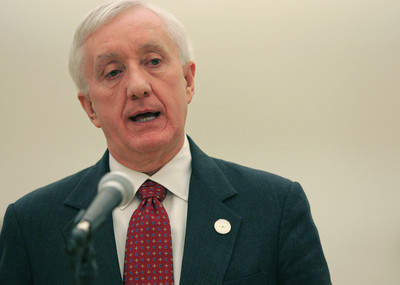
On Thursday, Klein returned to Las Vegas, this time in his second year of a five-year term as chairman of the Nuclear Regulatory Commission. He met with state and local officials to tell them of how the NRC's staff and a safety board will evaluate a license application for the Yucca Mountain repository project that the Department of Energy plans to submit for review in June 2008.
The commission he leads will decide any appeals and give final approval or denial of the license.
Later, at the NRC's hearing facility, on Pepper Lane, he offered assurance that he will remain independent and objective in any decision he makes on Yucca Mountain despite his history of strong ties to the nuclear power industry.
"We will make our evaluation based on technical merits in protecting the public and the environment," he said.
He added that his background will "absolutely not" have any influence on any appeal he might have to weigh.
"One of the advantages that I have that I often remind people is I'm on a leave of absence from a tenured faculty position.
"And you probably realize faculty members tend to be independent. So we have that aspect plus we are an independent agency, so we're independent squared," he said.
Klein also said it "is absolutely incorrect" for anyone to think that the NRC becomes an advocate for the Yucca Mountain project after the Department of Energy submits a license application.
"We are not an advocate for or against Yucca Mountain. Our job is to look at protecting the public and the environment. So we are not an advocate. We are a regulator, and we're an independent regulator," he said.
Bob Loux, executive director of the Nevada Agency for Nuclear Projects and an opponent of the proposed Yucca Mountain repository, 100 miles northwest of Las Vegas, said he does not think Klein can be objective in deciding any appeals the state might file.
Nor is Klein correct about the advocacy question, Loux said.
"First of all ... we have petitioned the NRC to actually remove the staff as the party advocate for the applicant, and the commission has denied our petition," Loux said.
"To suggest the staff is not going to be an advocate for the applicant is contrary to the NRC's own regulation," Loux added.
He said that Klein "is choosing his words carefully but he's misleading."
As for Klein's insistence that he will be objective and independent in his decisions on Yucca Mountain, Loux said, "That's a huge question."
Loux said that while Klein was at the University of Texas, "not only was he a shill for the nuclear industry in the ad campaign, in the early 1990s he received large amounts of grants and contracts from the Department of Energy."
Loux said that Klein previously worked in a federal nuclear program when he served before his NRC appointment as assistant to the secretary of defense for nuclear and chemical and biological defense programs.
"Any representation that he is neutral on this (Yucca Mountain) I think is very suspect," Loux said in a telephone interview from Carson City.
When Klein was asked during the news conference what he sees as the key issues in the license application, he said, "I think the key issue will be do we get one? When does that arrive?
"We cannot evaluate an application that we have not received," he said. Other than that, Klein said, "The key issue will be the technical quality of the application."
The effort to review and decide on the Yucca Mountain license application, if one is submitted, will take up to four years after the NRC staff evaluates its completeness.
More aboutYucca Mountain


