Nevadans for the Common Good’s Robert Hoo helps local groups help community
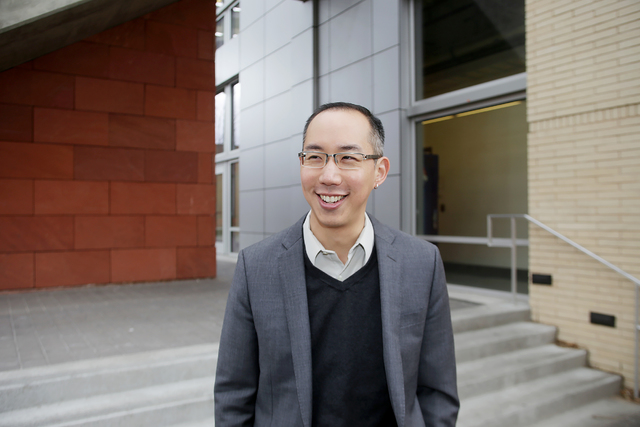
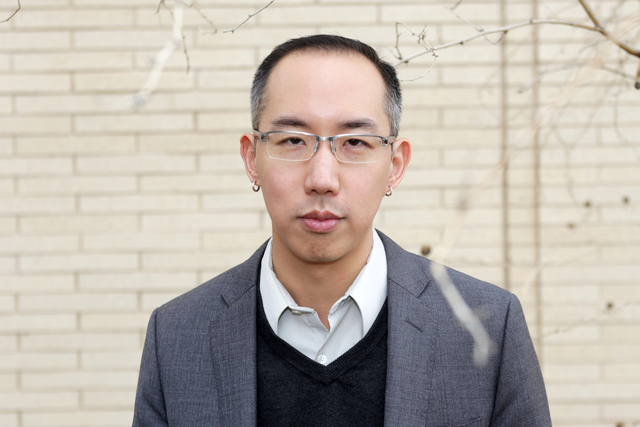
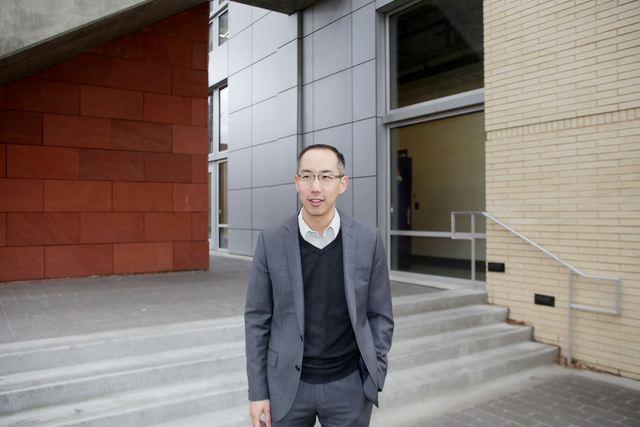


Five years ago, Robert Hoo moved to Las Vegas to become lead organizer of Nevadans for the Common Good, a nonprofit, nonpartisan grass-roots collection of faith communities and nonprofit organizations that aims to tackle urgent problems that valley residents face, such as the vulnerable elderly.
While Hoo, 40, was born in New York, his parents and other family members were born in China and fled during and after the Communist revolution. Some relatives who either stayed or couldn’t get out were killed, imprisoned, persecuted or sent to re-education camps, or simply disappeared.
Hoo says that, to this day, their sacrifices and his own appreciation for American ideals fuel his work. During his undergraduate years, Hoo did community work for a Connecticut nonprofit that worked with children, as well as neighborhood organizing in East Brooklyn targeting neighborhood blight.
And while Hoo later earned a law degree from Yale, “I just decided this is the way I wanted to spend my life,” he says.
Review-Journal: What does your work involve?
Robert Hoo: Lead organizer means that I am responsible for teaching the people from our member institutions how to build a broad-based organization that engages people in public life, that helps them have the power and voice to stand up for issues that are important and how to work together to build a better community. A lot of that is teaching, because where do you learn the skills and habits and practices to be citizens in the full sense of the word? We may have an introduction to that in school, but, really, it’s to develop that and to go out and meet people from different backgrounds — racial or ethnic or religious backgrounds, or from different political perspectives — and create a common agenda.
RJ: What do you find these days, in what seems to be pretty divisive times politically?
Hoo: I think the bad news is that if you look at the newspaper or evening news or you look at Facebook, it seems like we are more divided than ever. The good news is that many people recognize that and want to overcome that. So we’ve seen a surge since the (presidential) election of people who really want to sit down and work with their neighbors and work to build those relationships with people who are different than them.
RJ: How do people find common ground? Is it just learning about others so that you can relate to them better?
Hoo: I think that beginning is as simple as that and as complicated as that. It’s very complicated to really listen, to not just come at somebody with your interests and what’s on your mind and what you’re anxious about, but to actually put yourself in a place where you can really listen to someone else and understand their interests and where they’re coming from.
RJ: What do you find appealing about community organizing?
Hoo: I guess I’d say, on a personal level, I find it to be incredibly interesting and challenging and rich and meaningful to work with people from different backgrounds and build an organization together. And I’m biased, but I also think it’s the most important work in the world. Look at what’s going on in the world and in our country, and I think this work at the grass roots to really build a healthy, stable democracy is absolutely vital.
RJ: You worked in Los Angeles for several years before coming to Las Vegas. What did you expect to find here?
Hoo: I think what I expected was that many of the issues that the people (here) would face would be the same, that anywhere you go people are struggling to raise their children and make sure they get a good education and earn a decent living and obtain good health care. And I think, by and large, that has been true. Issues obviously have a local dimension, but people are people.
RJ: And what surprised you about Southern Nevada?
Hoo: What I did not expect was how accessible everything is in Nevada, that you really have citizen legislators you can go in and talk to. And we’ve been able to have a big impact in a short period of time, because this is a state where the opportunity is there to say, “Hey, we care about Meals on Wheels and we’ve researched the issue and we can testify as to why we think it would be a good idea to support it.”
Read more from John Przybys at reviewjournal.com. Contact him at jprzybys@reviewjournal.com and follow @JJPrzybys on Twitter.
GETTING TO KNOW ROBERT HOO…
Favorite restaurant?
Lotus of Siam
Favorite vacation destination?
Hawaii
Favorite hobby?
"I like to read. I read a lot of history and politics and some theology."
Favorite sports team?
The New York Mets ("I can remember the first game I went to with my dad when I was 6 years old.")
Piece of art that truly moved you?
The Vietnam (Veterans) Memorial by Maya Lin
What alternate occupation would you have pursued?
Either a filmmaker or general manager of the New York Mets.