



Building goes to class for talent


Penta Building Group President Jeff Ehret said it's not the executives who defected from Perini Building in 2000 to form Penta that have taken the company to $600 million in annual revenue, making it the fourth-largest contractor in Las Vegas and among the top 100 in the United States.
It's the ability to recruit and retain 175 salaried employees through promotions to project managers and superintendents and upper management positions.
"That's the key, not the three of us," Ehret said in reference to himself and senior vice presidents Ken Alber and Blake Anderson.
In an industry with 20 percent to 25 percent annual turnover, Penta averages about one-fourth of that, he said.
"In our minds, the first priority in recruiting starts with retention. The big key to retention is a keen philosophy in terms of accelerating all of our people's career development," he said.
Finding qualified workers has plagued the construction industry in Las Vegas since the building boom of the 1990s, Ehret said. Most contractors have to recruit from colleges and universities outside Nevada for construction management and engineering graduates.
The construction curriculum at University of Nevada, Las Vegas, has "languished" in student enrollment and faculty, Ehret said. Reno has a reputable engineering department, but it doesn't have an emphasis on construction.
Ehret searches for talent in more fertile grounds, such as his alma mater, Arizona State University. Other good construction schools include Chico (Calif.) State, Colorado State, Kansas State and even South Dakota State, he said.
Entry-level project engineers are making about $60,000 in their first year out of college, he said.
"The construction industry continues to face a shortage of skilled labor and trade contractor availability," said Karl Almstead, vice president of New York-based Turner Construction. "In many markets, the large volume of work has stretched the available labor and trade contractor resources, driving construction cost increases."
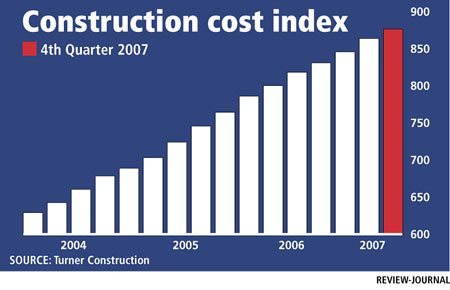
The Turner Building Cost Index rose to 876 in the fourth quarter, up 1.5 percent from the previous quarter and up 7.1 percent from a year ago.
Almstead said activity in nonresidential construction remains strong despite the residential subprime mortgage crisis and concerns about its impact on the financial industry.
"The strength of the developing economies of the world has added to the demand for raw materials and equipment, adding to the pressure on material prices in the United States," he said.
Ehret said contractors and subcontractors need to "get on board early" in the design process to come up with alternative systems and materials that will help bridge the gap between the 8 percent to 12 percent increase in construction costs and the 3 percent to 5 percent increase an owner or developer can charge for rent.
"It's not just material and labor escalation in Las Vegas. It's market escalation," Ehret said. "Supply and demand. That's what drives escalation here. Dealing with subcontractors, they're concerned with risk. Labor and material is much more quantifiable."
Greg Korte of Korte Co. is spearheading efforts to improve UNLV's construction program. He's joined by representatives from several major contractors in Las Vegas including Penta, Bruce King, Perini, Martin-Harris and Marnell Corrao.
"Part of it is the industry," he said. "They looked at the program and said, 'It's no good, let's not touch it.' Three or four years ago a group of us were looking for people and there was nobody to be had at UNLV. We're in Las Vegas, one of the busiest places for construction in the country. We ought to have a decent construction management program here."
Most of the students were employed full-time in the industry and taking courses at night, which is great, Korte said. But, he wondered, how do you attract high school graduates to go to night school?
Now, he said. most of the classes are during the day and enrollment has increased to 90 students from 75 a year ago.
"We are making great strides," Korte said.
Ehret said Arizona State University has an industry advisory council that consists of dozens of contractor and engineering firms, including several large national companies. They provide a significant amount of supplemental funding representing millions of dollars for scholarships, faculty endowments and capital improvements for facilities, he said.
The U.S. construction industry is predicted to be among the top 10 sources of job growth with total employment expected to reach 7.8 million by 2012, according to the U.S. Bureau of Labor Statistics. Estimates show that during this same time frame, the need for new entrants of craft workers will reach 185,000 annually.
Contact reporter Hubble Smith at hsmith@reviewjournal.com or (702) 383-0491.


