



Group helps encourage minority students to explore careers in aviation


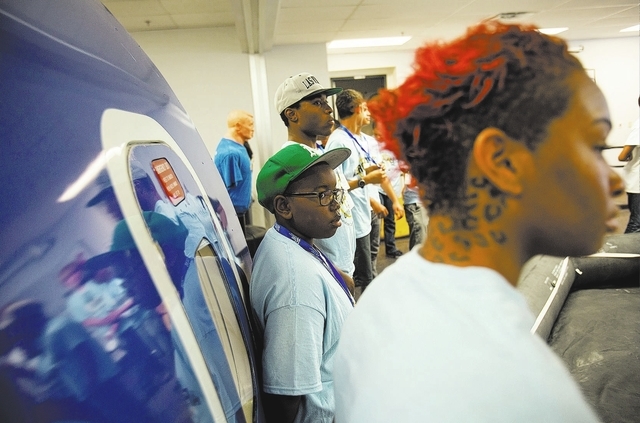


The 17 high school students filling a large circular life raft used teamwork as they worked together to put up a tarp to protect themselves from the elements.
In the scenario they were playing out, they had just escaped from an airliner that had ditched into the water. Now, they were responsible for saving themselves and their passengers as they awaited rescue.
It was a scenario no aviator would want to be a part of, but the exercise was designed to reinforce the No. 1 priority an airline must have for its passengers — safety.
It was Day Four for the students involved in Southern Nevada’s fourth Aviation Career Education program, part of Project Aerospace, an initiative established by the 38-year-old Organization of Black Aerospace Professionals.
A TEAM EFFORT
Since 1976, the Illinois-based group has worked with the Federal Aviation Administration and Tuskegee Airmen Inc. to encourage minority students to explore careers in the aviation industry. Only recently has the program found its way to Southern Nevada, but local organizers are encouraged by the enthusiasm sponsoring companies and organizations have for helping students chase their dreams.
“It’s hard for some of these kids to get access to these kinds of experiences,” said Geoff Berry, a Las Vegas-based pilot for Southwest Airlines and the director of the Las Vegas Aviation Career Education program.
The local academy is a six-day event in which students from California and Hawaii joined students from Rancho, Cheyenne, Canyon Springs and Coronado high schools to hear speakers, take tours, build model aircraft and pilot a plane.
High school counselors recommended the students for participation and sponsors paid for their participation. Most but not all of the participants were minorities.
“All of the ACE counselors are aerospace professionals who volunteer their time to motivate, mentor and chaperon students,” Berry said.
Organizers aren’t interested just in guiding students to careers — they want them to develop character skills and promote good citizenship and philanthropy. So, for a week, they came together to learn about flight and how they could make their way from the classroom to the cockpit.
In the Las Vegas session last month, students learned the history of minorities in aviation.
TUSKEGEE AIRMEN LEGACY
On the first day of the camp, they heard a presentation about the Tuskegee Airmen, the first black military pilots who fought in World War II in the segregated U.S. armed forces. The group trained in Tuskegee, Ala., as the 332nd Fighter Group and the 477th Bombardment Group.
Although the black military pilots saw action in Europe in 1944, it wasn’t until 1963 that a pilot broke the commercial airline color barrier when Marlon Green was hired by Continental Airlines.
By 1976, there were 80 black commercial pilots and the Organization of Black Aerospace Professionals was born.
As awareness spread and more minorities were hired by airlines, the organization began tracking the career paths of student participants in academies in 20 cities across the country.
Berry said the organization uses databases to follow the progress of program participants. The organization assists with grants, scholarships and fellowships for promising students and participants are monitored through age 25 in aviation and nonaviation careers to observe student roles as productive citizens and to collect information on their volunteer efforts.
The national program hit a milestone this year when the first academy participant graduated from the U.S. Naval Academy.
DAY Two OF CAMP
On the second day of the Las Vegas camp, students received training on the practical applications of science, technology, engineering and mathematics in aviation. They also were briefed on their first immersive activity — to “fly” in a simulator.
The tours began on Day Three with a full day at Nellis Air Force Base. Students toured the Air Warfare Center, the flight line and the Threat Training Facility.
McCARRAN TOUR
McCarran International Airport hosted the fourth day and students got a back-of-the-house tour of the ramp.
Southwest Airlines, the busiest carrier at McCarran, is a big supporter of the program and the class spent an afternoon at the airline’s recurring training center.
Instructor Mona Brinkmann took students through inflight training for flight attendants, demonstrating firefighting equipment, the onboard defibrillator and self-defense techniques with agitated passengers.
Students learned how flight attendants evacuate aircraft, demonstrating how to open doors and windows that weigh half as much as some of the participants.
And then, there was the raft demo.
“When we train, we do this in a pool we’re allowed to use at UNLV,” Brinkmann told the group.
It was still challenging for the group to work together on the dry land of the training center. Students quickly got the message that flight attendants are more than food and drink servers.
The second-to-last day of the event was a commencement of sorts, but the final day was what the students were most excited about.
FLYING HIGH
The class took off from Henderson Executive Airport and each student got a half hour of flying a Cessna-172 single-engine plane.
“Every facet of the aviation industry is built on a foundation of discipline,” Berry said. “Students quickly learn that they must practice self-discipline and be self-motivated to be successful in aviation.
“There is no pause button in an airplane,” he said. “Decisions must be made on the go. We think this attitude will follow the students in whatever career they decide to pursue.”
PROGRAM COSTS
The organization raises money through donations and it takes $200 to cover the cost of one student to attend the academy for all six days. That covers breakfast and lunch, transportation, T-shirts, supplies and the flight time.
McCarran and Nellis provide logistical support for the program.
“It’s a really cool program and everybody across the board is enthusiastic about it,” said Chris Jones, who assisted the academy from McCarran.
“A lot of these are at-risk kids and we think it’s important to show them this wide world out in front of them that they can pursue if they apply themselves in high school and college.”
He said the airport was an eye-opening experience for the students.
“It’s like a whole city out here,” he said. “I was really impressed with questions the kids asked and the caliber of what they take in at a young age.”
Contact reporter Richard N. Velotta at rvelotta@reviewjournal.com or 702-477-3893. Follow him on Twitter @RickVelotta.


