



Stocks thrashed but rally from steepest lows

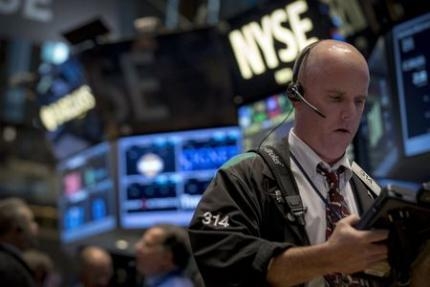


Stocks took a pounding on Wednesday, although Wall Street managed to peddle back from its steepest lows, and safe-haven government debt prices rose after U.S. and Chinese inflation data fanned worries about a global slowdown.
A key gauge of Wall Street anxiety hit its highest level since November 2011 as investors rushed to buy protection against further losses, and options activity surged as investors re-evaluated their strategies in light of the latest signs that the global economy may be losing its footing.
The S&P 500 fell as much as 3 percent, briefly turning negative for the year, while European equities finished 3.2 percent lower and marked their biggest one-day slide in almost four years.
Popular trades that have worked for most of the year, including heavy bets on the dollar, more gains in stocks, and on an eventual rise in yields, are unraveling.
A fall in China’s inflation rate to a five-year low and a decline in U.S. producer prices for the first time in over a year were worrisome signs to investors already skittish about the path of the global economy and caused them to reassess their views on when the U.S. Federal Reserve might hike interest rates.
“There’s concern about an absence of aggregate demand in the world, and that’s really what’s weakening the market. The big fear out right now is we’re not immune from that,” said David Joy, chief market strategist at Ameriprise Financial in Boston.
“If you look at the lows of the day, maybe we’ve put in a little bit of a trading bottom here. But I don’t think it makes these concerns go away.”
The latest news on the spread of Ebola added to a climate of fear, with Texas officials reporting that another healthcare worker in Dallas tested positive for the deadly virus. Almost 4,500 people, mostly in West Africa, have died of the disease.
An MSCI gauge of stocks in major markets was down 1 percent. The CBOE Volatility Index, commonly called the VIX or the “fear index,” closed at 26.25, up 15.2 percent, after earlier hitting 31.06, the highest level since November 2011.
The Dow Jones industrial average fell 173.45 points, or 1.06 percent, to 16,141.74, the S&P 500 lost 15.21 points, or 0.81 percent, to 1,862.49, and the Nasdaq Composite dropped 11.85 points, or 0.28 percent, to 4,215.32. Earlier in the day, the Dow had been down more than 400 points.
But trading was generally kind to local stocks:
— Allegiant Travel Co. gained $2.31, or 2.12 percent, to $111.49.
— Boyd Gaming Corp. gained 40 cents, or 4.38 percent, to $9.54.
— Caesars Entertainment gained 65 cents, or 6.92 percent, to $10.04.
— Full House Resorts fell 4 cents, or 3.03 percent, to $1.28.
— Global Cash Access gained 4 cents, or 0.60 percent, to $6.68.
— Las Vegas Sands gained 71 cents, or 1.19 percent, to $60.32.
— MGM Resorts International lost 22 cents, or 1.07 percent, to close at $20.40
— Southwest Gas Corp. gained 34 cents, or 0.64 percent, to close at $53.35.
— Wynn Resorts Ltd. gained 47 cents, or 0.27 percent, to close at $174.31.
Trading volume in the options market was the busiest of the year, according to Trade Alert data, while equities volume on Wall Street was near 12 billion shares, a nearly 50 percent increase from the average daily volume so far this month.
STICKING TO THE SCRIPT
Despite the volatility, financial advisers and stockbrokers stuck largely to their scripts.
They said the 2008 market debacle taught them to reach out to clients in times of turmoil and warn against drastic moves.
“We’ve preconditioned people not to get spooked too much on short-term movement,” Mike Frazier, president of Bedell Frazier Investment Counseling in Walnut Creek, Calif., said Wednesday morning as the Dow Jones Industrial Average had lost more than 330 points.
Frazier, whose firm manages $400 million for about 350 families, said fewer than a handful of clients called him Wednesday, in part because he has weaned them from “momentum” stocks that were up 20 percent to 30 percent over the last few months. Most of his clients have about 20 percent of their investment money in cash, and a substantial exposure to bonds, he said.
A New York City-based adviser at Morgan Stanley on Wednesday similarly said his team of three brokers were only slightly busier than usual.
“We’re calling to say we’re here and not hiding, but they’re not calling back,” said the veteran adviser, who deals largely with older clients who invest primarily in government bonds. His partners who are much more active in equities had a few people buy stocks at the levels they fell to Wednesday morning, but nobody was selling.
Michael Pomerantz, a Cherry Hill, N.J.-based independent financial adviser, had a more frenetic day.
“The Dow Jones Index dropped below 16,000 and all of a sudden 2008 comes into play and people are worried,” he said.
Pomerantz said he thinks many investors are over-reacting to a return of volatility. Still, he has been moving clients from stocks into short-term bond and money market funds over the past week, shifting their mix from 60 percent equities and 40 percent fixed income to a 50-50 split, he said.
For clients who are in stocks, Pomerantz makes sure they are in large-cap U.S. companies like Clorox Co., McDonald’s Corp. and Pepsi that fare well even in rocky markets, he said.
Flight from risk resulted in a massive rally in U.S. Treasuries, pushing the benchmark 10-year note’s yield as low as 1.865 percent, its lowest level since May 2013.
A LITTLE SHINE TO GOLD
The euro rose 1.4 percent against the dollar at $1.2836, just below a three-week high of $1.2885 hit earlier. The greenback lost 1 percent against the yen at 105.93.
Spot gold prices rose 0.7 percent, up for the sixth time in the last eight sessions with the help of the weaker dollar, but copper prices tumbled 2.3 percent.
Brent and U.S. crude futures fell, a day after posting their biggest daily drop in years, with more production, less demand and deflation expectations weighing heavily.
Brent lost 2 percent to $83.36 a barrel while U.S. crude fell 1 percent to $81.02.
Emerging markets were also hit with a fall in Russia’s ruble to its weakest level on record, while Russian government 10-year yields hovered near a five-year high, and shares in Moscow closed near a seven-month low hit last week.


