



The Day The Muses Died?


Did the notion of culture on the Strip die today?
To some, the closing of the Guggenheim Hermitage Museum at The Venetian after its 61/2-year run signals the end of nontraditional, nongambling-type resort amenities.
Others pointed toward the Bellagio Gallery of Fine Arts and a planned $40 million public arts program at the under-construction CityCenter as signs that refined activities unrelated to gambling are still alive and well.
"I still think we'll see these type of amenities," said David Schwartz, director of UNLV's Center for Gaming Research. Schwartz said different trends have floated in and out of Las Vegas. Broadway shows, for example, were performed in several venues during the 1970s, long before "Mama Mia," "Spamalot" and "Jersey Boys" found homes along the Strip.
"These things are cyclical. We've had businesses like this come and go," Schwartz said.
Brian Gordon, a partner in financial consulting firm Applied Analysis, viewed the Guggenheim's demise from an economic perspective. The Strip is a capital intensive boulevard. The Venetian might be able to place a business inside the Guggenheim's 7,660-square-foot location near the hotel's main lobby with something that is more conducive to the bottom line.
"I would assume The Venetian wouldn't have made this decision without something that offers a higher and best use for that space," Gordon said. "It's kind of like restaurants or production shows. Some of these things don't last forever. The Guggenheim may have run its course. It seems like a natural evolution."
The end of the Las Vegas branch of the Guggenheim was jointly announced April 9 by Las Vegas Sands Corp., the Solomon R. Guggenheim Foundation in New York and The State Hermitage Museum in St. Petersburg, Russia.
Venetian President Rob Goldstein has not yet said what will replace the Guggenheim. The museum, which opened in October 2001, has hosted 10 exhibitions of masterworks from collections housed in New York and St. Petersburg, and has welcomed more than 1.1 million visitors.
The original Guggenheim space at The Venetian was 63,000 square feet and only hosted only one exhibit, a 15-month-long run of the Frank Gehry-designed "The Art of Motorcycle." That space was turned into a $40 million custom-built theater to house "Phantom -- The Las Vegas Spectacular," the Strip's version of "Phantom of the Opera."
The Guggenheim was then moved to its current off-lobby site.
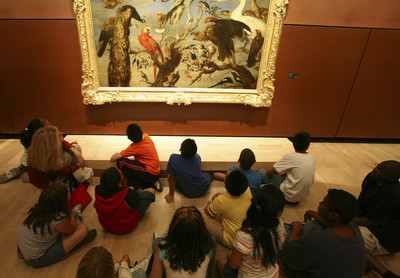
While 95 percent of the Guggenheim's paying visitors were tourists according to in-house estimates, Elizabeth Herridge, who has been the museum's managing director for five years, is proud that some 20,000 schoolchildren have been able to tour the exhibit for free.
Goldstein was also happy the museum made a mark on the community, although its passing has gone somewhat quietly.
"We are also proud the museum benefited the local community in so many ways, including its school tour program, educational lectures, teacher workshops and family programs that have been offered over the years," Goldstein said in a statement.
Herridge, who said she has been looking for a job while spending the past month closing out the museum, bristles when the Guggenheim is compared with the Bellagio Gallery of Fine Art. The Guggenheim is nonprofit and was able to exist annually through financial enhancements for marketing from Las Vegas Sands and personal donations from Sands Chairman Sheldon Adelson and his wife, Dr. Miriam Adelson.
"The Bellagio is not tax-exempt, and they are a for-profit venture that can do things we couldn't to do," Herridge said. "Don't get me wrong, the Bellagio Gallery of Fine Art is a wonderful facility, but they operate much differently than we did."
She wishes more locals would have visited the Guggenheim. She also doesn't believe a "museum on the Strip" will ever return.
"I think it's a pipe dream," Herridge said. "If we couldn't do it with the resources we had and the kind of friendship and support we had from the Adelsons and Rob Goldstein, then I don't know who can."
Schwartz doesn't want to believe that a venture like the Guggenheim couldn't return. He hopes the CityCenter public arts project might spur Wynn Resorts Chairman Steve Wynn to reopen his art gallery, which closed a few years ago.
"I don't think the closing of the Guggenheim is the end for these types of attractions," Schwartz said.
Contact reporter Howard Stutz at hstutz@reviewjournal.com or 702-477-3871.
READING ROOM LIVES, FOR NOW The Guggenheim's last day is today, but the Reading Room is still breathing. The upscale bookstore inside Mandalay Place was told in early February it would be a casualty as the 100,000-square-foot shopping mall that connects Mandalay Bay with Luxor retooled some of its offerings. While Las Vegas' literary community mourned its demise, MGM Mirage officials said the bookstore was not drawing a large enough customer base. No date was given for the 1,300-square-foot shop's closing. As of last week the Reading Room was still in business. An MGM Mirage spokeswoman said there was still no date for the store's closing. HOWARD STUTZ/REVIEW-JOURNAL


