Hater: The dating app that matches mutual negative attitudes
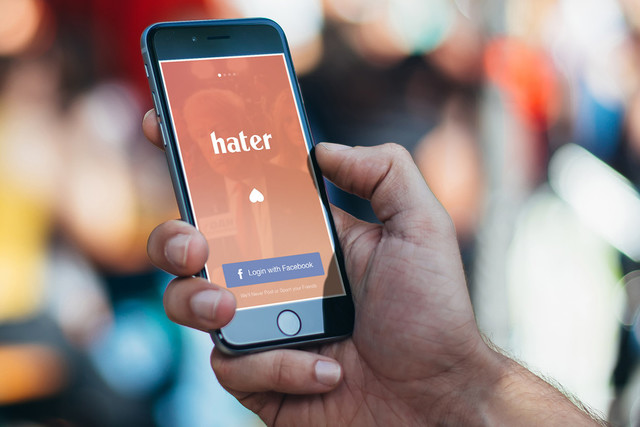


In love, the conventional wisdom is that positivity brings people together and negativity does not.
Matchmakers and dating coaches urge singles to talk about things they love, not vent about things they hate, on their dating profiles and on first dates. And singles themselves often talk about how, once they stopped going negative, they found that match that was eluding them.
It’s all very sweet and uplifting. And kind of boring.
We’re in an era of dating-app fatigue, after all, where the default setting is more apathy than positivity. Enter Hater, a dating app that actually encourages negativity.
Instead of prompting the user to fill an empty “about me” section with enough wit to get a stranger to swipe right, Hater asks users to swipe on topics ranging from the profane to the profound.
A few of their 2,000 examples: sad music; 5-dollar foot-longs; Harambe; flour tortillas; complaining. Swipe up to indicate you LOVE something; down to signal HATE; to the right to LIKE something; and to the left to DISLIKE. After just 10 minutes of swiping, no original creativity required, your profile will be full of LIKES, LOVES, DISLIKES and HATES, all used to match you with other Haters. Then the app gives you your top matches, which you can swipe left or right on and then message.
The idea for Hater began not as an app but as a comedy sketch … about a dating app that matches people based on what they hate. “When I pitched it,” app creator Brendan Alper says of his sketch, “people encouraged me to pursue it as an actual idea.” The conceit being: “What if you were swiping not just on people but on everything?”
The app launched on Tuesday, and so far the most hated topics hew to a particular theme: The top three are 2016 presidential election, Donald Trump and bullies; followed by hangovers, the rent being too damn high and bad sidewalk etiquette. According to Alper, Hater has over 120,000 users around the world.
Is it possible to form a romantic relationship based solely on a shared aversion to slow walkers? Probably not.
But Hater’s topics aren’t bad icebreakers. In testing the app myself, I swiped up, down, left and right on about 100 topics. And even if I was “matching” with users based on mutual hate, the first messages I received on the app stood out for being incredibly positive and upbeat. Alper adds that Hater doesn’t condone hate speech; there’s a reporting mechanism if anyone crosses the line. “We want to be edgy, but recognize that it’s all in good fun,” Alper said.
There’s some social science evidence to support the idea that mutual negative attitudes can do more to bond people than mutual positive ones. A 2006 study found that “when attitudes about others are shared (and weakly held), negative attitudes promote closeness more effectively than do positive attitudes.” The study found that participants bonded more strongly over shared negative attitudes about a third-party person than they did about mutual positive attitudes for things such as life philosophies and hobbies.
So go ahead and discuss your shared hate for our new president or Taylor Swift’s music — it might do more to bring you together than a mutual love of pizza.