



Students see effects of crowded classes
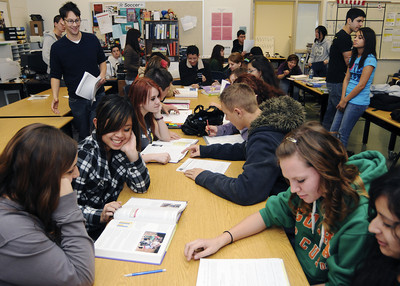


Lindsay Richardson had to sit on a couch at the beginning of the school year. "I felt uncomfortable and like an outcast," says the junior at Silverado High School. "I just wanted to sit at a desk so I could concentrate."
Richardson's situation was a result of overcrowding, and the large class sizes that are plaguing Clark County schools. Large groups of students are forced to squeeze into classrooms that were built for far fewer. Many students are left without supplies or desks to sit at.
Richardson since has been assigned a desk, but her class size hasn't decreased by much.
"There is nobody on the couch anymore, but it's still pretty big, and all the seats are filled," she says.
But even if every student in a large class had a desk, the question of how large class sizes might affect a student's ability to learn remains.
Silverado Principal Kim Grytdahl thinks teens learn better in smaller class settings.
"There is more teacher contact time," she says, and it's easier for teachers to "target the kids' individual weaknesses."
Students, too, see the effects that large class sizes can have on learning.
"Everyone's talking and you can't hear, especially when the teacher has no control," says Ashley Peterson, a senior at Clark High School.
After speaking with colleagues in the field, Grytdahl learned that other school systems average 25 to 30 students per class,.
According to the Clark County School District, the ratio of high school students to teachers in the district is 32 to 1. But many classes are considerably larger.
"My statistics class has 44 kids," says Samuel Ramirez, a senior at Las Vegas High School. Ramirez says he thinks teachers spend more time disciplining teens in larger classes than actually teaching, and that his teachers with smaller classes can spend more one-on-one time with students.
At Silverado, teacher and English-department head Nancy Harding says she thinks the department's largest class has 45 students.
"They're all big," Grytdahl says. "All about the same, with 45 or more."
Grytdahl says all the schools are trying to fix the problem of large class sizes, but that economic conditions make it difficult.
"As long as funding is bad, class sizes will remain big," Grytdahl says.
R-Jeneration


