Teen overcomes troubled start in life to help others


Watching Raven Asay and her mother, Brenda, in the living room of Raven's grandfather's home, it's impossible to think of them as anything but mother and daughter. They finish each other's sentences. Touch each other spontaneously. Tease one another, secure in knowing that the other will get the joke.
Yet, this obviously perfect match came about not through chance but by sheer determination: In 2003, Brenda adopted Raven after having served as her foster parent for two years.
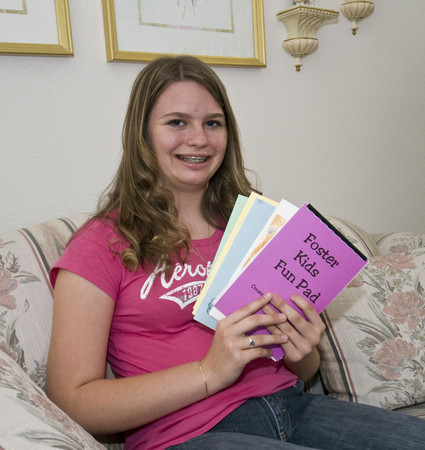
Raven, now 14, recently was named a winner of the 2009 Nestlé Very Best in Youth competition for the toy drives she has organized and the books she and her cousin, and fellow former foster child, Heather Wilder have written for other valley foster children.
While the prize is nice, it's not the most important one the teen has ever received. That would be the woman sitting next to her who she now, often and happily, calls "Mom."
Raven was born in California, but isn't clear about when or why she came to Southern Nevada. Until she was about 4, Raven had lived with her birth mother and her mother's boyfriend, and knows -- through official documents -- that her mom was young and in jail a few times. Beyond that, she remembers just enough to know that her early childhood wasn't "a pleasant one."
Most of Raven's childhood memories are like that, cobbled out of fragments unearthed during counseling or which jump out at her while watching a movie, then assembled like a big, frustrating jigsaw puzzle.
"It's odd. Like, things come back as I grow older," Raven says.
Raven wasn't quite 4 when she was placed in foster care. After a stay in Child Haven, she lived in a series of foster homes during the next several years. And, in them, Raven found it difficult to adjust to becoming part of a family.
"I was hard to handle. I threw fits a lot," she says. "I was confused about certain things, because one day everything would be fine. And, I guess, one day I'd want something and (her foster mom) didn't give it to me, or I didn't understand something, and I'd just explode. And, suddenly, I'd be (disciplined) because they didn't want me around their family doing this hitting and screaming."
"I like to say I tried my hardest to try to abide by the rules," Raven says, "but I guess I was a very strong-headed child."
"Little kids are supposed to have unconditional love from a parent, and Raven never had that," explains Kim Kallas, permanency supervisor with the Clark County Department of Family Services and Raven's caseworker for more than four years.
Raven "wouldn't let herself attach to people," Kallas continues. "It was a coping mechanism she developed: I'm going to reject you before you reject me.
"This was a brilliant kid. She was just so smart. But how does a 4- or 5-year-old express those feelings (of), 'I'm hurt, this is bugging me, where's my mother?' So what they do is act out."
While Raven was trying to figure out how families worked, Brenda was thinking of becoming a foster parent.
"I always wanted kids and didn't have any of my own," Brenda says. After completing the necessary training and certification process, Brenda went to meet Raven, then almost 7.
"She was just silly and goofy and a little shy -- she's not shy, but she was just pretending," Brenda recalls.
And what did Raven think of Brenda? "I thought you were nice," she says, turning toward Brenda. "I think my first thought was that you were nice. You were trying to talk to me."
Most people didn't, Raven explains. "They just kind of left me alone if I wanted to be alone. But she tried talking to me. I think she wanted to get to know me, and that was what made me think" -- she again turns toward Brenda -- "you were a nice person. And I trusted you, which is hard. I didn't trust a lot of people."
Brenda recalls that Family Services caseworkers thought Raven would be most apt to thrive in a family without other kids, where a foster parent could offer her undivided attention.
So, Raven says, "it was just me and my mom. We'd talk, and I told her everything, and we'd just talk about random stuff all the time. We played board games. We spent a lot of family time together, and that was nice because it really didn't happen like that before."
It wasn't all idyllic, though. Raven still would fall back into her hard-to-handle ways. Brenda recalls being told that Raven was prone to "intense, extreme temper tantrums (that) can last for hours."
Raven laughs. "I told you I was hard," she tells her mom.
"She took a wild risk, right there," Raven says. "If I was told this girl had extreme temper tantrums that would last for hours, I'd be, like, maybe, 'No, sorry.' "
Brenda had always thought that if she ever were to adopt, she'd adopt a baby. But a strange thing happened: When Raven would meet prospective adoptive parents, "I didn't want her to," Brenda says, smiling. "I was, like, feeling better when it didn't go so well."
Brenda decided to adopt Raven, breaking the news to her via a rigged Panda Express fortune cookie.
"It said something like, 'Welcome to the family,' " Raven recalls. "And I was like, 'Wait. Really?' "
About 21/2 years had elapsed between Raven's arrival and adoption. Raven was almost 9. And, she says, "I was ecstatic."
Now, Raven has a family -- mom Brenda, a grandfather whom Raven calls for cheering up whenever she feels down, a grandma, a slew of uncles, aunts and cousins, including Heather, 15, Raven's co-author of the foster care books.
Raven still deals with ripple effects from her earlier life, including occasional nagging fears that Brenda might, even now, change her mind.
"I mean there's always the little doubt in the back of my mind," she says. "It's going to take a long time for it to go away, just because it's been there for so long. It's been there the majority of my life. That's just the way it is."
Raven says her experiences have made her more compassionate, and more passionate, in helping foster kids. In addition to the book series, Raven and Heather collaborate on an annual Christmas toy drive for kids who are in foster care or other placements.
Kallas says Raven and Heather and their friends collect about 1,500 toys a year for kids who "sometimes would get nothing or get the smallest of gifts. It's just been amazing."
And the book series -- the books are distributed through Family Services and other agencies -- is "great," Kallas adds. "They're at a level where other kids can relate to it. It's not like an adult saying this or that, it's from a kid's perspective. So it makes it not only easier for kids to understand, but more meaningful that it's from another kid."
Raven figures that if she can "make it better and easier for them, I want to, and I will do whatever it takes, whether it's going in front of people to get a grant, which I've had to do a couple of times, or going into a store or mall and saying, 'I need you to donate these toys so I can help these kids.' "
Raven even has a sister now: Hanna, 4, whom Brenda adopted about 21/2 years ago. This fall, Raven will start her sophomore year at Centennial High School -- the school will be the recipient of the $1,000 award from Nestlé -- and she hopes to pursue a career in teaching and performing arts.
Today, Raven can look back on all of the bad things that have happened to her with not just acceptance, but appreciation.
"I always say I'm grateful for it all," she says, "just because if I hadn't gone through that, I wouldn't be here with this family and feel the love that I do and have the opportunity to do the things I've been able to do."
Kallas still keeps in touch with Raven and Brenda on a no-longer-official basis. She, too, is proud of what Raven has accomplished.
"It's nice to have a child who has that kind of success," Kallas says.
"There are happy endings."
Contact reporter John Przybys at jprzybys@reviewjournal.com or 702-383-0280.