



2 MILLION




No alarms sounded. No balloons or confetti came showering down from the ceiling.
Clark County's two millionth resident simply showed up sometime in the last three months, and no one -- not even the milestone newcomer -- noticed the difference.
"My guess is that it happened in September," said Jon Wardlaw, who oversees population estimates as assistant planning manager for Clark County. "It's not an exact science."
Wardlaw and other local demographers learned that lesson in spectacular fashion recently, when a flaw was discovered in the method used to estimate the county's population.
The subtle processing error, which had gone unnoticed for some time and involved housing units built in large developments during the second half of a calendar year, resulted in the discovery of about 27,000 county residents who had previously gone uncounted.
As a result, Wardlaw said, what originally looked like a sharp drop in the valley's growth rate turned out to be a modest decline. What looked like 2.7 percent growth, down from 5.3 percent the year before, was actually more like 3.7 percent.
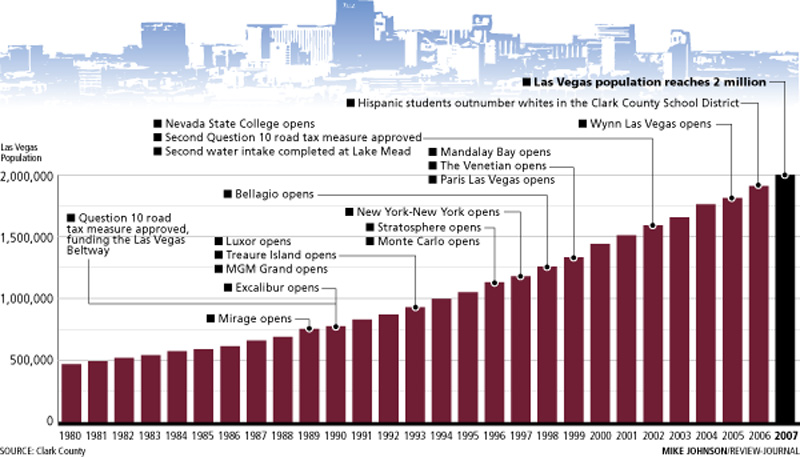
All of that translated to an official July 1 population estimate for Clark County of 1,996,542. And from that figure has produced a host of guesses about whether -- and when -- the county's odometer rolled over to 2 million.
University of Nevada, Las Vegas economist Keith Schwer said he suspects it could have happened as early as Aug. 15, but he plans to stick by his earlier prediction because it's easier to remember.
Several months ago, Schwer, who heads up UNLV's Center for Business and Economic Research, predicted the 2 millionth resident would arrive on -- why not? -- Oct. 31, otherwise known as Nevada Day.
He picked the same date in 1994 for when Clark County hit the 1 million mark.
"Last time it was in the afternoon. This time it (was) in the morning," he said with a chuckle.
Regardless of the exact date, 2 million is the latest milestone in a dizzying surge that has seen the county's population double since 1994 and quadruple since 1981.
All but about 3 percent of those residents live in the Las Vegas Valley, where growth is fueled, as it has been since the days of the El Rancho Vegas, by unending development along the Strip.
Nearly 39 million tourists visited Las Vegas last year, an increase of almost 350,000 over 2005. Analysts say that for every new resort hotel room built, the community gains roughly seven new jobs and 14 new residents.
"Nineteen of the last 20 years we were the fastest growing place, and Nevada was the fastest growing state, in the country," Schwer said.
The county's public services and infrastructure have struggled -- and in some cases failed -- to keep pace. And as the people keep coming, the improvements required to accommodate them grow ever more audacious and expensive.
Pressed by mounting demand and lingering drought, the Southern Nevada Water Authority is gearing up to build 285 miles of pipeline -- at a cost of more than $2 billion -- to import groundwater from across Eastern Nevada.
Meanwhile, state and local officials are scrapping and scrambling to fund $5 billion worth of highway "super projects," most of them designed to unclog Clark County's major arteries.
Even criminals are feeling the strain. At the county's downtown detention center, it took just two years to outgrow a 2002 expansion project that nearly doubled the facility's capacity. Now hundreds of inmates sleep on cots in the dayroom while officials rush the construction of a satellite jail that some predict could be filled to the brim almost as soon as it opens.
Then there is the Clark County School District.
Since the county's population topped 1 million in 1994, the district has opened new schools at a pace approaching one per month but still starts each year with too many students and not enough teachers and classrooms.
"I hope the two millionth person is a math teacher looking for a job," Superintendent Walt Rulffes said.
In nine years with the nation's fifth-largest district, Rulffes has seen enrollment increase by more than 100,000 students.
"I do think to some extent that the growth is a distraction to the academic mission," Rulffes said.
Clark County Commissioner Bruce Woodbury has seen more growth than most people.
The county was home to about 20,000 when Woodbury was born here in 1944. As a child, he lived down the street from Huntridge Circle Park and attended John S. Park Elementary School near Charleston Boulevard and Maryland Parkway.
"That was sort of the edge of town," he said. "I liked Las Vegas back then."
Woodbury moved to Boulder City in 1978 and joined the commission in 1981, as Clark County's population was closing in on the half-million mark.
"Certainly back in the '80s we knew we had rapid growth, but the predictions then were that it would taper off," he said. "The growth has just never stopped since then. It's never really slowed down to any extent."
As a result, the Las Vegas Valley is "way too big" for his tastes, and it has been for some time.
"I'm not one who frankly likes this rapid growth. I think the quality of life is suffering to a certain extent in terms of crime, traffic congestion, (and) school crowding," said Woodbury, who recently assumed the title of longest-tenured county commissioner in Nevada history.
Clark County Manager Virginia Valentine, who moved here the year Woodbury took office, said rapid growth has completely changed the character of Las Vegas. "It doesn't have that kind of small town feeling like it used to. It doesn't really jell as a community," she said.
One possible explanation for that, said UNLV's Schwer: "We're all from someplace else."
Nevada has the lowest percentage of natives in the country. Less than a third of current residents were born in the Silver State, and more than half have lived here fewer than 12 years, Schwer said.
Using simple probability and some data collected last year, Schwer said a rough thumbnail sketch can be made of the milestone newcomer.
The 2 millionth resident is probably male, since Nevada is home to slightly more men than women. And like almost 49 percent of newcomers, he is probably white, though other ethnic groups, especially Hispanics, are coming to Clark County in increasing numbers.
If the 2 millionth resident adheres to the averages, he is about 38 years old and earns about $43,800 a year. He has a high school diploma and at least some college education, if not a bachelor's degree. He is married or has a live-in girlfriend, and he is more likely to rent the roof over his head than own it, at least at first.
The 2 millionth resident probably came from somewhere in California, most likely the southern half of the state. "He's probably been to an In-N-Out Burger, put it that way," Schwer said.
More new residents come here from California than any other state. Arizona is second, Florida third, Texas fourth. New York, Illinois, Washington, Utah, Michigan and Hawaii round out the top 10, Schwer said.
Steve Soehlig probably isn't that 2 millionth resident, but he fits the profile pretty well.
He is 42 years old. He has a master's degree and earns around $44,000 a year. He was drawn here from Arizona by a job tied to tourism.
Soehlig even got here at about the right time.
On Aug. 12, he moved to Las Vegas from Phoenix with more stuff than his one-bedroom apartment could hold. The next morning, he started his new job as guest services supervisor for Virgin America airline, which began flights into McCarran Oct. 10.
Until he moved here, Soehlig hadn't been to Las Vegas for five or six years.
"It's amazing how much it's changed. I didn't realize it was this large. I didn't realize it had grown so much," he said. "Two million is a huge number, and it's a major milestone."
Like a lot of newcomers, though, Soehlig views Las Vegas as a stepping stone, a temporary stop on the way to someplace else. After a year or two, he hopes to move up to one of Virgin's larger operations, possibly in Europe.
"I don't know if I'd want to raise a family here necessarily," he said. "(Las Vegas) is very transient, just like Phoenix. People come for jobs. They come for the opportunity. They don't come to stay."
Recent figures from U-Haul seem to bear that out.
During the first seven months of 2007, the national trailer rental company helped move 4 percent more people out of Las Vegas than it helped move in.
Last year, U-Haul vehicles leaving the valley outnumbered those coming in by about 3 percent, reversing the trend from 2005 that saw 3 percent more trucks and trailers coming in than heading out.
Wardlaw the demographer said Southern Nevada tends to have a high level of population "churn" that must be accounted for in any population estimate. Ultimately, though, Clark County continues to see a net gain of between 4,700 to 6,000 residents a month, and he does not expect to see a major decline anytime soon. "There are too many jobs here," he said.
Woodbury grudgingly agreed.
"One part of me wishes we could (have) put up a fence and not let that two millionth person in," he said. "But people are coming, and we have to be ready for them."
Contact reporter Henry Brean at hbrean@reviewjournal.com or (702) 383-0350.
ESTIMATE ROOTED IN SIMPLE FORMULA Producing an official population estimate for Clark County doesn't end when the number crunchers finish their work. This year's total of 1,996,542 as of July 1 won't become a matter of record until State Demographer Jeff Hardcastle reviews it and Gov. Jim Gibbons accepts it early next year. And before any of that happens, estimates require the approval of the Southern Nevada Planning Coalition, a panel of elected officials representing the county, its cities and the school district. Coalition members gave the OK to this year's number last week. The county's annual population estimate is rooted in a simple formula: the total number of housing units times the occupancy rate (generally around 95 percent) times the number of people per household (about 2.5). "It's hard to know what the number of units is going to be, and it's hard to know the occupancy rate. That's the real killer," said county demographer Jon Wardlaw. To get a better sense of how much housing is out there, eight members of Wardlaw's staff spend several weeks each year counting rooftops in recent aerial photographs of developing portions of the valley. More than 10,000 parcels of land had to be checked for new homes this year alone. As tedious as that might sound, it's easier than it used to be. "Back in the 1990s we would physically drive around and check them," Wardlaw said. Because only one population estimate is produced each year, the county won't officially push past the 2 million mark until July 1, 2008, the date of the next official estimate. By then, demographers predict, the population will have surpassed 2 million by at least 50,000 people. By HENRY BREAN REVIEW-JOURNAL


