



2ND CONGRESSIONAL DISTRICT

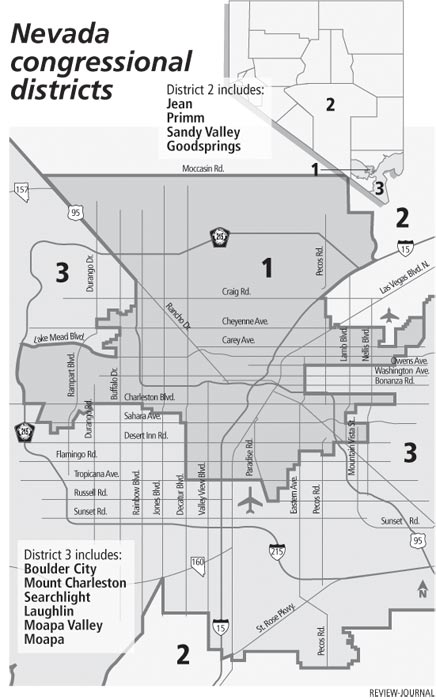


Two years ago, then Republican Secretary of State Dean Heller won the 2nd Congressional District seat in a race against Democrat Jill Derby by 5 percentage points at a time when Republicans enjoyed a 48,000 registered voter advantage.
In their rematch, Derby is counting on upsetting Heller, in part because a surge in Democratic registrations has cut the Republican advantage to 24,000 voters.
"There has been a huge shift because voters recognize we can't have more of the same," Derby said. "I represent change."
Green Party member Greg Bergland, Independent American John Everhart and Libertarian Sean Patrick Morse also are competing for the seat, which has been held by Republicans since it was created in 1982.
In her campaign, Derby has been asking voters if they are better off than when President Bush took office. Few are, she said.
Heller said Derby's question would make sense if she were running against Bush, but not against him.
He noted that he drew national attention this summer when he repudiated big spenders in his party and said some Republicans should lose this November because they have forgotten traditional Republican principles.
"It's the old mantra: They came to change Washington, and Washington changed them," Heller said at the time.
Heller said the election will be close and that he will be hurt if Republican presidential candidate John McCain does poorly in the state.
But he predicted he will win. He said he responds to every request for help from constituents, who often need assistance in securing their Social Security checks or in getting health care in veterans hospitals.
In the reporting period that ended in August, Heller had more than $1 million in campaign contributions, a better than 2-to-1 advantage over Derby. But Derby said her fundraising efforts have gone well and she now has contributions "approaching" $1 million. She wouldn't give an exact figure.
Derby believes Heller is vulnerable because he has voted with Bush 92 percent of the time and he espouses the Republican attitude that the economy functions best with little or no regulation of big business.
"No regulation doesn't work," said Derby, claiming that is what caused the Wall Street mess that led to congressional passage of the $700 billion bailout bill. "We need to put in oversight and regulation so this never happens again."
She pointed out that Heller "hardly has been a powerhouse" in Congress, earning the 435th spot out of 435 members in the House of Representatives last year by the nonpartisan group Congress.org. This year Heller rose to 420th in power, according to the survey.
"I am very low on the totem pole," Heller said. "I am very aware of that."
But Heller maintains he has been effective. He said he was judged the 435th most powerful after he had been in Congress for two weeks. Congress.org knew nothing about him and put him at the bottom because he was a member of the minority party from a sparsely populated state, Heller said.
He pointed out he has passed four bills as a freshman, three more than Rep. Shelley Berkley, D-Nev., did in her first term. He added he has a good relationship with Democrats such as Rep. Barney Frank, D-Mass., who chairs the House Financial Service Committee, on which Heller also serves.
Heller added he has sided with President Bush only 75 percent of the time on votes that actually matter to Bush.
"I think I am an independent voice," he said. "Someone who doesn't go along with his own leadership."
If he were working in tandem with Bush, then Heller asks why would he vote against the Wall Street bailout bill backed by the administration.
"It didn't punish the individuals who put us where we are today," he said. "It didn't help the individuals who were not at fault, seniors, people with 401(k)s. And were there any regulations to keep it from happening in the future? The answer was no."
Both Republicans and Democrats deserve blame for the crisis, according to Heller, pointing out policies adopted by President Carter in the 1970s contributed to the problem, as did Bush's policies.
"No hands are clean on this issue," said Heller.
To correct the problem, Heller advocates looking at the regulations that helped America through the Great Depression in the 1930s. He said barriers should be enacted to prevent lenders from selling mortgages to insurance companies, commercial and investment banks.
Derby said she would support efforts by the government to end the downturn by spending money on needed public works and infrastructure projects. She also backs a move to create universal health care, although not necessarily a single-payer system.
Something is wrong when the U.S. health care system is ranked 34th in the world, between Costa Rica's and Slovenia's, Derby said.
Heller added he favors expanding the health care system, but using more of a business approach.
"I want business to provide health care for their employees," added Heller, contending 80 percent of Americans like the current health care system.
Bergland said the country now is "pretty much busted" and Congress gave it to Wall Street. The Bush administration has "looted the nation," he added.
He advocates that citizens take steps to reduce their gasoline consumption and reliance on purchased electricity. The time may come when gasoline tops $10 a gallon, Bergland added.
"We don't have the luxury of doing nothing. We have to make sure our crops are grown and get food to the people. Sometimes I am a doomist. Sometimes I think everything will be all right."
Everhart calls himself an "average Joe" who backed Republican Ron Paul's campaign.
If elected he would seek to end the war in Iraq within six months.
He added he has not seen such discontent with the government since the Vietnam War.
Morse said people are fed up with both major parties, calling them two sides of the same coin.
The problem with the economy has not been the lack of regulation, but with Congress approving regulations that gave some businesses advantages over others.
"The oil companies and electric companies have been getting sweetheart deals for a long time," Morse said.
Instead of bailing out Wall Street, Congress should have forced banks and insurance companies into foreclosure and sold them off to the highest bidders, he said.
Contact reporter Ed Vogel at evogel@ reviewjournal.com or 775-687-3901.
HOUSE DUTIES Members of the U.S. House of Representatives are elected to two-year terms in the lower house of Congress. Their main duties involve passing laws, allocating spending, reviewing the performance of federal agencies and protecting the interests of their states. They are paid $169,300 per year. REVIEW-JOURNAL


