



Camps see room for improvement


When the vote came in from the Iowa caucus on Jan. 3, the winner declared victory and the losers conceded defeat.
When the vote came in from the New Hampshire primary on Jan. 8, a different winner declared victory and a different loser gracefully conceded.
In Nevada, naturally, things couldn't be quite that simple.
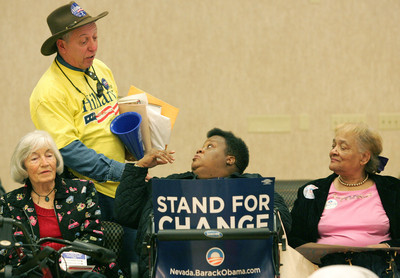
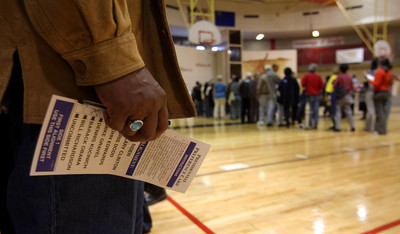
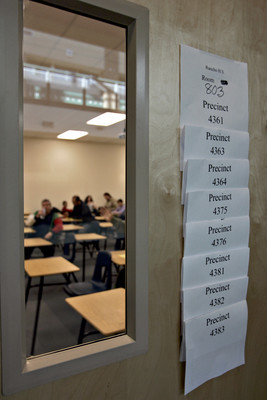
On Sunday, the campaigns of Democrats Hillary Clinton and Barack Obama were still haggling over Saturday's Nevada caucuses, slinging charges of voter intimidation and casting a pall on the historic event that the state's political parties would have preferred to celebrate.
"Of course, we are taking a look at all of the input we received from the caucus, good and bad, to improve the caucus next time," said Kirsten Searer, deputy executive director of the Nevada Democratic Party. She noted that no candidate is challenging the results of the caucus, in which Clinton won the majority of the precinct delegates and defeated Obama by 6 percentage points.
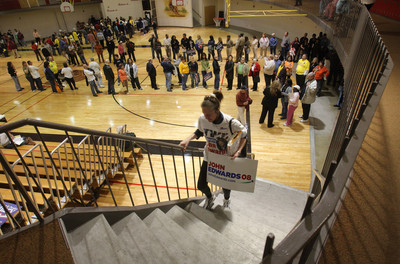
"We had incredibly high turnout, more than double the highest estimates, and we are proud that so many Nevadans turned up to share their voice on caucus day," Searer said.
Saturday's caucuses, the biggest political event in the state's history, didn't decide anything. Both the Democratic and Republican fields remain volatile and unsettled.
But that doesn't mean Nevada didn't make a difference as the Democrats and Republicans continue to struggle to determine their respective standard-bearers for November.
On the Democratic side, Nevada showed that Clinton has gained a strong hold on the women's vote and is popular with Hispanic voters who are becoming increasingly important, said national political analyst Jennifer Duffy of the nonpartisan Cook Political Report.
"The women's vote in Iowa," which went for Obama, "begins to look like an aberration," Duffy said.
The Obama campaign had claimed it would win Nevada the way it won Iowa, with a strong grass-roots organization that turned out massive numbers of new voters. But "it seems that Clinton treated Nevada a lot more like Iowa than Obama did," Duffy said.
Clinton practiced the micro-targeting her campaign is known for, reaching out to Hispanic voters in their neighborhoods and at Mexican restaurants and importing Latino luminaries such as labor icon Dolores Huerta, Los Angeles Mayor Antonio Villaraigosa and former Housing Secretary Henry Cisneros.
Aside from Spanish-language advertisements, Obama made a more generic appeal to voters as a whole, holding the mass rallies he is known for and, in the last week of the campaign, counting on the Culinary union to help make inroads with workers and Hispanics.
"Going to the source, restaurants and smaller groups and neighborhoods, bringing out the community leaders: that is how you would organize Iowa," Duffy said. "Obama seemed to rely more on his New Hampshire strategy of reaching out to as many people as possible."
New Hampshire is a primary, not a caucus, and Clinton eked out a win there despite the assumption that momentum was strongly in Obama's favor.
"Caucuses are all about organization, and that's what she did (in Nevada)," Duffy said. "They targeted really well, and they got their people out."
A serious test looms for Clinton this coming Saturday, when South Carolina Democrats hold a primary, Duffy said. Polling in Nevada showed Obama running away with the black vote, which is a majority of the South Carolina Democratic electorate.
If Clinton doesn't do well with blacks in the first-in-the-South primary, she and Obama will be back to a tie.
Meanwhile, native Southerner John Edwards, who got just 4 percent of the precinct delegates in Nevada on Saturday, is mounting what appears to be a last stand in South Carolina. His poor showing here, in a state where he was once thought to have an advantage with the large number of union voters, makes it "hard to see him go on," Duffy said.
Nevada also marked a shift in tone toward the vicious between the top two Democrats, and the sniping continued Sunday.
Clinton was in New York, Obama in Georgia. But their campaigns remained hung up on the Nevada process, which was chaotic to say the least.
Both the Clinton and Obama camps were calling for a full investigation into complaints from their supporters, which both said numbered in the hundreds.
"We're not calling the results into question at all. I want to make that clear," Bob Bauer, the Obama campaign's legal counsel, said in a Sunday conference call with reporters. "The purpose of this is solely to make sure this is highlighted and does not occur in the future."
Bauer said the Obama campaign heard of many irregularities but drew attention to one in particular. A manual the Clinton campaign gave its precinct captains states that the caucus doors were to be closed at 11:30 a.m., when the party's official rules say anyone who got in line by noon was to be included.
"We had hundreds of calls on caucus day, and the pattern that emerged was doors were being closed at 11:30, and supporters of Senator Obama and perhaps other candidates as well were being told that once the doors closed they were no longer allowed to participate."
The Clinton campaign fired back, saying they were the ones who had been victimized, particularly by Obama's supporters in the Culinary union. Campaign workers didn't have the authority to close caucus doors early, Clinton national campaign spokesman Howard Wolfson said.
"The bottom line is this: Senator Obama's allies engaged in intimidation and strong-arm tactics against our supporters at their workplaces and at caucus sites," Wolfson said. "They ran outrageous, false and offensive ads against Senator Clinton."
Obama expected to win Nevada and didn't, and "all the false claims and the grasping at straws by the Obama campaign isn't going to change any of that," he said.
The ads Wolfson referred to were Spanish-language radio spots paid for by Unite Here, the international parent of Culinary, Nevada's largest union. The ads called Clinton "shameless" and said she "does not respect our people."
Culinary's political director, Pilar Weiss, wearily said, "This is the third or fourth round of this."
The ads, she said, were referring to a failed lawsuit the Clinton camp supported that would have prevented workers from voting on the Strip. The union was scathing in criticizing the lawsuit, saying it would disenfranchise working people, many of them women and minorities.
"It's a little weird at this point, after they've won, that they're still beating on this," Weiss said. Clinton won seven of the nine special precincts.
The union would never engage in the tactics the Clinton campaign has alleged, such as telling workers they could caucus only for Obama or threatening them with lost shifts if they didn't, Weiss said. She said the proof was in the results.
The at-large caucuses, Weiss said, "were big, they were crazy, they were like rallies. People were passionate, and supporters of different candidates were having vigorous discussions."
National expert Duffy said the caucus process is "a model that takes some getting used to. The reason it works in Iowa is they've done it for so long. If you're new to the process, it's incredibly disorienting."
Still, even in Iowa claims of fraud and voter suppression are rampant, especially with this year's record turnout, she said.
The back-and-forth shows the campaigns are digging in, Duffy said. "It's absolutely getting more intense. My guess is South Carolina gets really ugly."
Meanwhile, among the Republicans, Mitt Romney's enormous victory in Nevada might have been overshadowed by Saturday's South Carolina Republican primary, in which Romney placed a disappointing fourth. But a win is a win, Duffy said.
"He leads the delegate count right now," she said. "In the end, that may matter. Is he getting the bounce out of it that he might from another state? No, not really."
The Republicans now head to Florida, where Rudy Giuliani is hoping to resuscitate his campaign in the Jan. 29 primary.
After that, for both parties, it's Tuesday, Feb. 5.
In past election cycles, the day a few states had simultaneous primaries got nicknamed "Super Tuesday."
This time, with more than 20 states voting on that day, observers have struggled to come up with an appropriately superlative moniker. It has been called "Giga-Tuesday," "Tsunami Tuesday" and "Monster Tuesday."
In Las Vegas last week, the president of the Hispanic Chamber of Commerce had his own suggestion: "Martes Gigante."
Texas Rep. Ron Paul came in a remote second in Nevada, with 14 percent of the Republican vote. Duffy said that because Paul's supporters are very motivated, they can do well in a caucus, but primaries are more of a challenge, and he is likely to fizzle on Feb. 5.
Sunday's newspapers all over the country featured the images of cocktail waitresses caucusing in casino ballrooms. That's not something the presidential nomination has seen before.
"People found it extremely unusual but also entertaining," Duffy said. "But there was no judgment made on the legitimacy of the caucus. It was, 'Well, that's Nevada, that's how they do it.'"
The nearly 116,000 Democrats and some 44,000 Republicans who participated show how engaged Americans are with this uniquely exciting election, Duffy said. And the high turnout has made Sen. Harry Reid, thought foolish for predicting 100,000, look prophetic.
"Harry Reid deserves a victory lap, absolutely," she said. "Nobody saw it being that high. Nobody I talked to thought they'd get close to that number."
Contact reporter Molly Ball at mball @reviewjournal.com or (702) 387-2919.


