



Disease strikes bighorns
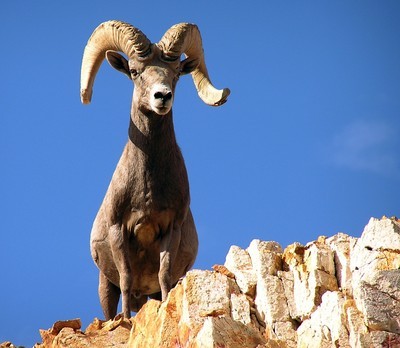


RENO -- A disease outbreak may have wiped out a herd of California bighorn sheep in northwest Nevada, wildlife officials said Wednesday.
"In this case, we honestly don't believe any are left," Dr. Mark Atkinson, a veterinarian with the Nevada Department of Wildlife, told The Associated Press.
About 110 bighorns are believed to have died of bacterial pneumonia in the Hay's Canyon Range, though biologists don't know how the animals contracted the disease.
"We really don't know what causes it," Atkinson said.
Before European pioneers began settling the West, three species of bighorn sheep, California, Rocky Mountain and Desert, inhabited much of Nevada's mountainous terrain.
By the 1960s, only Desert Bighorns were left in extreme Southern Nevada.
Today, because of an aggressive reintroduction program, biologists estimate there are 9,000 in all, scattered across the state.
In 1989, the Wildlife Department began re-establishing the species in the Hays Canyon Range, a chain of mountains roughly 50 miles northwest of Gerlach near the California state line. Since then the herd had continued to grow.
The first hint of trouble came in August 2005, when "one coughing and one sneezing" bighorn sheep were observed, according to the Wildlife Department.
There was no other indication of disease until last October, when a hunter reported seeing a sick ewe that was found dead a few hours later.
Game wardens retrieved the carcass for testing, which confirmed the ewe had died of bacterial pneumonia.
Over the next several weeks, wildlife biologists, assisted by the conservation group Nevada Bighorns Unlimited, conducted aerial and ground surveys of the region.
"After finding that one dead animal ... we went back in there to see if we could find other sheep and see if they were healthy or not healthy," Atkinson said.
What they found were some carcasses and sick and dying sheep, from which samples were taken.
"Just the fact we found six sheep in the process of dying is unusual," said Mike Dobel, the Department of Wildlife's western region supervising game biologist.
The extent of the die-off became clear by November.
"We realized we couldn't find very many sheep," Atkinson said. "The real finding was just the absence of sheep."
Dobel said the range has experienced severe drought conditions in recent years, which might have made the sheep more vulnerable to disease.
"Wild sheep seem to do really well, until they get some type of external stresser," he said. "Something kind of pushes them over the edge.
Wildlife officials said there's no evidence the wild herd was infected by domestic sheep, which are farmed in the area.
"What we do know, we want to try to keep as much distance as we can between domestic sheep populations and wild sheep populations," Dobel said.
A similar die-off of bighorn sheep occurred in the Santa Rosa Mountains north of Winnemucca in 2003-2004. About a third of that herd was lost to the same kind of respiratory infection.
Since then, Dobel said the herd has shown signs of rebounding.
"That mountain range is much larger" than Hays Canyon, he said. "There's much better water sources, better vegetation.


