Elected officials see need for changes in handling of police shootings
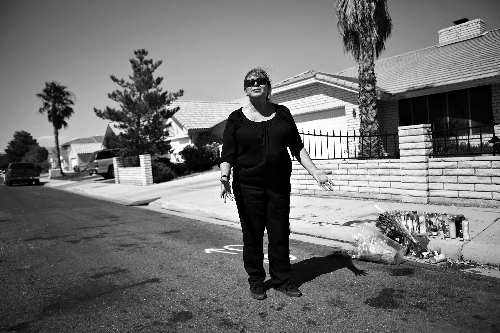


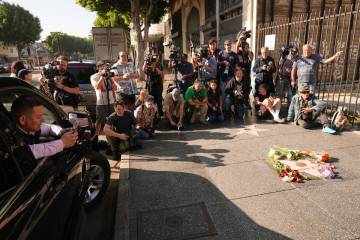
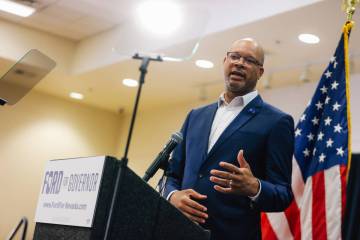

Candidates to become the next Clark County district attorney should expect to be questioned about their willingness to do criminal reviews of fatal police shootings, three county commissioners said Friday in response to a Review-Journal investigation that revealed breakdowns in the review process.
"It's critically important that the DA candidates express what they feel about that inquest process and, more importantly, how they would handle these types of cases," Commissioner Larry Brown said.
Commissioner Mary Beth Scow echoed that thought.
District Attorney David Roger has said he will resign next month and may take a job representing the Metropolitan Police Department's largest union. The seven-member County Commission will appoint a replacement to serve out the remaining three years of his term.
On Wednesday, the Review-Journal revealed that prosecutors for decades have not formally reviewed police shootings unless the head of the officer's agency requests it -- a sharp departure from the way homicides involving civilians are handled.
Commissioner Steve Sisolak said the newspaper investigation revealed deeper problems, such as the agency's slowness in removing problem officers, that the community needs to address.
"It seems to be so egregious and the statistics are so overwhelming that, OK, we've got a problem and it's looking us in the face but we don't want to admit it," Sisolak said.
He said he received about 100 calls and emails from constituents last week expressing concern about the issue.
"Not one has said they think the system is OK as it stands," he said.
SHERIFF: REPORT UNBALANCED
The focus of the Review-Journal's yearlong investigation was the Las Vegas police department, which was responsible for more than 80 percent of the 378 officer-involved shootings in Clark County since 1990.
The newspaper found that the department is slow to take action against problem officers and to adjust policies and procedures to limit the use of deadly force. The series is available online at lvrj.com/deadlyforce.
Sheriff Doug Gillespie declined comment for this article but on Tuesday he appeared on the Alan Stock talk radio show on KDWN-AM 720 to defend his department's record.
"I do my level-best not to become defensive," Gillespie said. "I have to look at it. I have to critically analyze it. And I have to use that information as best that I can to continue to lead what I believe is the finest police department in America."
He told Stock that the newspaper series was not "as balanced as I'd like" and "glossed over" changes the department has made over the years in training, policies and equipment to help prevent shootings. He also disputed the newspaper's determination that the department's internal review process is lacking in critical examination of shootings.
Gillespie said his agency does closely examine the incidents on both the individual and systemic levels to identify trends that could be addressed through better policies and training.
"We take a hard look at those," he said. "I think what this article is saying, in their way, is they feel we need to do a better job of that. And I can commit to you and the rest of this community ... that's exactly what we have been doing and will continue to do so. Status quo is not acceptable, never will be, at the Las Vegas Metropolitan Police Department."
Las Vegas Police Protective Association Executive Director Chris Collins didn't dispute the Review-Journal's findings but took issue with the way some incidents were represented in the series.
"I don't think you put any effort in putting anything positive in the shootings," he said.
NO WIN FOR POLITICIANS
The city of Las Vegas and Clark County jointly set the budget for Las Vegas police, but the sheriff is an elected official responsible for running the agency.
David Damore, a University of Nevada, Las Vegas political science professor, has called officer-involved shootings "the million-ton gorilla in the room, and nobody wants to talk about it," as well as a "no-win" for politicians.
Few local elected officials were willing to say much when contacted by the Review-Journal last week.
One, Las Vegas City Councilman Steve Wolfson, is a defense attorney and one of several candidates to replace Roger. He did not respond to requests for comment. Neither did council members Ricki Barlow, Lois Tarkanian, Stavros Anthony -- a former Las Vegas police captain -- or Mayor Carolyn Goodman.
Councilman Bob Coffin said he was "dumbfounded" when he learned that the DA wasn't doing criminal reviews after fatal shootings, and he encouraged county commissioners to address the issue when they appoint the next district attorney.
"They've got to get public commitment that they (DA candidates) will re-engage in the process," Coffin said of commissioners. "That one thing can make a huge difference."
Councilman Steve Ross said he hadn't read the series and didn't have any immediate plans to do so.
"I have a busy week ahead," Ross said.
Clark County commissioners Lawrence Weekly, Susan Brager and Tom Collins did not return calls seeking comment. Commissioner Chris Giunchigliani is out of the country and could not be reached for comment, according to her office. The commission will accept applications for district attorney through Dec. 9, and has not yet scheduled candidate interviews.
EXPERT REVIEW
Eugene O'Donnell, a law and police science professor at John Jay College of Criminal Justice in New York City, said the Review-Journal series should serve as a call to action for Las Vegas police.
"A lot of things need to happen that probably should have happened already," said O'Donnell, a former New York prosecutor and police officer. "Either the police department or the powers that be in Las Vegas will do it on their own, or they might be forced to do it."
O'Donnell said the newspaper's conclusions are supported by hard data.
"This is not a cop-bashing issue," he said. "Cops themselves are the biggest victims when there isn't professional oversight and training and accountability. Cops are the ones who are shortchanged by bad policies."
Bill Sousa, a UNLV criminology professor, called the series "a fair analysis."
Sousa reviewed the newspaper's raw data as well as its findings before publication. He said the methodology is sound.
Two members of Nevada's congressional delegation -- Rep. Joe Heck and Sen. Dean Heller, both Republicans -- said the series raised important issues.
Rep. Mark Amodei, who represents Northern Nevada, said he would support a congressional mandate for the FBI to start tracking and reporting police shootings by department, just as it tracks crime statistics.
There is no national clearinghouse for information on police shootings. An FBI spokesman said a congressional mandate would be required for his agency to gather those numbers.
"In the interests of public safety, officer safety and deriving best practices, I think it's preferable to have more data than not enough, especially when addressing the ramifications of deadly use of force," Amodei said in a statement. "To the extent that the FBI can and should be involved in tracking such data, that's something as a member of the House Judiciary Committee that I'm willing to consider and inclined to support."
In a joint statement, Las Vegas FBI Special Agent in Charge Kevin Favreau and U.S. Attorney for Nevada Daniel Bogden said they "carefully reviewed" the newspaper's series but are prohibited from commenting on the possibility of an investigation into the issue in Clark County.
"However, we can assure the local community that all law enforcement use of force incidents are taken very seriously, and that we carefully review each matter," they said.
SERIES CONFIRMED COMPLAINTS
Representatives of organizations long critical of police shootings in Clark County said the Review-Journal series validated their concerns.
Richard Boulware, a federal public defender and first vice president of the Las Vegas NAACP, said the series highlighted "real structural and systemic problems the community can only resolve through real systemic, structural reform."
The Review-Journal found that while blacks make up less than 10 percent of the county's population, they represent 32 percent of all Las Vegas police shooting subjects, and are also over-represented in the ranks of unarmed people shot at by Las Vegas police.
Boulware said the series "points to the fact that this is not just the grievance of a small proportion of the community, but a systemic problem."
"You guys have tapped into that this was a larger issue," he added. "It's not just now the minority community. Now everybody's involved in this thing."
The most consistent calls for reform over the last two decades have come from the American Civil Liberties Union of Nevada, and its general counsel, Allen Lichtenstein.
"What this also shows is that despite a lot of rhetoric about changes at Metro, old habits die hard," Lichtenstein said.
"They do a very good job on some things, but there are problems that need to be fixed," Lichtenstein added. "The sheriff and the top brass have talked about making changes. Well, now they kind of need to step up and make those changes."
Review-Journal special correspondent Alan Maimon and Review-Journal reporter Brian Haynes contributed to this report. Contact reporter Lawrence Mower at lmower@reviewjournal.com or 702-383-0440.
DEADLY FORCE: When Police Shoot, and Kill
An in-depth investigation based on original reporting by the Las Vegas Review-Journal and police reports, interviews with police and with those who have been shot by police since 1990.