



Foreclosure mediators take oath


More than 32,600 foreclosures have been filed in Nevada since July 1 and about 10 percent of those affected have requested help from the Nevada Foreclosure Mediation Program.
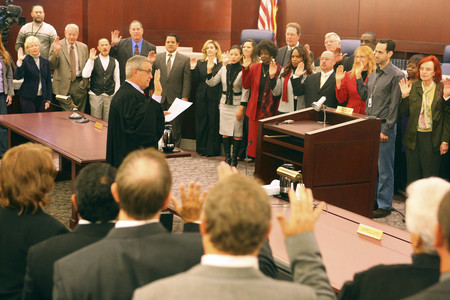
On Friday, dozens of newly trained mediators took an oath administered by James Hardesty, chief justice of the Nevada Supreme Court, bringing the total number of mediators to roughly 165, most of whom are located in Clark County, the state's hardest-hit area.
"The state is suffering mightily in this economic crisis," Hardesty said, adding the cratering is the result of several events, but not "the people who want to own their own home and ... live the American dream."
He said the mission is to try to resolve issues between lenders and borrowers.
The Nevada program, said Hardesty, is "one of a kind" in the U.S. In an interview following the ceremony he said there are several elements of the program that make it unique. For example, Nevada is a "non-judicial disclosure" state, meaning most foreclosures are achieved through a notice of default from the trustee and do not involve court proceedings.
California, another non-judicial foreclosure state hit hard by the housing collapse, is looking to Nevada for guidance, Hardesty said. The program was established June 1 after lawmakers passed legislation establishing the mediation program and named the state Supreme Court to lead it. Hardesty said justices were surprised to be handed the responsibility.
No other state's highest court is involved so deeply, said Hardesty. He said the Legislature handed the ball to the high court because of the judiciary's experience with skilled mediation. Another unique factor of the program is that lenders are compelled to participate. After all, the purpose of the program is to "help keep Nevadans in their homes," said Bill Gang, the Supreme Court's public information officer.
Program administrator Verise Campbell was credited with taking the issue from concept to reality in one month. Campbell deflected that praise back to Hardesty, saying his ability to pull together a working group that included lenders, real estate professionals, borrowers, judges and experienced mediators was crucial.
"This program is only five months old, and over 500 mediations have been completed since mid-September," Campbell said.
It can take months, however, to know whether a mediated settlement will work out. That's because it's unknown whether terms agreed to by the parties can be met over time.
Hardesty noted the program is paid for by participants and not taxpayers. The cost of mediation is $200. "We started with no money, no training and no mediators ..." Hardesty told the group. "We reached out to the legal community and the real estate community."
Friday's ceremony was video-conferenced between the Regional Justice Center in Las Vegas and the Supreme Court building in Carson City. Nineteen of the 68 mediators sworn in will help Northern Nevada residents.
Though reports indicate the flow of foreclosure filings has slowed in recent weeks, that doesn't necessarily mean the crisis has reached its apex.
Hardesty believes dozens more mediators will need to be hired and trained. "Frankly, we can't have enough mediators," he said.
To date, between 300 and 400 applications have been submitted. The vetting process includes background checks, verifying statements made on applications, and examining potential scheduling conflicts.
Attorneys, including senior judges, and real estate professionals make up the bulk of new mediators. Hardesty said the decision to hold the swearing-in ceremony was made to "impress upon the public just how important this is. Very high ethics are involved," he said. "You are neutral, not an advocate."
Contact Doug McMurdo at dmcmurdo@reviewjournal.com or 702-380-8135.
How To Get Help
The Foreclosure Mediation Program is open to owner-occupied residential properties that have received foreclosure notices filed on or after July 1, 2009. Commercial property foreclosures and non-owner-occupied residential properties are ineligible. Requests for mediation must be filed within 30 days of a foreclosure notice filing.
For more information, call the Foreclosure Mediation Hotline at 702-486-9380 or 775-687-9816 in Northern Nevada.
More information can be found on the Nevada judiciary Web site at www.nevadajudiciary.us or www.foreclose@nvcourts.nv.gov. "The Web site is the best source," said Bill Gang, the Supreme Court's public information officer. "It gives you everything you need to know, including frequently asked questions."
LAS VEGAS REVIEW-JOURNAL


