



Lake Mead cleanup proves successful
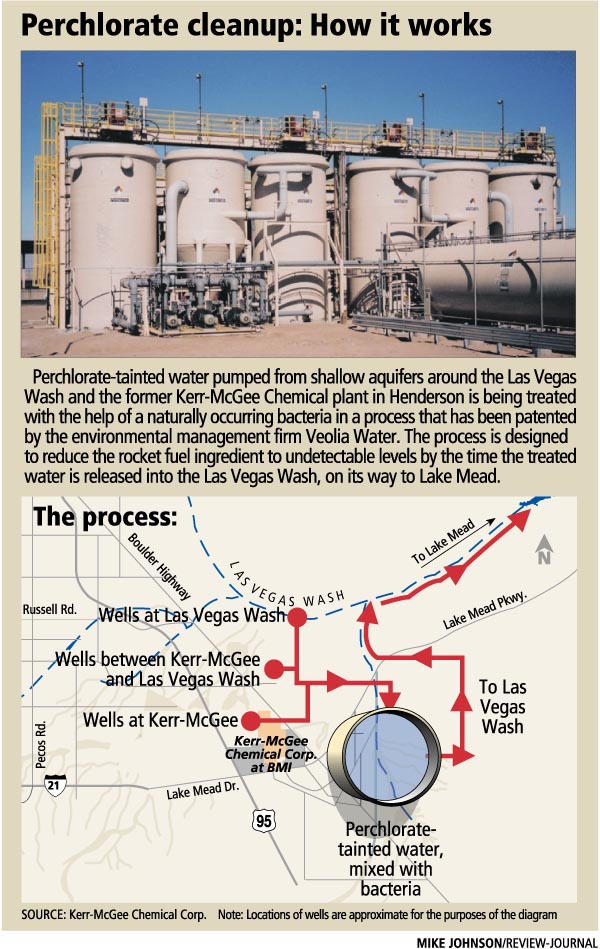


While environmental officials in other states have been bickering over who is responsible for cleaning up contamination from the rocket fuel ingredient, perchlorate, and to what level, water quality officials in Nevada have blazed a trail to follow.
J.C. Davis, a spokesman for the Southern Nevada Water Authority, credits the Nevada Division of Environmental Protection with spearheading the cleanup effort that has dramatically reduced levels of it in Lake Mead since it was first discovered there a decade ago.
He said the turning point came when hydrologists were able pinpoint locations where the contamination was entering Las Vegas Wash, which empties into Lake Mead, Southern Nevada's primary drinking water source.
"The key is you take it out before it gets into the lake," Davis said Tuesday.
The tainted groundwater is intercepted, perchlorate is extracted and clean water is then released to continue its course to the lake.
"The people who were actually manufacturing perchlorate stepped up without any compulsory requirements and did the cleanup," he said, recalling how water officials and former rocket fuel manufacturers around Henderson huddled with Nevada environmental officials in the late 1990s to plot a course of action.
"Everybody said, 'What's the object?' The goal is to protect drinking water customers instead of about arguing whether or not it was regulated or to what level of cleanup," Davis said.
Perchlorate has been known to affect the thyroid at high levels.
Prolonged exposures can reduce the amount of thyroid hormones that control the body's ability to break down food and produce energy.
Once cleanup measures were in place, perchlorate levels fell rapidly, even during drought years like this year when the lake's level is reduced and dilution is comparatively low.
At first, treatment by one former manufacturer, Kerr-McGee, focused on extracting perchlorate using an ion exchange process.
But in 2004, the preferred method switched to using bacteria that consumes perchlorate.
The chemical was manufactured near Henderson at the former Kerr-McGee Chemical Corp., now Tronox, and the former Pacific Engineering & Production Company of Nevada. The compound, ammonium perchlorate, was used as an oxidizer for rocket fuel.
While perchlorate can't be removed through conventional filtration or ozonation processes at the plants that treat drinking water from Lake Mead, the level in local treated drinking water last year was less than 2 parts per billion. That's down from an average of 8 parts per billion to 10 parts per billion in 2004. The highest reading in November 2000 was 24 parts per billion.
A 2006 study by the Centers for Disease Control and Prevention that explored adverse health effects in women who drank water and ate food contaminated by low levels of perchlorate focused on levels of nearly 3 parts per billion, which amounts to about a teaspoon of water in an Olympic-sized swimming pool.
Davis said since cleanup efforts have taken effect, perchlorate in Lake Mead has been consistently below 3 parts per billion.
"We didn't wait for regulations because we know those things take time," he said
Contact reporter Keith Rogers at krogers@reviewjournal.com or 702-383-0308.


