



Law mandates better vehicle fuel efficiency
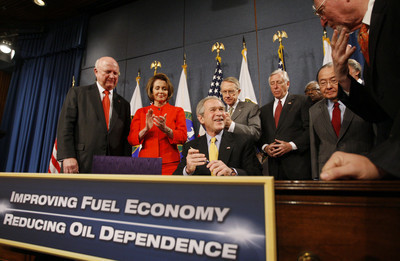


WASHINGTON -- President Bush signed into law last week legislation to promote energy efficiency and the use of ethanol fuel as a substitute for gasoline. The bill was one of the final and most far-reaching accomplishments by Congress this year.
Before recessing for the holidays, the House put the finishing vote on the energy bill, passing it 314-100.
The new law requires automakers to increase the fuel efficiency of cars, small trucks and SUVs by 40 percent, to an average 35 miles per gallon by 2020.
It also requires fuel companies to increase their use of ethanol and other biofuels to 36 billion gallons by 2022, a fivefold increase.
The new law even calls for phasing out incandescent light bulbs beginning in 2012. In the short term, they may be replaced by small fluorescent bulbs now on the market that supply as much light using less energy.
Supporters said the bill was the first step in a clean energy revolution that will decrease U.S. reliance on foreign oil.
Dissenters said the bill will actually do very little to increase domestic production of energy, and that it will increase energy costs for consumers.
The bill won enough support for passage after its Democratic sponsors agreed to delete a section loathed by Republicans that offered tax breaks for renewable fuels and paid for them by increasing taxes on oil and gas companies.
Reps. Shelley Berkey, D-Nev., and Jon Porter, R-Nev., voted for the bill. Rep. Dean Heller, R-Nev., voted against it.
FINAL IRAQ VOTES
Democrats tried one final time to force an end to the war in Iraq, and fell short like every other time this year.
An amendment by Sen. Russ Feingold, D-Wisc., that would have required President Bush to begin redeploying U.S. troops from Iraq beginning within 90 days failed by a 24-71 vote.
The outcome was similar to more than three dozen attempts to bring change to the Bush war strategy.
With few defections, Republicans stayed with Bush's strategy during a year when American deaths mounted but where some saw signs of progress in Iraq.
Feingold's amendment would have tied strings to an end-of-the-year spending bill for Pentagon operations in Iraq and Afghanistan.
Sen. Harry Reid, D-Nev. voted for the amendment. Sen. John Ensign, R-Nev., voted against it.
Senators followed by voting for an amendment by Minority Leader Mitch McConnell, R-Ky., that added $70 million to the spending bill for war operations but without restrictions.
Ensign voted for the amendment while Reid voted against it.
The war funding was made part of a massive spending bill that contained $555 billion to fund most parts of the government until the end of next September.
Congress previously had passed only one of 12 appropriations bill for fiscal 2008.
For the most part, President Bush forced Democrats to bring the spending into line with his budget levels.
But Democrats said they were able to redirect spending into some of their priorities, like veterans health care and housing.
Democratic lawmakers also added $11 billion in "emergency spending" that fell outside Bush's budget parameters.
The spending bill was finalized by the House, 272-142. Berkley, Heller and Porter voted for it.
MIDDLE-CLASS TAX HELP OK'D
Congress passed a one-year "patch" to avoid having 23 million families inadvertently fall into a higher tax bracket.
But the $50 billion bill was approved only after Democrats were forced to abandon their insistence that the costs be offset by tax increases on other, wealthier groups.
The bill addressing the "alternative minimum tax" passed 352-64 in the House in the final hours of the session.
Under congressional "pay as you go" rules, Democrats wanted to offset the cost by increasing taxes on wealthy hedge fund managers and private equity executives. But they could not muster enough votes to overcome Republican opposition.
The votes against the alternative minimum tax fix were cast by conservative Democrats incensed that the bill was not being paid for.
Berkley, Heller and Porter voted for bill.
SCHIP EXTENDED
Congress extended funding for the State Children's Health Insurance Program through March 2009, resolving what had been a major dispute this year between Democrats and Bush over expanding medical benefits to low income families
Bush vetoed two bills during the year that sought to expand the SCHIP program.
Although Democrats said the bills would improve government-funded health coverage for millions of poor children, Bush and many Republicans complained about costs and contended they would have undercut private insurance plans.
With debate exhausted at the end of the year and SCHIP about to expire, Congress merely extended the current program by a 411-3 vote.
Berkley, Heller and Porter voted for the extension.


