Life at the top
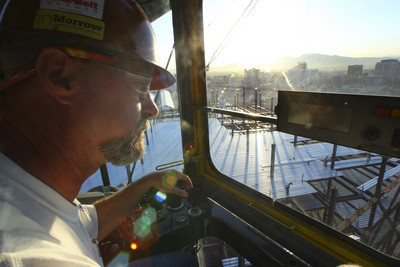
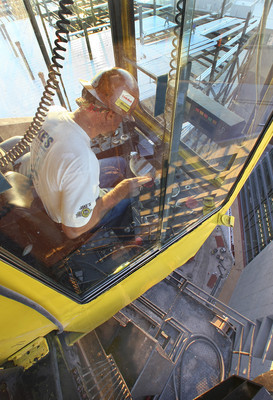




Phillip Harmon exits the elevator at 14, the highest floor with an actual floor.
It is 5:30 a.m., an hour after the Jake's Crane, Rigging and Transport foreman arrived at the construction site for the World Market Center's Building C, which is set to open next year. Following some mundane paperwork, his real job is about to begin.
"You're liable to see anything up there," the 48-year-old says.
There isn't much of an actual floor on 14. Harmon's daily walk to Tower Crane No. 1 -- there are three -- occurs across a ridged steel skin that feels like the surface of a gigantic George Foreman grill.
"This is a 1900 TG series," Harmon says beaming as he arrives at the uncomfortably thin and open bridge that, 200 feet in the air, joins the building to the crane's tower base. He gazes across at the crane like a boy at his new erector set.
"Look at the size of that," he says, explaining that the crane weighs 350,000 pounds.
The bridge can be accessed only by bending apart, then ducking between, two horizontal steel cables wound boxing-ring tight. The maneuver is difficult enough when the crane isn't operating. But because it is, the tower sways about a foot in every direction.
"If it didn't move, it would blow itself apart," Harmon says as the tower traces out random circles and figure eights like a schooner.
"This is nothing," he says, explaining that there's hardly any wind today.
Harmon has operated cranes for nearly 28 years, in New Orleans, Chicago, St. Louis and his hometown of Kansas City, Mo., his last stop before relocating to the Las Vegas Valley last year.
"I came out here because of all the work," Harmon says as he starts his skyward climb. "It's amazing, the boom going on."
Harmon, a member of the International Union of Operating Engineers Local 12, works an average of 65 to 70 hours a week, for $36.96 an hour.
"When I came out here, my scale jumped about $3 an hour," he says.
But there is a personal cost for Harmon's professional gain. His wife and 13-year-old daughter still live in Kansas City.
"I haven't seen them in five weeks," says Harmon, who rents a small Green Valley apartment. "I'm trying to get them moved here."
A half-hour and 93 grease-soaked ladder rungs later, Harmon pokes his head through a circular hole and enters the crane platform. He greets operator Jimmy Tate, who powered down the grand machine when his eight-hour shift ended seven minutes earlier.
The 20-square-foot control cabin has an air-conditioner, but to call its sun-brutalized climate "air-conditioned" is a stretch.
After five minutes of safety checks, Harmon turns a key and powers the crane back up.
"It's air-actuated, so it's loud!" he shouts over the engine noise. (Some operators wear earplugs, Harmon says, "but I don't think it's loud enough to bother with that.")
On the ground, a crew from Raymond Construction scrambles to prepare a panel that Harmon will help transform into part of Building C's exterior. It will take them six minutes to tie the panel to the crane's hook, upend and wash it.
"I figured I would end up farming like my dad and his dad," Harmon says. "But I got to 16 years old and saw that the farm life just wasn't me."
However, it did give him heavy-machinery experience.
"I was running tractors by the time I was old enough to get in the seat," says Harmon, who was introduced to the crane at a New Orleans oil refinery in 1980.
"The crane sort of chose me," he says. "They asked me if I wanted to learn how to run one, and any kind of a machine with a boom and a cable always interested me."
Operators need 1,000 verifiable hours of working around cranes to take the National Crane Certification Association test on each of five classifications of crane: lattice boom truck, lattice boom crawler, small telescopic boom, large telescopic boom and tower.
"It used to be 2,000," Harmon says, "but there's a shortage of crane operators right now."
"Boom!" a voice on the intercom interrupts. It belongs to a guy that Harmon knows only as Judah. This is Harmon's signal to begin his first pick.
The panel wiggles a bit before lifting off. Weighing 400 pounds, it consists of Sheetrock screwed to steel studding with a painted concrete film. Maneuvering two joysticks attached to a swiveling Captain Kirk chair, Harmon reels in the hoist line slow and steady.
"This is a very delicate dance," he says, explaining that the slightest bump, against anything, could tear his payload to pieces.
"It takes just one 'aw, shit,'" Harmon says, to rub out all the "attaboys" since the last "aw, shit."
While continuing to reel inward, Harmon lowers the crane's boom. The move, which causes the payload to briefly halt its ascent, is necessary because the target is 187 feet out from the crane's tower.
"This is very dangerous," Harmon says. "So I have a real good respect for everything."
Harmon has seen cranes destroyed before.
"They'll overload them," he says. "That's why we have monitoring systems in here." He points to an LCD indicator displaying his payload's weight, in addition to how far out the boom is and at what angle. A load chart posted behind him spells out what weights can be picked at what angles.
"Safety is No. 1," Harmon says, flashing back to what he says was his only serious accident.
"I had a guy get his fingers caught in the rigging," he says. "I was looking at another man who was communicating to me without seeing what was happening."
Luckily, the worker only broke a couple of fingers.
"I had seen he had his hand hung in (the payload)," Harmon says.
Judah's voice interrupts again.
"Keep on coming," it says. "Give me a load up as you're coming down."
Before Judah has completely uttered the word "high," which means stop, Harmon has complied.
"It's kind of like playing Simon Says," Harmon says. "They tell you things over and over, and you've got to react to exactly what they tell you every time."
The crane's motor suddenly quiets. Harmon has shifted to low gear, cutting his line speed in half.
"We're trying to catch a swing," he says, explaining that lighter payloads are actually more difficult because they "float around out there."
Harmon's pet peeve is construction workers who don't understand how a crane moves.
"They think you're able to pull a stick and make it move just like that," he says, snapping his fingers. "It doesn't work that way because you're constantly trying to keep up with the counterweights underneath you, the movement of the boom, the sway and the wind."
In the gang box behind Harmon is a symbol of something else crane operators tend to hate about the job: a bottle filled with orange-colored jack fruit guava Vitamin Water. By the time it returns to ground level, its contents will probably be yellow.
"You can't leave the crane," Harmon explains, even to go to the restroom. (Crane operators get one 30-minute lunch and two 15-minute breaks per eight-hour shift.)
Harmon is lucky. As a foreman, he fills in for other operators. (He'll visit both of this site's other cranes during his shift, which runs until 4 p.m., both to operate and troubleshoot.) But, until Jake's hired a fourth operator for this site six months ago, Harmon was trapped in this cabin every day, sometimes for 16 hours straight, if he had to relieve another operator.
"It isn't the boredom," he says, "because somebody's talking to you all the time. It's just having to be here and do pick after pick after pick, sometimes 300 in a row."
"A lot of guys will get in tower cranes and can't deal," he says.
Harmon says he's better able to cope than many.
"You just think about things to keep yourself occupied mentally," he says, "because physically, you ain't going nowhere."
The view is one of Harmon's favorite things.
"As the cranes progress up, it gets better," he says. "We started out at 162 feet and now we're at 312. It's an enjoyable thing to look around and notice little things -- landscaping and things. It's something to occupy you on your breaks."
Ten minutes after the panel left the ground, a gloved hand reaches out from the seventh floor to pull it in. Harmon's job is to hold it in place as it's welded onto the building.
It all seems worth it, Harmon says, at least during those moments he looks out at the structures he helped build. Harmon's proudest accomplishments, he says, are the 20,000-seat Sprint Center and the federal courthouse in Kansas City. (He has been in Las Vegas long enough to help build, before this project, the third tower of the MGM Residences.)
"It's something that nobody can take away from you," Harmon says, before Judah cuts him off again.
ON THE WEB watch videoIN DEPTH: CRANES• The State Bird of Nevada• Life at the top• Element of danger