



Nevada a microcosm of fight for West


The Nevada caucuses were born out of resentment.
Sen. Harry Reid, D-Nev., looked at Iowa and thought, why do they get all the attention?
Why does that little state, overwhelmingly white and rural, get such a big say in determining America's choices in presidential elections?
Why couldn't another state share the job?
He wasn't the only one thinking that way. More than a year ago, the Democratic National Committee under the leadership of Chairman Howard Dean, who seeks to broaden the party's geographical reach into traditionally Republican states, also was looking to diversify the party's nominating process.
There were other candidates as the party sought a Western state to add to the mix. But Reid happens to be the most powerful Democrat in the U.S. Senate, and he helped make the case for Nevada. The DNC was convinced.
Nevada Democrats, it decreed, would vote in January, after Iowa but before New Hampshire.
Nevada Republicans saw that their opponents were poised to lavish the state with attention, and some feared for the party's future in a state that's closely divided between the two parties.
So, earlier this year, rank-and-file Nevada Republican activists took it upon themselves to schedule their own caucuses for the same date as the Democrats.
Since then, the picture has become cloudier. The nominating calendar has been mired in confusion, and Nevada has had trouble guarding its claim to early-state status.
With other states trying to horn in on the same territory and candidates unable to ignore Iowa and New Hampshire's demands for their traditional primacy, the Nevada caucuses have been aptly termed an awkward stepchild. Being a big deal in picking the president, it turned out, wasn't as simple as marking a calendar.
Nonetheless, Nevada political leaders hope the stepchild will one day grow up. Cinderella, after all, was a stepchild whose beauty wasn't immediately apparent.
There are many obstacles. But if the Nevada caucuses reach their potential, the effects could be far-reaching -- nothing less than changing the American political landscape.
NEVADA DEMOCRATS, NEVADA REPUBLICANS
The first question about the Nevada caucuses is what effect they might have on the Democratic and Republican nominations.
It's a question both of timing and sensibility. The caucuses are timed so that Nevada Democrats and Republicans have a chance to make a high-profile statement early on in the nominating process.
But what do Nevada Democrats and Nevada Republicans want? Is it any different than what partisans want in Iowa or New Hampshire?
You'd hardly confuse a Nevada Democrat with, say, a Massachusetts Democrat. The party's 2006 gubernatorial nominee, state Sen. Dina Titus, owns a gun and opposes driver's licenses for illegal immigrants, but she's considered liberal by Nevada standards.
Jill Derby, chairwoman of the Nevada Democratic Party, said party members here are "more independent." They tend to favor gun rights and resist government intrusion, she said. The vast expanses of public land make natural-resources issues immediate.
Nevada Republicans are distinctive, too, said Eric Herzik, political scientist at the University of Nevada, Reno. The national Republican Party appears split between religious conservatives whose priorities are issues like abortion and gay marriage and fiscal or state's-rights conservatives whose highest priority is keeping government limited. Republicans here fall solidly into the latter camp.
Unlike Republicans in many Southern states, Nevada Republicans don't look to churches as an organizing force.
Herzik pointed out the current Republican governor, Jim Gibbons, is a nonchurchgoing, pro-choice politician who campaigned almost entirely on a promise not to increase taxes.
By campaigning in Nevada, the candidates, including the eventual nominees, will come into contact with these singular Nevada voters. The parties hope they will have learned something in the process.
NEVADA AND ITS ISSUES IN THE SPOTLIGHT
One thing they will have learned is the ins and outs of the Yucca Mountain issue.
Iowa voters famously demand that candidates go into detail about farm subsidies and ethanol. If Nevada has such an issue, it's the proposed nuclear waste repository about 100 miles from Las Vegas.
All the candidates who have come here have been asked what they think about the dump, which most Nevadans and Nevada officials oppose.
Some have sought to curry favor by trumpeting their opposition. Sen. Hillary Clinton, D-N.Y., got hearings on the issue in the Senate. The other Democratic candidates also oppose Yucca.
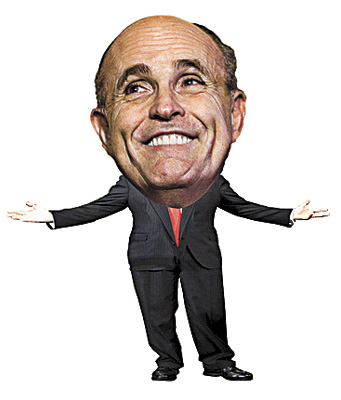
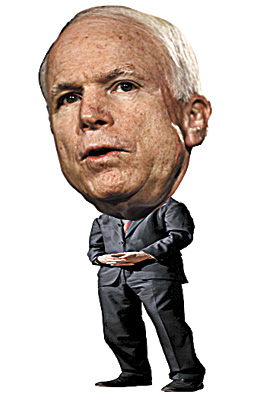
No Republican candidate has taken a stance against Yucca. Sen. John McCain, R-Ariz., openly supports the project. Former New York Mayor Rudy Giuliani and former Massachusetts Gov. Mitt Romney have danced around the topic, while former Tennessee Sen. Fred Thompson has refused to answer.
What previously was seen as a one-state issue now is in the national spotlight.
Nevadans also share with other Westerners concerns about water, land, and the building of new infrastructure, said Democratic guru Billy Vassiliadis, who supports Sen. Barack Obama, D-Ill.
Nevada's service economy sets it apart from the manufacturing and industrial concerns that predominate elsewhere. The issue of immigration, while a hot button across the country, is closer to home here.
The Nevada caucus "is good for the West," Vassiliadis said. "Early on in the presidential campaign, instead of just farm subsidies and tariffs, candidates are going to have to talk about public lands and infrastructure."
ORGANIZING FOR 2008
There's another type of infrastructure that concerns the campaigns -- the type of infrastructure that wins a caucus.
Particularly on the Democratic side, Nevada has felt the effects of multiple candidates trying to organize voters statewide.
Obama has seven campaign offices around Nevada. The major Democratic campaigns have upwards of 50 staffers apiece.
The state Democratic Party, which four years ago was run by two part-time staffers, now has about 30 employees.
For months, the party and campaign staffs have been fanning out across the state, working to persuade people to get involved in the political process and to vote for a Democrat.
There are now nearly 9,000 more Democrats than Republicans on the voter rolls. A year ago, it was the reverse.
Without an early caucus, it's unlikely Democrats would become this active until mid-2008.
The party hopes that once a nominee is chosen, those staffers and volunteers and newly registered Democrats can start working toward November.
Pete Ernaut, a Reno Republican consultant and lobbyist, saw this happening and warned fellow party members that if Democrats were the only ones doing this, Republicans wouldn't be able to compete.
That's the main reason Republicans decided they would also have an early caucus.
"The caucuses bring a much higher focus and more resources at the grass-roots level," Ernaut said. "All these campaigns come in and either have paid staff or organized volunteers. After the nomination's decided, they all coalesce into one team behind the nominee."
Nevada, a state that voted twice for Bill Clinton and twice for George W. Bush, was hotly contested in 2004 and will be again in 2008. Both parties want to be ready for battle.
THE WEST IN TRANSITION
The fight for Nevada in 2008 is a microcosm of a bigger fight on the horizon: the battle for the West.
Both parties hope that giving a Western state more say in the presidential process will make them more relevant in the West, which many argue is the key region to winning national elections.
Increasingly, the Northeast and upper Midwest belong to the Democrats, while the South and lower Midwest are Republican. The West Coast states are increasingly Democratic as well.
But the Intermountain West, which overlaps all or part of 11 states from the Rocky Mountains on the east to the Sierra Nevada and Cascade Range on the west, is in a period of political flux.
Once solidly Republican and predominantly rural, states such as Nevada, Colorado, New Mexico and Arizona are gaining population, becoming more urban and diverse, and giving hope to Democrats.
Both parties believe they have a shot at the electoral votes in the region, and both parties want to make inroads with the Hispanic population that is concentrated in the Southwest and not firmly in either party's column.
"The national (Democratic) party is looking at the Intermountain West as the place for growth and potential for the party," Derby said. "Six years ago, of the eight states in our region, you had eight Republican governors. Now there are five Democrats."
It's no accident, Derby said, that the Democratic National Convention in August 2008 will be held in Denver.
Ernaut said the West's independent-minded voters are something of a last frontier for the polarized country.
"Both parties have realized that the future of presidential politics lies in the West," said Ernaut, who is chair of the Nevada Republican caucus effort. "The campaigns in the last few presidential cycles have been unbelievably close. If you're a strategist for either party, you have to create a game plan (to win by) a very small margin. And there's not that many true swing states left."
A YOUNG CAUCUS
If Nevada were Iowa, the effects on national politics could be profound. The parties might choose different nominees. The issues of America's fastest-growing region would get more attention. The state's political parties would be gearing up for one of the most important battlegrounds of the general election.
But if one thing has become abundantly clear since that DNC decision in 2006, it's that Nevada is not Iowa.
To Republicans, Nevada's early caucus seems not to have registered in their party's consciousness. Only a couple of candidates have even a few staffers here. None of them have been here more than five times to date. They've seemed more interested in collecting checks from the moneyed interests in Las Vegas than winning over the state's voters.
For their part, the Democratic candidates, flush with cash and goaded by their party leaders, have set up shop here, opening offices and hiring staff. The major candidates have visited at least 11 times apiece, some of them 20 times.
With the blessing of the DNC, Las Vegas played host to a national debate last week.
Even that unprecedented attention, however, is nothing compared to New Hampshire and especially Iowa.
The candidates have held literally hundreds of events in Iowa, often spending four or five days at a time in the state, traveling to the small towns at its farthest corners.
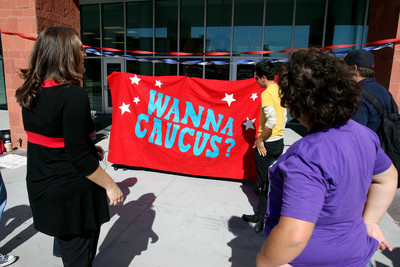
Meanwhile, Nevada isn't the only state to see the benefits of being an early state in the presidential nominating process. The weeks before Feb. 5, when both parties say the contests should start, have been crashed by other wannabes.
The nominating calendar, then, is not as simple as 1-2-3. It's a fractured mess of states vying for attention.
It looks now like Nevada will be the Democrats' third contest, after Iowa and New Hampshire. Nevada Democrats are satisfied with that and point out that it puts them in position to be a tiebreaker.
The Republicans' situation is worse. Wyoming Republicans moved up to Jan. 5. In Michigan, Republicans didn't agree to boycott the Jan. 15 contest as the Democrats did. And South Carolina Republicans moved to Jan. 19, stealing part of Nevada's thunder.
On Feb. 5, more than 20 contests will be held, including the one in California. Many pundits and operatives are calling for wholesale reform of the nominating system to end the pileup it has become.
Between all the maneuvering and Iowa's untarnished belle-of-the-ball status, Nevada has started to feel like the Chopped Liver Caucus.
"Nevada is not going to be a make-or-break state for any candidate on either side," said Jennifer Duffy, analyst for the Cook Political Report, a Washington newsletter.
"For the Democrats, it either helps a candidate build momentum or gives new life to a candidate who's been lagging behind," Duffy said. "For the Republicans, it will probably have very little effect, because they don't seem to be paying much attention to it."
Nevada boosters are frustrated that the hand-wringing about what the caucus is worth threatens to drown out the caucus itself.
"Tradition isn't built overnight," Ernaut said. "The media and presidential politics are still centered in the East and change won't come quickly. But it will, and when it does we're going to be in the right position."
Derby agreed: Give it time.
"When we got into this, we didn't expect to get the same amount of attention as Iowa and New Hampshire, because they have the tradition," she said. "But we think we're being taken seriously.
"I think we have to prove ourselves this time around, and we're well on our way to doing that," she said. "January 19 will tell the tale."
Contact reporter Molly Ball at mball@ reviewjournal.com or (702) 387-2919.
2008 ELECTIONSGet more news, voter information


