



Nevada still on track to get fourth congressional seat, officials say


CARSON CITY -- Nevada's population may have dropped by nearly 100,000 people in the past two years, but state Demographer Jeff Hardcastle and others familiar with the U.S. Census still think Nevada will gain a fourth seat in the House of Representatives.
Hardcastle said Nevada was the fastest-growing state for 19 consecutive years and hasn't lost enough people to blunt that overall growth spurt.
Having a fourth House seat would give the state more political clout in Congress.
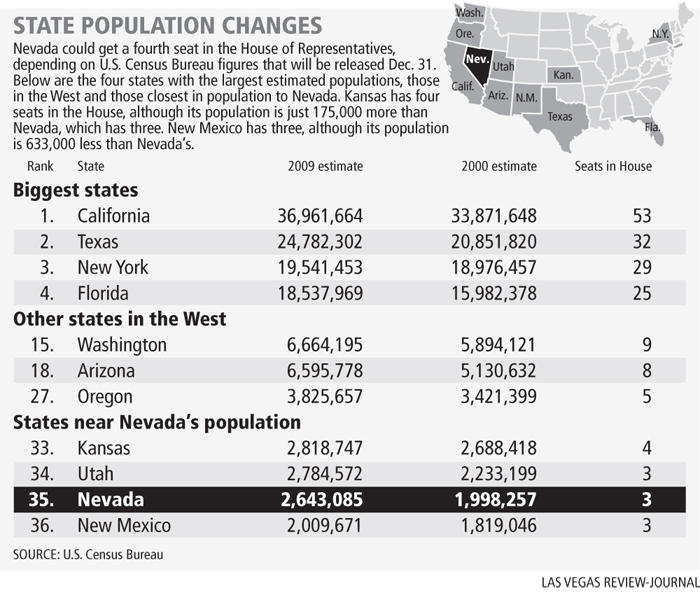
Based on the demographer's and U.S. Census Bureau's population estimates, Nevada's population probably will be about 200,000 people short of the ideal number of residents to pick up another seat, but that doesn't mean it's out of the running.
Nevada now has three seats in the House. It picked up its last seat after the 2000 census.
Utah, which has about 150,000 more residents than Nevada, would be in a better position to gain a fourth seat, based on population estimates.
Nevada won't know for sure that it has gained a seat until Dec. 31, when the Census Bureau reports the results of its 2010 census to each governor.
How seats in Congress are awarded is determined strictly on the basis of population as determined by the census every 10 years. Every state, regardless of its population, is entitled to one seat.
Both USA Today and the Election Data Service have reported in recent weeks that Nevada is still on track to pick up its fourth seat.
A source familiar with the census count also predicts Nevada will gain another House seat, despite its recent population decline.
Assemblyman Tick Segerblom , D-Las Vegas, who heads a committee handling redistricting matters for the 2011 Nevada Legislature, also thinks the state will gain another congressional seat.
The Nevada Policy Research Institute, a conservative think tank based in Las Vegas, agrees with that assessment. But it already accuses Segerblom's committee of starting to draw districts in a way that makes it likely Democrats can win three of the four House seats.
Three House districts would be centered in Clark County, the other would cover most of the rest of the state, according to institute analyst Kyle Gillis. One of the Clark County seats would include portions of Lincoln and Nye counties.
"We haven't thought about drawing congressional districts yet," Segerblom insisted. "We haven't even got approval of a fourth district, although everybody says we will get it."
Besides drawing the boundaries of congressional districts, the Legislature also must redistrict Assembly and state Senate districts -- and give more representation to Clark County because it now has nearly 72 percent of the state's population.
Segerblom said the 63-member Legislature could be expanded so that rural counties and Washoe County do not lose members, but that would be cost prohibitive when the state is facing revenue shortfalls in a deep recession.
"That is a big decision," Segerblom said. "No one wants to punish rural or northern counties. But you can't ignore reality."
If legislators do not increase the Legislature's size, then Clark County probably will pick up one seat in the state Senate and two in the Assembly.
Any decision on redistricting would require the consent of both Democrat-controlled houses of the Legislature and of Republican Gov. Brian Sandoval, a former Reno assemblyman who takes office in January.
The last time redistricting was done, in 2001, Republicans controlled both the state Senate and the governor's office. Deals were made between Republicans and Democrats in creating the 3rd Congressional District so that Republicans had an opportunity to take that seat.
Republican Jon Porter subsequently won the seat, later taken by Democrat Dina Titus. Republican Joe Heck won the seat in November.
In exchange, Democrats were given more sway over drawing legislative districts, particularly those in the Assembly. Democrats have controlled that house throughout the decade.
What is known at this point is that the Census Bureau estimates the 2010 U.S. population at 310 million.
Since there are 435 seats in the House of Representatives, each congressional district ideally should have 712,500 residents.
Nevada, therefore, should have had a population of 2,850,000 to insure it qualifies for four seats in the House.
But Nevada's population last year was estimated by the Census Bureau at 2,643,085.
Demographer Hardcastle, however, then put Nevada's 2009 population at 2,711,000, a drop of 27,677 from the previous year.
This fall, he estimated the state 2010 population at 2,640,000, a 71,000-resident drop.
That means the population might be 200,000 short of the number that would guarantee Nevada another seat.
Hardcastle consistently has put the Nevada population higher than the Census Bureau's estimates.
Several organizations are predicting Texas will gain four seats, Florida will gain two, and six states, including Arizona, Utah and Nevada, will get one each.
New York and Ohio each would lose two seats because their populations have remained flat since the last census. Illinois, Michigan and six other states in the Rust Belt each would lose one seat.
Even if Nevada picks up the fourth congressional seat, it might hold it only until the next Census, in 2020, unless the population starts to grow again.
Hardcastle sees an additional 50,000 population loss in the next few years and then largely flat growth until 2030.
He has good reason for his pessimism. Nevada has lost 190,000 jobs in the past three years.
People flocked to Nevada earlier in the decade because of the availability of jobs, Hardcastle said.
If they can't find work, then they leave.
Contact Capital Bureau Chief Ed Vogel at evogel@reviewjournal.com or 775-687-3901.
Nevada Policy Research Institute paper on redistricting


