Plan targets homeless tent city






"Homeless" is a word that covers a broad range of people. Some are mentally ill. Some are addicted to alcohol, drugs or gambling. Some found themselves on the streets after losing a job or a house, or were victims of domestic violence. Some will say they simply like being outside.
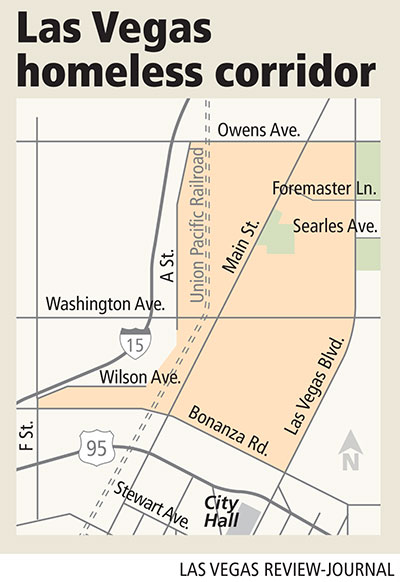
The problems caused by homelessness are as varied as the people who make up that population. Crime. Sanitation. Drug trafficking. Impacts on businesses and property values where homeless people congregate, which in Las Vegas is a small downtown area around Main Street and Owens Avenue.
It's called the "homeless corridor," although city officials have rechristened it the "corridor of hope" in conjunction with a new $2.1 million plan aimed at moving people out of a persistently growing tent city on Foremaster Lane and into temporary and permanent housing -- along with, hopefully, the resources they need to keep a roof over their heads.
Las Vegas is not alone in this. Clark County, North Las Vegas and the state of Nevada all have money from the federal stimulus bill -- $6.2 million overall, earmarked for helping people stay in their homes or getting them into some kind of shelter.
Money will also be set aside for case management, such as making sure participants get the health care, counseling or medication they need, as well as reaching out to homeless people in need of services.
At the same time, Las Vegas city leaders have been talking tough about recalcitrant homeless people who won't seek or accept services that could get them off the streets. The city's gotten itself in trouble in years past for overreaching on the homeless issue.
"We're going to be tougher than ever," Mayor Oscar Goodman told his fellow council members last week. "There will be a lot of civil libertarians who will be screaming and yelling.
"Maybe when they open up their mouths the first time, we'll take one of the chronic homeless ... and tuck them into the crybaby's backyard."
Councilman Ricki Barlow, who represents the area that includes the homeless corridor, expressed a more nuanced point of view, talking about working with police and service providers to house the area's homeless and keep others from moving in.
But he also staked out a tough position on what he called the "criminal element" within the homeless population.
"You gotta go," Barlow said. "If you are not going to live by the laws that residents and taxpayers live by, then you've got to move on.
"For too long, individuals who refuse services continue to disrupt the business owners who pay taxes, who provide the business that our economy needs, who are now running the risk of shutting down due to the fact that their customers cannot get into the facility."
Actually accomplishing that could be tricky. The city once passed a ban on feeding the homeless in city parks to discourage the homeless from congregating in certain places. A court set aside that ban.
Also enacted was a prohibition on sleeping within 500 feet of human feces. That was taken off the books, but afterward three people were arrested for it anyway, costing the city $45,000 in legal settlements.
"We would have to work closely with the legal department and law enforcement and the ACLU to see what the measure will be," said Barlow.
"We're going to come up with it. They will move."
The American Civil Liberties of Nevada has challenged some of the city's previous approaches to dealing with homeless people, and Executive Director Gary Peck said he was glad to hear about plans to dedicate money for housing, case management and outreach.
"Those are really good steps," he said.
But the city's going to keep digging a hole for itself if it gets too aggressive, he added.
"We live in a society where people can make choices -- even bad choices. They shouldn't be criminalized for that," he said, as long as they aren't breaking the law.
"The approach over the years has been nonsensical, futile and doomed to fail. The problem is, we don't have the political will to get the job done."
Councilman Steve Wolfson, who toured the homeless corridor area with Barlow last week, disagreed.
"We're going to take, not giant steps at first, but careful and coordinated steps," Wolfson said.
"Aggressive, I think, misstates it. It's going to be assertive, but we don't want to hurt people."
Contact reporter Alan Choate at achoate@reviewjournal.com or 702-229-6435.
LOCAL STIMULUS MONEY TOTALS $6.2 MILLION
The stimulus package approved in February included $1.5 billion for what’s known as the Homeless Prevention and Rapid Re-housing Program. Between Las Vegas, North Las Vegas, Clark County and the state of Nevada, the local share of that is $6.2 million:
$4 million is for housing assistance, such as keeping people in housing or re-establishing them in short- or long-term housing. That includes motel vouchers, rental assistance, deposits and moving costs, but not mortgage help.
$1.4 million for outreach, case management, housing searches and credit repair. The funds can’t be used for credit card bills or consumer debt.
The rest goes to administration and information gathering, such as a planned census of the tent city on Foremaster Lane.
Other steps are being considered, said Gary Schofield, deputy chief with the Las Vegas Metropolitan Police Department. Those include trash cans and portable toilets in the homeless corridor area, as well as lockers where people staying in area homeless shelters can store their belongings. Right now, people can’t store large bags in the shelters, and residents pay people staying on the street to watch their stuff.
Service providers, city officials and law enforcement have been meeting for about a month on a coordinated plan, said Schofield. A draft version is being circulated.
“Everybody’s doing really good work, but they’re not working in conjunction,” he said. For instance, each homeless organization has homeless outreach, “but none of them know what each other is doing.” Those efforts could be combined.
Las Vegas’ share of the funds is $2.1 million, and the city is accepting comments on its plan for the money until today. The plan must be submitted to the department of Housing and Urban Development by May 18. A copy can be viewed here.