Professor working for Army
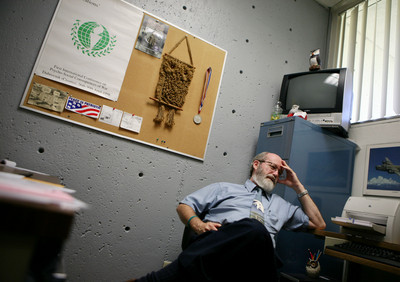



A UNLV assistant professor is in Germany this week training 35 Army counselors how to treat soldiers suffering from substance and other addictions.
Larry Ashley, director of the university's Problem Gambling Treatment Program, is teaching counselors how to battle addictions when their patients are also struggling with post-traumatic stress.
Addiction and post-traumatic stress disorder, or PTSD, go hand in hand as soldiers and veterans, struggling to deal with the traumatic experiences of combat, seek an escape from their environment or memories, Ashley said.
The 61-year-old Ashley, himself a veteran of the Vietnam War, left for Germany on Monday and will return Saturday. He'll be visiting soldiers receiving treatment for their addictions today, and will be training the counselors Thursday and Friday.
"I'm looking forward to it, but it'll be really intense," he said last week in his office at the University of Nevada, Las Vegas. "It won't be a vacation for me."
The combination of illnesses also makes it doubly difficult to treat.
PTSD doubles the chances that a person will have an alcohol abuse disorder, and triples the chance that the person will have a drug abuse disorder, according to a report last year by the National Center for PTSD, a part of the Department of Veterans Affairs.
Between 12 percent and 20 percent of veterans of the Iraq war are believed to have PTSD, according to the center.
That's lower than the 30 percent of veterans of the Vietnam War who suffered from the illness.
But Ashley said the illness often doesn't occur until later in life.
"We're still seeing post-traumatic stress emerge in World War II vets 40 to 50 years after the fact," he said.
Although alcoholism is by far the most common form of addiction for soldiers, they're also susceptible to other addictions, such as eating and gambling, Ashley said.
"We often don't look at those as addictions, but you can sell your body and soul to any of them," he said.
The counselors in Germany, who were expected to be from several bases throughout the country, are already educated on how to treat addiction. Ashley will instruct them on the difficulties of treating addictions in a combat environment.
And those difficulties are numerous.
In addition to the prevalence of PTSD and other mental illnesses, soldiers have the daily stress of combat, the stress of being away from home and, for many women in the military, the risk of sexual harassment and assault.
Those problems can frequently trigger addictions in soldiers.
"We've always used, historically, as a society ... drugs to modulate mood," said Pat Duncan, chief of addictions at the local Department of Veterans Affairs. "When you leave from work sometimes, and you've had a miserable day, what is it that people say? 'Go home and have a cold beer.' Or we tell somebody, 'You know what? I need a drink.' "
For Ashley, the chance to help soldiers is a personal reward that also comes with the risk of reviving memories of his own combat experience in Vietnam.
"If you can relate to who you're treating, it can affect you harder," he said.
A sergeant who was drafted into an Army mechanized infantry unit, Ashley spent 13 months in Vietnam "just trying to stay alive."
"You're not the same person you are when you come back," he said.
The experience steered him toward a lifetime of helping others fight addiction and stress disorders.
This will be his first time training Army addiction counselors, but it won't be his first overseas counseling job.
He spent two weeks in Vietnam in 1994 for a study on the effects of PTSD on Vietnamese veterans, and he made a presentation on "trauma and substance abuse" in 2004 in Germany for the European branch of the American Counseling Association.