



Research links scores to teacher absences
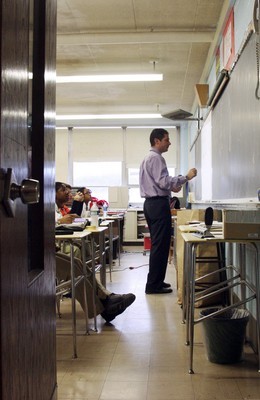


WASHINGTON -- A year is a long time in a child's education, the time needed to learn cursive writing or beginning algebra. It's also how much time students can spend with substitute teachers from kindergarten through high school, time that's all but lost for learning.
Despite pressure on schools to increase instructional time and meet performance goals, the vacuum created by teacher absenteeism has been all but ignored, though new research suggests it can have a harmful effect in the classroom.
The problem isn't just with teachers home for a day or two with the flu. Schools' use of substitutes to plug full-time vacancies -- the teachers that children are supposed to have all year -- is up dramatically.
Duke University economist Charles Clotfelter, among a handful of researchers who have studied the issue, said the image of spitballs flying past a daily substitute often reflects reality.
"Many times, substitutes don't have the plan in front of them," Clotfelter said. "They don't have all the behavioral expectations that the regular teachers have established, so it's basically a holding pattern."
Clotfelter's examination of North Carolina schools is part of research suggesting that teacher absences lead to lower student test scores, even when substitutes fill in. And test scores have gained heightened importance because the 2002 education law penalizes schools if too few students meet testing benchmarks. The goal is to get all children reading and doing math at their grade levels by 2014.
Keith Rheault, superintendent of public instruction for Nevada, said state lawmakers have similar concerns about the use of substitutes and directed the Department of Education to start collecting data this year on the use of long- and short-term replacements in the classroom.
The biggest concern is the effect on student learning at the high school level in core subject areas such as science, math and English, where a substitute might not always have the most desirable qualifications, he said.
But resolving the problem is not easy, particularly in fast-growing areas of Nevada where teacher shortages frequently require long-term substitutes, Rheault said.
The problem might become worse in Nevada if an exodus of experienced teachers occurs because of a possible change in health insurance benefits affecting Nevada's local government workers, he said.
That change is the subject of a case before the Nevada Supreme Court.
Raegen Miller, a postdoctoral fellow at the University of Washington, is examining the effect of teacher absences on fourth-grade test scores in a large, urban school district that he chooses not to identify. His findings show that 10 teacher absences within a year cause a significant loss in math achievement. When the regular teacher is gone for two weeks, the absence can set students back at least that amount of time.
"Teachers often have to re-teach material, restore order and rebuild relationships after absences," said Miller, who is conducting the research with Harvard University education professors.
The potential harm multiplies when subs are used in long-term roles in a classroom. Though long-term substitutes often have better credentials than those chosen for daily fill-ins, they are no replacement for regular, full-time teachers who have gone through the normal hiring process.
Nationwide, the number of schools reporting that they used substitutes to fill regular teaching vacancies doubled between 1994 and 2004, according to Education Department data. The latest data showed more than a fifth of public schools use subs in such a way.
One factor behind the increase was a rise in the number of schools reporting they had full-time vacancies. That points to teacher shortages in some communities.
Also, schools are being more thorough in reporting on vacancies and on school staffing because requirements of the No Child Left Behind law, Miller said.
With math in particular, the higher the level taught by the absent teacher, the harder it is to find a substitute, said Francis Fennell, president of the National Council of Teachers of Mathematics. "If the prime teacher of calculus is going to miss some time, man, are you in trouble," he said.
At Baltimore Polytechnic Institute, a high school with a math and science focus, a substitute might be in a math class one day and an art or science class the next, principal Barney Wilson said.
"We're not expecting him to teach the material. We're expecting him just to follow the lesson plan that the teacher laid out," Wilson said.
Algebra teacher James Todaro recently was injured in a car accident and needed to stay home for several days. Each day, the bandaged and bruised Todaro came to school to leave an updated lesson plan for the substitute.
But that is not the case across the country, and substitutes want improvements, said Geoffrey Smith, director of the Substitute Teaching Institute at Utah State University, which provides training to substitutes and schools.
"They will be the first to say, 'I wish we had more competent lesson plans left. I wish we had better control of the students,'" Smith said.
Review-Journal Capital Bureau writer Sean Whaley contributed to this report.
Effect of Substitute Teachers


