



Response times by heavy rescue unit good despite union warning

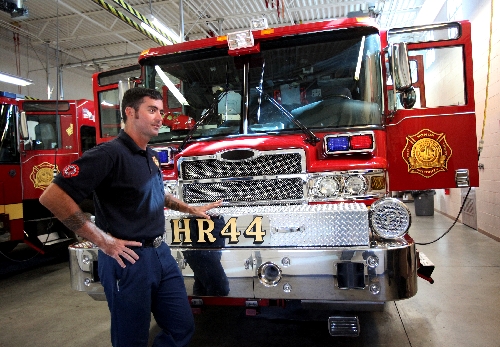


Last summer, as dire warnings sounded from some quarters, Clark County officials passed responsibility for technical rescue and hazardous material calls to Las Vegas Fire & Rescue as a cost-saving measure.
Predictably, the city's calls for those services increased, and response times went up slightly because of the greater distance crews now must cover to reach some calls.
But it's still pretty much business as usual, according to Las Vegas Fire Department officials who say the consolidation of services has gone well.
The city has not had to add staff or overtime to deal with the higher number of calls, said Fire Chief Mike Meyers, and officials say no deaths have been attributed to having just one team.
"Response times looked good," Meyers said. "The crews are comfortable with handling the workload. To me, things are going fine right now."
When the change was announced, the Clark County firefighters union criticized county management, saying response times for heavy rescue could triple and that eliminating the county unit would potentially endanger tourists on the Strip because of the size and complexity of the properties.
In a statement, the union praised Las Vegas firefighters but pointed to incidents where the county team might have made a difference. Union President Ryan Beaman also said union officials are going into arbitration to have the unit restored.
County commissioners and others dismissed the worries as overblown, noting that regular fire crews are equipped to handle most emergencies.
The goal was to reduce overtime by creating a reserve pool of firefighters who could fill in for absent co-workers at regular pay instead of time and a half.
Last year, the county spent $15.3 million on firefighter overtime. Six months into the current budget year, the county is on track to spend $9.5 million, a savings of $5.8 million, or 38 percent.
"This is really a significant savings," Clark County Manager Don Burnette said. "That is clearly the biggest cost containment item of all the ones we put in place last summer."
And, he said, "we never thought it would burden (Las Vegas), and in our opinion we don't think it has."
From June 5 to Dec. 31, 2009, before the change, the Las Vegas heavy rescue team went to 280 calls. Of those, 247 were in Las Vegas, 23 were in Clark County and eight were in North Las Vegas. The team arrived at 90 percent of its calls in 14:48 minutes or less.
For the same period last year, after the change, the team went to 352 calls. They included 273 in Las Vegas, 74 in Clark County and three in North Las Vegas. They arrived on scene to 90 percent of the calls in 15:41 minutes or less.
Heavy rescue, or technical rescue, is not a first-response unit, and other fire department personnel arrive at scenes much faster, Meyers said.
The unit has a large equipment truck, an ambulance and a regular fire truck and is manned by 10 people per shift, all trained in technical rescue, which includes rescues from confined spaces, underground incidents or rescues from the sides of buildings.
They also have special equipment such as heavy-duty saws, equipment for saving people trapped in burning buildings and air bags that can lift thousands of pounds.
"They get called for all kinds of things," Meyers said. "It could be difficult rescues for car accidents that are over and above what a normal engine company could handle. Heavy tractor-trailer accidents, multiple vehicles, those kinds of things. Collapses. People who fall from construction sites where there will be a long extraction.
"They're not limited. Anytime they think they need specialized rescue, this is the type of team that handles it. They're creative and they're structured to kind of operate on the fly."
Traveling longer distances in huge Clark County hasn't been an issue so far, at least, not a new issue, Meyers said.
"Heavy rescue is used to that. It's a single resource. It's not spaced out like a regular fire station, where there's one every five minutes. Somebody's going to get there within the normal response times for that jurisdiction, and these individuals will come five, 10, 15 minutes later."
But those minutes can make a difference, Beaman said in a prepared statement: "The city of Las Vegas units have every bit of sophisticated training as we do," he said. "It becomes a question of delayed response to an emergency because the crews are located farther away."
In August, for example, a family traveling near the Nevada-California border had a tire blowout and crashed into a parked asphalt truck. The county heavy rescue team would have been closer because of its location at the south end of the Las Vegas Valley. In this case, the mother died at the scene, the father died at the hospital after being airlifted, and their three children were safely transported to the hospital.
"Our guys, they didn't have the tools available to extricate those people," Beaman said. "I don't know if the outcome would've been different, but it would've been nice to have a (county) heavy rescue available. We do know that quick response times save lives."
Las Vegas heavy rescue was not called to that scene, city spokeswoman Diana Paul said.
County Commissioner Steve Sisolak said county officials made the heavy rescue move to save money, but only after fire officials promised that it wouldn't harm the public.
"There clearly hasn't been any loss of life because of this," he said.
Sisolak also acknowledged that Las Vegas is carrying a load for the county.
"When you've got this joint agreement ... if I help you one time and you help me four, at some point you're going to say, 'I can't keep doing this,' " Sisolak said.
"In an ideal world, we'd like to restore all the services that were eliminated in all departments. I think it's a long way before we can start restoring. Now we're trying not to cut more."
The county firefighters union, meanwhile, has filed a complaint about disbanding the heavy rescue team, contending that county officials violated their collective bargaining agreement by eliminating the staffing. The dispute is scheduled to go before an arbitrator in late February.
Contact reporter Alan Choate at
achoate@reviewjournal.com or 702-229-6435.


