SHARING SHEEP
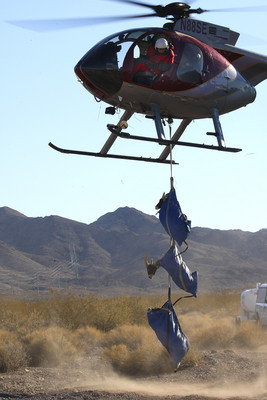

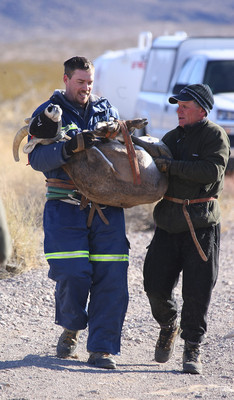





Reminiscent of the opening scene from the TV show "M*A*S*H*," a team of wildlife biologists and volunteers ran to meet a helicopter Tuesday after the pilot carefully lowered three slings to the desert floor west of the River Mountains.
Instead of wounded soldiers, though, inside each baglike contraption was a plump, healthy desert bighorn sheep.
Only minutes before, the bighorns had been darting across rocky ravines along the ridge on National Park Service land before they became ensnarled in a net big enough to cover a pair of picnic tables.
The net had been shot from a special .308-caliber rifle by a gunner aboard the helicopter, 30 feet above them.
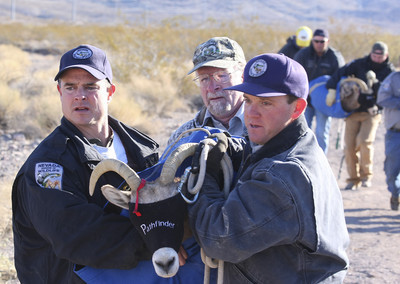
A crewman on the ground slipped blindfolds over their eyes and put hobbles on their legs to keep them subdued for the short flight to the base camp.
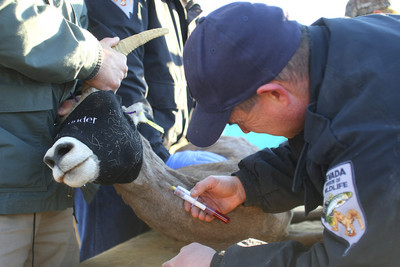
There, with the blades of the helicopter still whirling a safe distance away, three team members grabbed each sling holding a 70-pound ewe and carried them about 30 yards to a set of canvas-draped tables. Veterinarians and big game biologists and a horde of assistants, inoculated them, extracted blood samples, monitored their temperatures, swiped bacteria samples from the back of their mouths, and clipped yellow tags on their ears.
Collars equipped either with GPS signal transmitters or radio telemetry devices were put on some so that, after their release, biologists in Reno and Las Vegas can track their movements on computer screens.
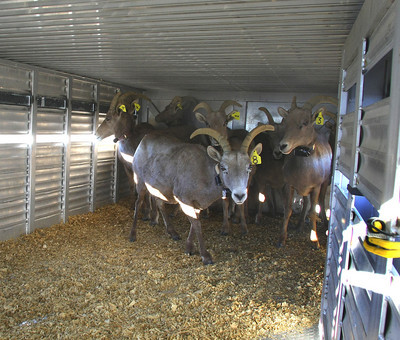
It was part of the effort to trap 25 bighorns from the boxed-in herd of River Mountains sheep that at more than 250 is nearing capacity and transport them to Lincoln County's Delamar Mountains. That's where a relocation effort has been under way since 1997.
"We're trying to get this herd established in this mountain range that hasn't had sheep in it since the early 1900s," said Nevada Department of Wildlife big game biologist Mike Scott.
Department spokesman Martin Olson said the transplant effort is a way to keep the River Mountains herd from overpopulating its range, which is surrounded by roads and human encroachment from the fast-growing urban areas of Henderson and Las Vegas. Sheep from the herd, sometimes 50 to 100 at a time, often graze on the lush grass of Boulder City's Hemenway Park, which he described as a "buffet" for bighorns.
"This is a fantastic opportunity to take them from a place that's approaching capacity and put them in a place where there's more food and water," Olson said.
He said there are "plenty of sheep" left for people to view in the park.
"The release takes about 10 seconds. You open the gate and it's over," he said.
In the Delamar range, he said, "We can tell where they're moving. Some will join other herds. Some will form herds of their own."
Collars that biologists use to track them last about two years. By interpreting the "clicking" signal, they can tell if an animal is active, has died or lost its collar.
On Sunday, the team trapped 24 ewes and one young ram in the Muddy Mountains near the north end of Lake Mead and released them in the Delamar range. Together with the 25 from the River Mountains, the Delamar population will double. When spring comes it might triple when the ewes give birth to lambs.
Nevada wildlife officials estimate that in the 1860s, the statewide bighorn population was 30,000.
Today in Nevada, there are roughly 6,500 desert bighorns, 2,000 California bighorns and 250 Rocky Mountain bighorn sheep. Nearly 1,600 desert bighorns have been trapped and transplanted in the state since 1968.
The desert bighorn sheep population had dwindled in the early 1960s to a low of between 1,200 and 1,400, according to Bill Vasconi, past president of the Fraternity of the Desert Bighorn. The preservation group contributed $12,000 and provided volunteers for this week's relocation effort.
Nevada wildlife officials have rounded the low count number to between 2,000 and 3,000.
Vasconi cited two primary factors that caused the decline. One was the influx of miners who found the sheep to be easy prey and who also drained their water supplies.
The other reason, Vasconi said, "was the vast array of ranchers that had domestic sheep. There's no immune system in our wild sheep. Many were lost by diseases from domestic sheep."
At Tuesday's gather, Nevada wildlife veterinarian Mark Atkinson collected swabs that were put in the sheep's mouths to check for mycoplasma and pasteurella bacteria, "the main culprits that cause pneumonia in bighorn sheep," he said.
Olson said the 25 captured sheep were given shots of Vitamin E for strength, an antibiotic to fight infection, and a preventive injection for roundworm and lung worm.
Kathy Longshore, from the U.S. Geological Survey's Biological Research Division, helped collect blood samples that will be used to study the herd's genetic viability.
The GPS tracking system is key to monitoring the herd's movement, Longshore said.
"It's very exciting. We get eight locations sent to us a day. So, now we're actually getting daily movement patterns. Then, when we want to find the animals it's much easier," she said.
Vasconi said he hopes 50 more bighorns can be transplanted in the Delamar range in the spring. Seven water projects, or guzzlers, have been installed to accommodate the herd and other wildlife.
"That area can hold 350 bighorns," he said. "We know the potential is there. We want to make it work."
Contact reporter Keith Rogers at krogers@reviewjournal.com or (702) 383-0308.
View the slideshow