Entrepreneurs share stories of getting businesses off the ground




Want to start a business? During the economic recovery, when there's plenty of space to be leased and rent is low, it might be a good idea, emphasis on "might."
U.S. Small Business Administration statistics show that would-be entrepreneurs have a tough row to hoe. In their first two years, 33 percent of all businesses fail. After four years, that figure doubles, according to the SBA.
Timing and location also play a part in a business' success or failure. Don't want the hassle of a brick-and-mortar location? A website may be the answer. It reaches the world and can sell items around the clock. But online businesses face heavy competition and have to fight their way to the top of search engines.
SCORE hosts seminars to start a dialogue with prospective entrepreneurs. The nonprofit association is under the auspices of the SBA and offers free advice and assistance about opening a business.
Scorelv.org provides a reality check, asking: Are you self-motivated? Are you a master multitasker? Do you have good customer communications skills and good time-management skills? Do you know something about marketing?
"The key to success is not having a great idea. There are lots of great ideas out there," said SCORE representative Lori Murphy, who mentors entrepreneurs. "The key to success is in getting your product out there."
Money is another factor. Loan possibilities can be found through the SBA, such as the Nevada Microenterprise Initiative, which provides funding for small companies with five or fewer employees, including the owner.
Fabian Vincent, vice president and business development officer for Plaza Bank, 8275 W. Flamingo Road, said the days of using one's home as collateral are far behind, so having cash on hand is often necessary.
"Usually it's friends and family and savings and credit cards and that kind of stuff until they're established and have some sort of historical cash flow," he said. "Then they can go to the bank and say, 'Hey, look, I've been in business a year, two years, and this is what I've been able to do,' because what pays back a loan is cash flow. Cash flow, that's the key."
Las Vegas Ward 6 City Councilman Steve Ross said the current economy is ripe for new startup companies.
"This is probably the golden time for young people and even old people like me to think about starting a new business," he said. "They used to say home ownership is the American dream, which it still is, but you know what, business ownership is the American dream, too. When people know that they can work for themselves, provide for themselves and do something that makes them happy, it's not a job, it's fun. And I think now is the right time, now is the right economy, to start up."
CREATING A PRODUCT, FOLLOWING A DREAM
If brothers and business partners Lamarr and Nick Williams of Summerlin have done their homework, they'll have their ScullyBand on the market in time for the 2012 Summer Olympics in London.
The ScullyBand is a combination headband and skullcap. Lamarr, the elder of the two brothers, came up with the idea in 2003.
"I was just playing basketball ... and I sweat profusely when I work out, so I said, 'I need to come up with something that's going to absorb this sweat,' " he said.
But it had to be fashionable, too. He took a headband, combined it with the skullcap style, and the ScullyBand was born. It uses a high-end wicking material for the main piece, similar to the material marathon runners wear, and it comes in different sizes and colors.
Within a couple of months, he had several prototypes sewn up by a friend, but he didn't know what to do with them and soon got discouraged. The dream flickered out.
"I destroyed them," Lamarr said. "I ripped them apart and everything."
In 2008, he saw a photo of himself wearing one, and it reignited his determination. This time, he vowed, he'd follow through until it was on the market. He wanted to do it right, so he took business courses at West Los Angeles College, learning about marketing and supply lines. Nick, a loan officer at U.S. Bank, came on board, as did silent partner Todd Uglow.
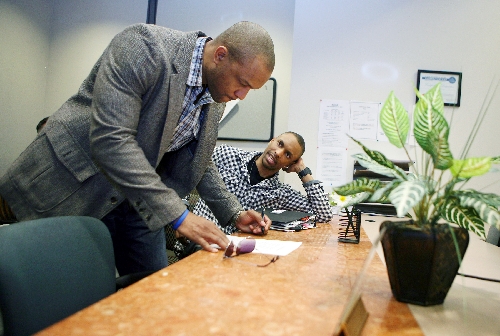
Two years later, the brothers contacted SCORE. They were matched with Bob Cushman, a jovial and brutally honest volunteer who would mentor them.
At the first meeting in December 2011, the pair brought a business plan with them ... or what they thought was a plan.
"They had 'something' on paper," Cushman said. "It stank."
He told them why a business plan was necessary and outlined what it entailed. SCORE materials also helped put in focus what they needed to do.
The brothers did their homework. A couple of weeks later, they handed Cushman a new plan.
It was good, as far as it went and spoke clearly of the piece of apparel, where it would be made and where the wicking material would be found, but it left out any market analysis and financial structuring. Also, the plan needed to be slanted to find investors, but it was written as though approaching a bank for a loan, speaking solely of immediate sales.
"It needed a financial projection that would be of interest to those with investment capital, who take the complete risk," explained Cushman. "Investors don't want to see (yearly increases of) $1 million, $2 million, $3 million in sales. They want to see $1 million, $5 million, $20 million," Cushman said. "Without a line extension, without those additional products, you don't get to $20 million."
When Lamarr returned with those numbers, the plan was better, but it still needed to be organized properly. Otherwise it would mark them as amateurs, and they'd never find investors, Cushman said.
"We actually sat in my office, and I snipped it apart with a pair of shears and reorganized it," he said.
That done, a few more holes needed plugging, and the brothers returned home again for further research. Each meeting gets them closer to presenting their idea to the right people. They said each part of the process has been a learning experience.
This day, the meeting went over specifics and was full of new terminology: startup costs, initial balance, shareholders' equity and three-year projections. Lamarr took notes, nodding to signal that he understood. Then they went into choosing whether to manage sales by customer, such as Aéropostale stores, by product line and how to create their brand.
The brothers used an online resource similar to LegalZoom to set up their enterprise as a limited liability company. They appeared at the county clerk's office to file for a fictitious business name, also called a DBA, or doing business as. With that in hand, they went to a bank and opened a company account.
The next step is securing funding so they can make their dream of worldwide sales a reality.
OTHER ENTREPRENEURS SHARE THEIR STORIES
Other Las Vegans have been in the same shoes as the Williams brothers and faced similar challenges.
Robert Takhtalian is an example of necessity being the mother of invention. About 15 years ago, he had gum disease that was so prevalent, he was warned he might lose all his teeth.
He pored over research books and medical journals, made a list of ingredients and concocted a mouth rinse, mixing everything up in his kitchen. Within weeks, his teeth were no longer loose and his gums no longer swollen.
"I could bite into an apple again," he said.
Takhtalian had friends and family try it out. With their glowing reports, he decided to market it as VITA-MYR. Myrrh, a natural gum, is one of the ingredients.
He found a manufacturer of health store products, which tested his recipe and agreed to make it. The only catch was that he would have to order as many as 25,000 units at a time.
"Twenty-five thousand is like, it's huge," he said. "I was like, 'What do I do with all of it? How do I sell that much?' "
But he did. He got it into health food chain stores around the country and supplement stores such as Las Vegas Nutrition Center.
Takhtalian said his best advertising is being on radio talk shows. Since launching VITA-MYR in 2000, he and his wife, Yvonne, have added 85 more products.
His advice to others starting a business? Do your homework before you spend a penny.
When Dr. Joseph Thornton developed TushMD, a supplement that relieves hemorrhoids, he secured a law firm to set up his corporation and hired a patent attorney. There were also warehousing needs, as his product is manufactured in California. He was not hampered by FDA regulations because he labeled his supplement so it wasn't categorized as a drug. He said it took about a year to set up the company.
"I have no business background, so a lot of it was trial and error," he said.
The product debuted about two years ago. His reputation as a board-certified colon and rectal surgeon with 40 years of experience helped him get TushMD into local compounding pharmacies. He also sells it online.
What did he learn about selling a new product?
"Someone once told me, 'You can have the best product in the world, but if nobody's ever heard of it, (it won't sell),' " he said. "It's all about marketing."
To that end, he has begun a TV, radio and newspaper advertising campaign.
Vickie Huchmala doesn't have an invention to sell. She began Gifted Baskets of Distinction and puts together gift baskets filled with snack products. She said she had friends taste-test the products.
"Our overall favorite was white chocolate with cranberries caramel corn, but our signature product was bourbon balls," she said.
The gift baskets include freshly baked cookies, a strategy to bring on fond memories of mothers baking goodies for their families.
Startup costs were minimal - $200 to print a brochure and $400 for a website that came with the two-year contract on godaddy.com. She and her business partner spent $300 in packaging and $200 on ads.
They priced the basket at $49 but soon faced a dilemma, as shipping it cost $30.
"We went, 'That's crazy. Why would anyone (pay) that?' " she said. "So we decided to package them in gold boxes instead, and that way we could ship them at a flat rate."
Another obstacle was securing the use of an industrial kitchen with a health department seal of approval for baking the cookies. The holidays brought about two dozen online orders. The entrepreneurs have come up with a new product, a jar of dry ingredients that buyers cook at home. It requires no food preparation on Huchmala's part.
After the holidays, they added dog birthday parties, called Party Paws, to the mix and set up a card table at the dog park to speak with pet owners. The Party Paws birthday parties began Feb. 6.
Contact Summerlin/Summerlin South View reporter Jan Hogan at jhogan@viewnews.com or 387-2949.