Esprit survived a quarter century at Lotus





If he were alive today, it's doubtful that Colin Chapman, Lotus automobile creator, would have kept the Esprit going for the past 27 years.
Chapman, who died of a heart attack at age 54 in 1982, produced some of the most innovative and groundbreaking sports cars around. Under his guidance, Lotus open-wheel Formula machines dominated international motor sports throughout the 1960s and 1970s. Much of the technology developed for competition also trickled down to his specialty sports cars that were produced in limited numbers.
However, Chapman was the type of genius dreamer/developer/promoter who quickly lost interest in projects once they had been completed. As a result, most Lotus models rarely stayed in production past four or five years before something else took their place.
The Esprit turned out to be the exception to the rule. It also turned out to be an exceptional car.
It wasn't the first Lotus road car to feature an engine positioned behind the front seats (the smaller Renault-powered Europa holds that honor), but it was the first that was squarely aimed at upscale buyers. It was also a car designed to crack the lucrative North American market where other European carriage-trade manufacturers had established themselves.
The first Esprit prototype was shown in 1972. Designed by the brilliant Italian stylist Giorgetto Giugiaro, the wedge-shaped car so impressed Chapman that only minor modifications were made to the final version. The fiberglass-bodied car entered full production four years later and was lauded for its sophisticated shape and for its typical (for Lotus) advanced independent suspension and braking systems, anchored by a beam-type steel chassis.
Under its rear engine cover was a 160-horsepower 2.0-liter DOHC four-cylinder engine connected to a Citroën-developed five-speed manual transmission. The powerplant had originally been developed by Lotus a couple of years earlier for the Jensen Healey roadster. This modest powerplant proved reasonably effective at propelling European-spec 2,200-pound Esprits, but North American versions, with their mandated smog controls, plus the added weight from their crash-absorbing 5-mph-bumpers, were lackluster straight-line performers. The Esprit's real strength, however, was in its ability to navigate twisty back-country roads where its handling prowess could be put to good use.
In the first five years, more than 2,000 copies were sold, impressive for a hand-built car that required nearly 600 employee-hours to construct.
Sales of the Esprit were, no doubt, aided by its highly visible placement in two James Bond movies, the best known being "The Spy Who Loved Me."
First-generation Esprits retailed in the $16,000-$20,000 range, depending on the year and equipment. These prices would increase substantially after 1980 with the launch of the Esprit Turbo. The newly energized engine, increased to 2.2 liters of displacement, delivered 210 horsepower. Zero-to-60-mph times came in at about six seconds, a full three seconds quicker than for the nonturbocharged Esprit that remained in production. Suddenly there was supercar performance to match its supercar looks.
The Turbo also received a strengthened chassis, upgraded suspension, better brakes, more effective cooling system, larger wheels and a quieter cabin.
The first major change to the Esprit's bodywork occurred in 1988, six years following Colin Chapman's death. In-house Lotus designer Peter Stevens tinkered with the original Giugiaro shape, subtly rounding off its corners and sharp edges while maintaining the unmistakable Esprit silhouette. Horsepower was also upped to 228 horses (172 without the turbo).
Appearances in movies such as "Pretty Woman" and "Basic Instinct" continued to reinforce the Esprit's specialty-car status while its quick handling and performance characteristics continued to impress buyers.
This new-look Esprit, dubbed the S4, continued essentially unchanged until 1993 when a fresh nose was fashioned and the formerly optional rear wing was reshaped. By this time, Lotus engineers were extracting an impressive 300 horsepower from the tiny engine. As for the car itself, the price of admission had reached the $70,000 mark, but was still considerably less than any Ferrari or Lamborghini and was dangerously close to Porsche 911 Turbo territory.
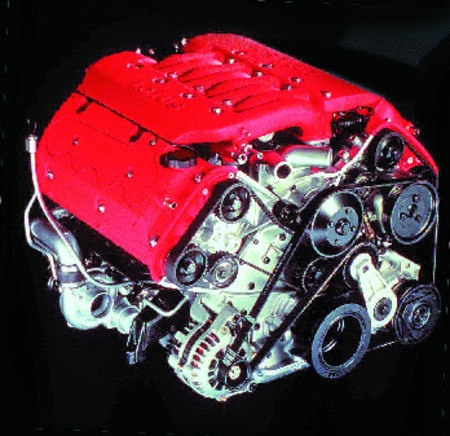
The four-cylinder engine gave way to a 3.5-liter twin-turbo V-8/six-speed manual transmission combo in 1997. With 350 horsepower on tap, the Esprit was faster than ever and possessed the kind of under-the-hood cachet most customers expected from such a limited-production -- and pricey -- exotic.
However, the end was in sight for the Esprit, precipitated in part by transmission supplier Renault ending production of the six-speed gearbox. The car was also showing its age, but more in form than in function. The fact is, if Lotus was going to charge nearly $90,000 for a sports car, it had better look, as well as act, the part.
For 2004, Lotus brought the smaller and considerably cheaper (around $40,000) Elise to our shores. Still, nothing will ever really replace the Esprit, which, for more than a quarter century, represented the spirit, style and the memory of Colin Chapman.
Malcolm Gunn is a feature writer with Wheelbase Communications. He can be reached on the Web at www.wheelbase.ws/mailbag.html. Wheelbase Communications supplies automotive news and features to newspapers across North America.