Nonprofit group helps moms kick addictions in home environment

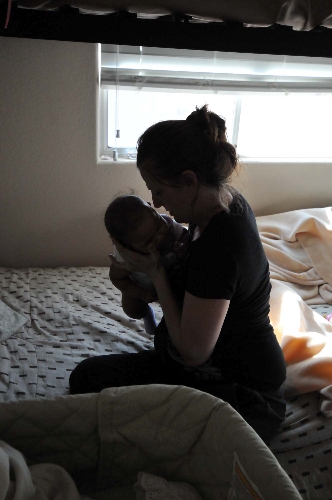






Jessica Marks waits nearly two hours at the Social Security office attempting to get a Social Security card. She's 35 and never had one before. She has never had any kind of I.D. She has never needed it.
Marks was a prostitute and addicted to drugs until recently.
"My focus was on staying high and not getting arrested," Marks said. "All I did was try to avoid going to sleep, especially if I didn't have a place to stay, which meant getting high."
Marks sometimes saw up to 30 men a day to support her habit.
She said she hopes those days are over.
She resides in a sobriety house in the southwest area with six other mothers trying to kick their addiction to drugs.
Marks spends her days making baby formula, changing diapers, drinking coffee, doing house chores, putting on makeup. She is learning to cook for the first time in her life. She made her first pork chops this month.
"I'd like just the simplest things," Marks said of her future goals. "I just want to be happy, and I want to be a good mother and have a job. That's where I'd like to see myself in a year."
Marks and her 4-month-old daughter, Kora, are in a foster care program unlike any in the valley. It's All About Kidz is a nonprofit organization created by two former drug counselors. Executive director Marina Rit and former director Veronica Mitchell started the program in September.
The program is in danger of closing because of funding. Rit and Mitchell have been keeping the program afloat with their own money -- an estimated $2,000 a month out of their own pockets -- but they said they can't do it any longer. They have applied for grants and expect to receive some government funding, but that won't happen until July, they said.
Unless they can get support from local donors, the program will have to close. The mothers will be on their own. Their children will be placed in foster homes.
To make a donation, call 445-0203 or visit aakidz.org.
"The way that foster care is set up is totally inadequate," Rit said. "I don't think they should separate the mother and the child. I just don't think it works.
"On the one hand, we say addiction is a disease. On the other hand, we then punish those that use (drugs). I don't think it's healthy or productive to remove the child from the mother, so we came up with a great solution: We'll take them both into treatment."
Rit explained a typical situation she and Mitchell witnessed hundreds of times working in drug court: A mother who tests positive for drugs during childbirth will have her baby removed by the Department of Family Services' Child Protective Services division. That child will be placed in foster care for a year. Mothers have to meet requirements set by a social worker in CPS that include scheduled visits, counseling, drug testing and other criteria.
"What we would notice in our work at drug court," Mitchell said, " over and over, the moms would wind up losing their kids, and then there's no impetus to stay sober. Why bother?"
Rit and Mitchell said that outcome was "typical" for mothers.
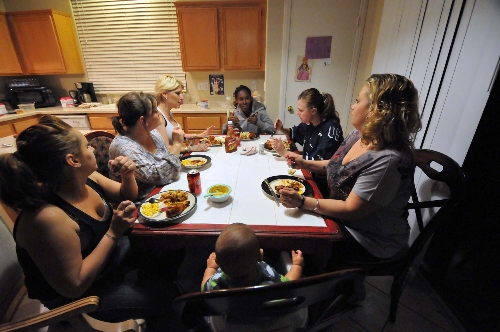
The seven mothers in It's All About Kidz live a life of routine inside the five-bedroom, four-bathroom house. They wake by 7, eat breakfast and clean the kitchen by 8. No TV is allowed during the daytime. The women are to work, look for work, attend counseling and other court-ordered group meetings, perform chores and take care of their children.
Each woman prepares dinner one night a week, and everyone eats together at the kitchen table. They clean, have a few hours of free time, and most are in bed by 9.
Since the program started, no one has failed a drug test.
Marks said she has been clean since August and moved into the house at the beginning of January. She's learning how to live a normal life, which is difficult because she has never had one.
Marks grew up in Portland, Ore., and does not have the fond childhood memories that most do.
She rubs the back of her head with her hand, explaining how it is flat because she was rarely held as a baby. Her mother, Cocaine Katie as she was known around town, gave birth to Marks in the backyard and left her outside in a bucket.
Marks would be told this years later by her sister who, as a 6-year-old, found her baby sister outside. She brought her inside, cleaned her and wrapped her in a blanket.
To get the baby to stop crying and sleep at night, her mother would blow marijuana smoke into a bag and place it over the infant's head.
Marks recalled being sexually abused at age 4 by her mother's boyfriends. That continued throughout her childhood, she said.
At 10, Marks was given to foster care and adopted.
"But by then," she said, "it seemed I was already tainted. When it came time for me to have stability, I didn't know how. So I started taking off, running away, messing up."
At 13, she became a prostitute.
At 14, she was pregnant.
"When I had (the baby), I was just too young and selfish," Marks said. "So I left her with my mother and never came back."
Marks spent most of the 1990s and 2000s addicted to crack and other drugs. She moved to several states in an attempt to avoid warrants. She was released most recently from the Florence McClure Women's Correctional Center near Nellis Air Force Base in 2010.
It has been nearly 20 years since Marks has seen her adopted mother or her oldest daughter, Brianna. Marks said she wants to reconnect with them.
Marks said it helps being around other single mothers and their children because she is able to learn from them. She said she feels encouraged being around women who are going through the same thing she is.
The location is also constructive, Marks said.
Mitchell and Rit said it was important that these women be placed in an affluent neighborhood.
"We've both worked at treatment centers before that were in the 'hood," Mitchell said. "To me, the message you're sending is, 'This is what you deserve. You're an addict. Who cares? You deserve to be in the ghetto.' "
"We picked a spot that was outside that with less temptation. To say to them, 'You deserve this. (You are) a worthwhile person.' "
For Marks and the six others in the program, every day is a struggle.
"Sometimes I'm tempted to take the easy way out," Marks admits while waiting at the Social Security office.
She pauses, disconcerted by the admission.
"Just that I thought about it freaked me out."
What's keeping Marks clean is asleep in the stroller next to her.
"If it wasn't for (my daughter), honestly, I'd still be out there," Marks said. "I just don't want to repeat what I did to my first daughter.
"I believe everything happens for a reason. I believe I was given this little girl, this little life, to save mine."
Contact View education reporter Jeff Mosier at jmosier@viewnews.com or 224-5524.
Help It's All About Kidz
It's All About Kidz needs donations to remain in operation. To make a donation to the program, call 445-0203 or visit aakidz.org.