Porsche revisits hybrid technology with 911 GT3 R
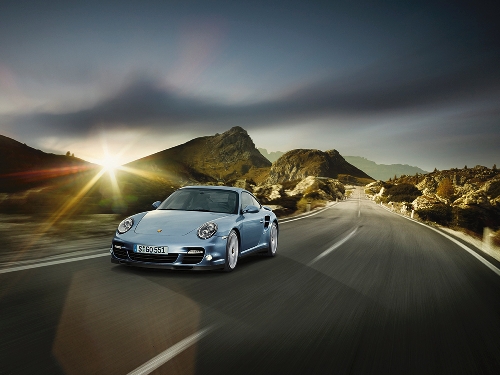


Like other automakers, Porsche is experimenting with hybrid technology. But unlike others, the legendary German sports-car maker started tinkering with gasoline-electric engines more than a century ago.
The Porsche 911 GT3 R Hybrid race car has been generating excitement since its debut performance in May 2010 during a 24-hour endurance competition at Nurburgring in Germany. It continued its standout performance this year by competing in the American Le Mans Series during a 1000-mile Petit Le Mans event at Road Atlanta in Georgia and winning a 621-mile Le Mans GT class event in Zhuhai, China.
The hybrid technology in the Porsche 911 GT3 R uses a unique flywheel kinetic energy recovery system, or KERS, which was originally developed by Williams Hybrid Power for Formula One racing. Porsche has adapted the technology for Grand Touring racing.
The Porsche 911 GT3 R uses a parallel hybrid configuration where a four-liter, flat-six gasoline engine provides 480 horsepower to the rear wheels of the vehicle but two 60-kilowatt electric motor/generators are also available to drive the front axle. Rather that use a bank of traditional chemical battery cells for electrical energy storage, the KERS unit uses an electro-mechanical flywheel power generator that can quickly convert electrical energy to kinetic energy within a spinning flywheel, then release it again as electrical energy.
The flywheel is energized and spun up when the driver brakes the car while going into a turn. When passing another vehicle, the driver presses a boost paddle on the steering wheel that can add large bursts of energy to the two electric motors, creating 160 horsepower and lots of torque that speed up the front wheels of the drive train. These bursts only last about six to eight seconds before the spinning flywheel slows down under load, but the KERS unit can then replenish its kinetic energy from the next braking motion of the car within seconds.
Although Porsche's hybrid-car technology seems unique and new for the 21st century, its automotive DNA can be found in 110-year old technologies developed by its company founder.
Ferdinand Porsche has long been revered as a pioneer of the German automotive industry and was posthumously awarded Car Engineer of the 20th Century by the International Automotive Hall of Fame in 1999.
Porsche started his career with the Bela Egger Electrical Co. in Vienna, Austria, where he worked on early designs for an electric hub motor, an "inside-out" electric motor where the rotating part of the motor is on the outside and the stationary electromagnetic field is on the inside. Hub motors can be fitted to spokes on a wheel and are still very popular today because they can directly drive the wheels on electric bicycles and scooters.
In 1898, Porsche took on his first automotive design project with Jakob Lohner & Co., which built stately carriages for royal families in Austria, Sweden, Romania and England. Lohner commissioned Porsche to improve the performance of his new battery-powered electric horseless carriages. The resulting System Lohner-Porsche design replaced a single rear-wheel electric motor with two hub motors mounted in the front two wheels of the carriage. The dual electric motors could accelerate the carriage more quickly with front-wheel drive. However, the weight and size of the lead-acid batteries still limited the ability of the carriage to travel long distances and go up steep hills.
His solution to the range limitations of existing EV technology at that time was to design a "Mixte" hybrid concept. Instead of one large and heavy lead-acid battery pack, he combined a small gasoline engine that drove a dynamo to continually charge up an electrical energy storage bank of "accumulators" that was lighter in overall weight. This design created a series-hybrid electrical power source, similar to the design of today's Chevrolet Volt. From 1901 to 1906, more than 300 Lohner-Porsche hybrid gasoline/electric vehicles were sold, some of them setting new speed records for that era during auto racing competitions.
To view a picture of a 1903 Lohner-Porsche "Mixte" production car that shows the two front wheel electric hub motors, as well as other hybrid gasoline/electric cars from that era, visit www.hybrid-vehicle.org/hybrid-vehicle-history.html.
Stan Hanel has worked in the electronics industry for more than 30 years and is a long-time member of the Electric Auto Association and the Las Vegas Electric Vehicle Association. Hanel writes and edits for EAA's "Current Events" and LVEVA's "Watts Happening" newsletters. Contact him at stanhanel@aol.com.