Water rights permit couple to keep aquatic features, greenery
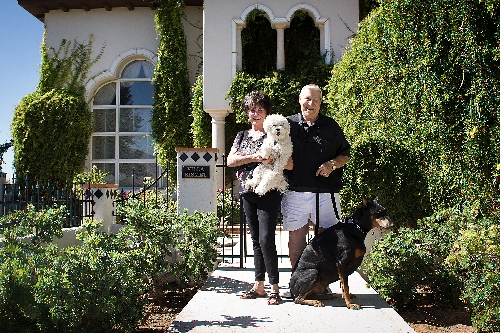


Count Guido Roberto Deiro and his wife, Joan, call their home Villa Kismet.
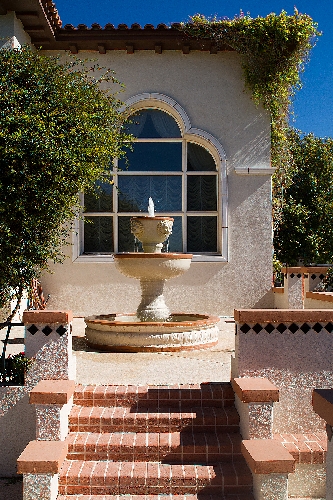
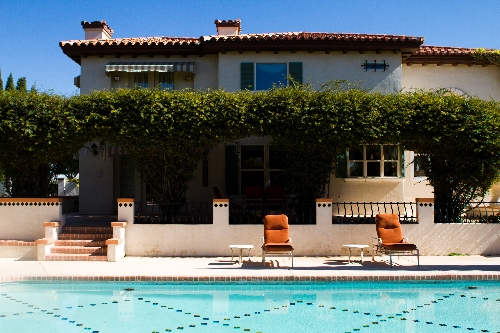
They have seen to each detail of its destiny -- the literal translation of kismet -- from their 7,300-square-foot home and guest house to the 136 trees, 50-foot swimming pool, fountains, bird baths and lush greenery, all seated on 1.5 acres in Centennial Hills.
The property draws a lot of attention from visitors to the nearby community orchard. Some even knock on their door to ask how the Deiros pull it off in this desert dwelling.
"I tell them, 'I own my own water rights,' " Count Deiro said.
Because their home is a certain distance away from a utility line, the Deiros were eligible to purchase water rights and pump from a well. Their rights are patented and irrevocable, Count Deiro said, and recognized by the Nevada Division of Water Resources.
The Deiros' well is 500 feet deep and contains 5.52 acre feet of water.
One acre foot of water is 325,851 gallons and equivalent to 1 acre of ground covered with 1 foot of water, said Jason King, state engineer with the Nevada Division of Water Resources.
The Deiros' well is upstream from the main Las Vegas aquifer and classified as "fossil water," as it is untreated. The Deiros test it for contaminants and filter out silt, but mostly what's pumped into their pipes is unblemished.
"Bottled water doesn't taste as good as that," Joan Deiro said. "We're very fortunate."
There are rules for maintenance, forfeiture and abandonment with their water. In sum, if you don't use it, you could lose it, Count Deiro said.
"I can't use more than I own, and I have to use a certain amount a year," he said.
But that doesn't mean the Deiros waste water.
The fountains, bird baths and sprinkler system are all on automatic settings. The pool is 5 feet in the deepest part and the couple don't need to heat it six months of the year. The 15-year-old main house was built to Mediterranean stylings, which naturally conserves energy, Count Deiro said.
"Everything here is intentional," he said.
He estimated that if he had to tap into a utility line of water, his bill would be $1,400 a month.
Count Deiro said their decision to seek out the water features and greenery as opposed to Xeriscape was influenced by overall temperature.
"The ambient temperature is about 15 to 20 degrees lower than rock yards," he said. "It was done out of necessity, not duty."
Count Deiro said his power bill to cool the two buildings on his property is about half of what it would be if his yard was Xeriscape.
"It creates a bubble of heat that isn't green," he said. "It's like putting yourself on a frying pan. We conserve water at the risk of wasting energy."
The Deiros, who are both in their 60s, hire a grounds keeper and a staff to maintain the pool. Live-in security keeps the entire property safe.
Count Deiro, who holds a formal title and can trace his family history to Italian nobility in the 1600s, grew up in Las Vegas.
"When I was a young man, there was so much water that it flowed up under its own pressure," he said. "Water is what made the West grow. The availability of water governed the expansion of Nevada."
Today, the water is accounted for, owned and regulated.
All sources of water within the boundaries of the state, whether above or beneath the surface of the ground, belong to the public, according to the Nevada Division of Water Resources.
Count Deiro paid about $150,000 for his first 1.8 acre feet of water in 1986, and he purchased more usage four times at varying cost.
Everyone, from giants such as the Southern Nevada Water Authority to a gas station in the middle of the state, can submit an application to the state to purchase water rights, King said.
The only exemption are domestic owners, like the Deiros, who maintain the right to transfer "like a Cadillac," Count Deiro said, the rights to another person or entity if they wished.
King said all of the water in the state, which amounts to 256 basins, is appropriated.
About 70 percent of the 1,500 or so applications his office fields a year are transfer or "change" status.
"Every one of the basins is unique," King said. "We have values for each one and what we estimate for perennial yield or the amount of water that can be appropriated each year."
The state division is involved to ensure the water is being used appropriately.
"We are the driest state in the nation in terms of precipitation, and for 21 of the past 24 years, we were the fastest-growing," King said. "Right there is the rub. We have the least amount of water, and we are the fastest-growing. In a perfect world, you cut it off and say there is no water to appropriate. We don't do that."
Count Deiro served on the Southern Nevada Water Authority's Advisory Committee for Groundwater Management about 10 years ago. He helped give advice to state legislators on management of ground water. He championed for a Garden Valley rancher who was in jeopardy of losing everything when the Southern Nevada Water Authority and the U.S. Department of the Interior filed for water rights in the area over him about 10 years ago.
Courts eventually ruled in the rancher's favor, and now any resident can seek out his own water rights.
"I feel proud of that," Count Deiro said.
The Deiros plan to maintain Villa Kismet at the level they have built it, they said. Their pool is a "family focal point," they said, for their children and grandchildren. Their two dogs make daily use of the 10,000 square feet of green space.
"I'll finish my days here," Count Deiro said. "Do I want to spend my days picking up dog poop from rocks? No."
For more information or to view a list of water rights owners, visit water.nv. gov.
Contact Centennial and Paradise View reporter Maggie Lillis at mlillis@viewnews.com or 477-3839.