



UAB decision on football program could affect UNLV



The fight at Alabama-Birmingham rages on, with those rallying to save football at the school gaining momentum after it looked as if their battle was hopeless.
What happens at UAB will have far-reaching effects, including at UNLV.
UAB president Ray Watts decided Dec. 2 to shut down the football program, saying the university no longer could afford to subsidize two-thirds of what has been a $30 million operating budget for the athletic department. Supporters of the program have since rallied to try to bring back football, and Watts is weighing whether keeping the sport makes financial sense.
If Watts sticks with his decision to end Blazers football, such a decision would influence other schools in similar financial situations to look seriously at taking such a bold step.
If Watts relents because evidence suggests more harm than good would result from getting rid of football, that gives hope to struggling programs everywhere to keep going, including at UNLV.
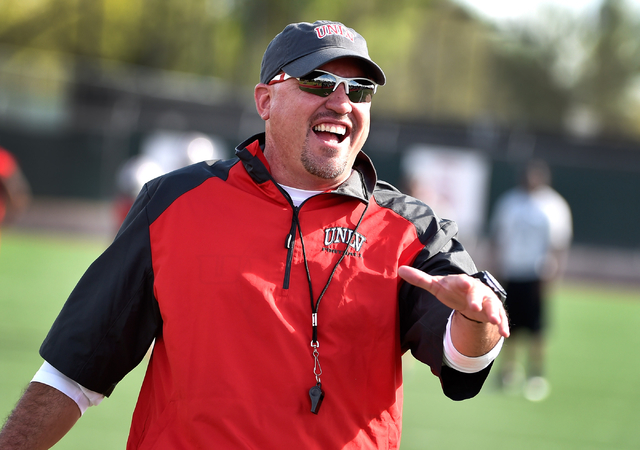
Talk of killing football at UNLV has subsided with the hiring in December of coach Tony Sanchez, who has brought energy to the program and created a buzz in the community for the first time in a decade or so. Rebels fans want to give him every chance to succeed.
And if he doesn’t?
That’s why what happens at UAB is so important.
UAB hired a company called College Sports Solutions to make a detailed report on whether football — as well as bowling and rifle — should be brought back. Former San Diego State athletic director Jeff Schemmel created CSS and is its president. Former UNLV athletic director Jim Livengood is a consultant for CSS and worked on the UAB report.
Livengood referred questions about the report to Schemmel, who said he was not allowed to talk about specifics.
But details have been reported. The 97-page report makes the case for and against bringing back football, but largely sides with keeping the sport, arguing it makes more financial sense to do so because of the revenue from Conference USA that otherwise would be lost.
“The real questions become what does UAB want to be in intercollegiate athletics, in whose company does it want to stand, and what is the best fit to match the mission and vision of the university?” the report asked.
“We do believe that if a decision is, in fact, made to reinstate these sports, it would foster much goodwill and stimulate a substantial amount of spiritual and financial support from alumni, donors, ticket holders, friends, students, faculty and the community. It could create a unique opportunity, not only through that support, but also through unprecedented positive national attention to the university.”
Watts said he will make a decision by June 1. Schools, including UNLV, from outside the power five conferences will be watching.
■ HURRICANE WATCH — Miami hasn’t played in the Orange Bowl since leaving in 2008 for Sun Life Stadium in Miami Gardens, and the new facility never felt like home.
It certainly didn’t have the same atmosphere as the old Orange Bowl, which was in the heart of Miami. Also, Sun Life Stadium, with 65,326 seats, is too large a venue for the Hurricanes, who share the stadium with the NFL’s Dolphins.
Now the Hurricanes want to return to Miami, and they are teaming with former soccer star David Beckham. They are working on a stadium in the 40,000-seat range that, according to the Miami Herald, would be home to the ’Canes and a potential Major League Soccer team.
The university, however, has 17 years remaining on its lease with Sun Life Stadium, though expert lawyers can find ways out of contracts.
Even if contractual details get worked out, that doesn’t guarantee the Hurricanes will move back to Miami. There are complications with a deal with a possible MLS team, and a stadium site needs to be found.
But if the Hurricanes make their way back to the city, it would restore much of the luster lost since their departure. When Miami had it rolling in the Orange Bowl, there was a vibe around the program that can’t be duplicated in Sun Life Stadium, which is 20 miles from campus.
And people complain about the distance between Sam Boyd Stadium and UNLV.
■ LEAVING TOWN — If anyone knows how important it is to be ready as a backup quarterback, it would be Darell Garretson.
Or at least it should be him.
He was forced into action the past two seasons when Utah State starter Chuckie Keeton went down with knee injuries. Garretson rescued the 2013 season for the Aggies, leading them to the Mountain West title game and a 21-14 victory over Northern Illinois in the Poinsettia Bowl.
Garretson’s own season ended prematurely last year when a wrist injury caused him to miss the final seven games.
When the NCAA awarded Keeton an extra year of eligibility in February, Garretson decided to leave the school, and on Monday he said he was transferring to Oregon State. Garretson is walking on and can’t play until 2016 because of NCAA transfer rules, making it seem like Keeton coming back wasn’t the only reason he left.
Because if there isn’t more to the story, it’s an odd move and one Garretson might come to regret.
Contact Mark Anderson at manderson@reviewjournal.com or 702-387-2914. Follow him on Twitter: @markanderson65. He also is first vice president of the Football Writers Association of America.


