





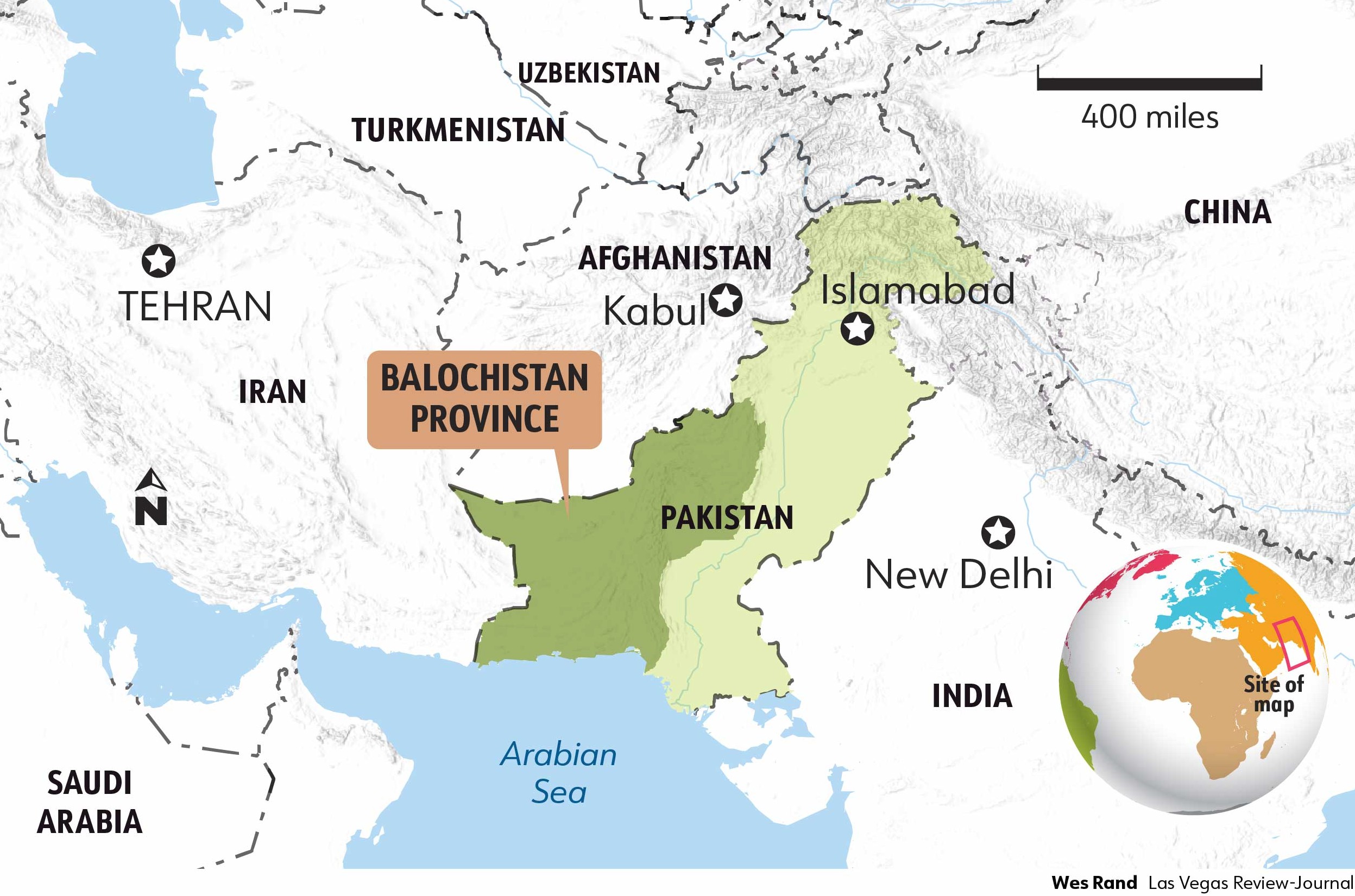
The province of Balochistan is the largest and poorest in Pakistan, covering a sparsely populated territory.
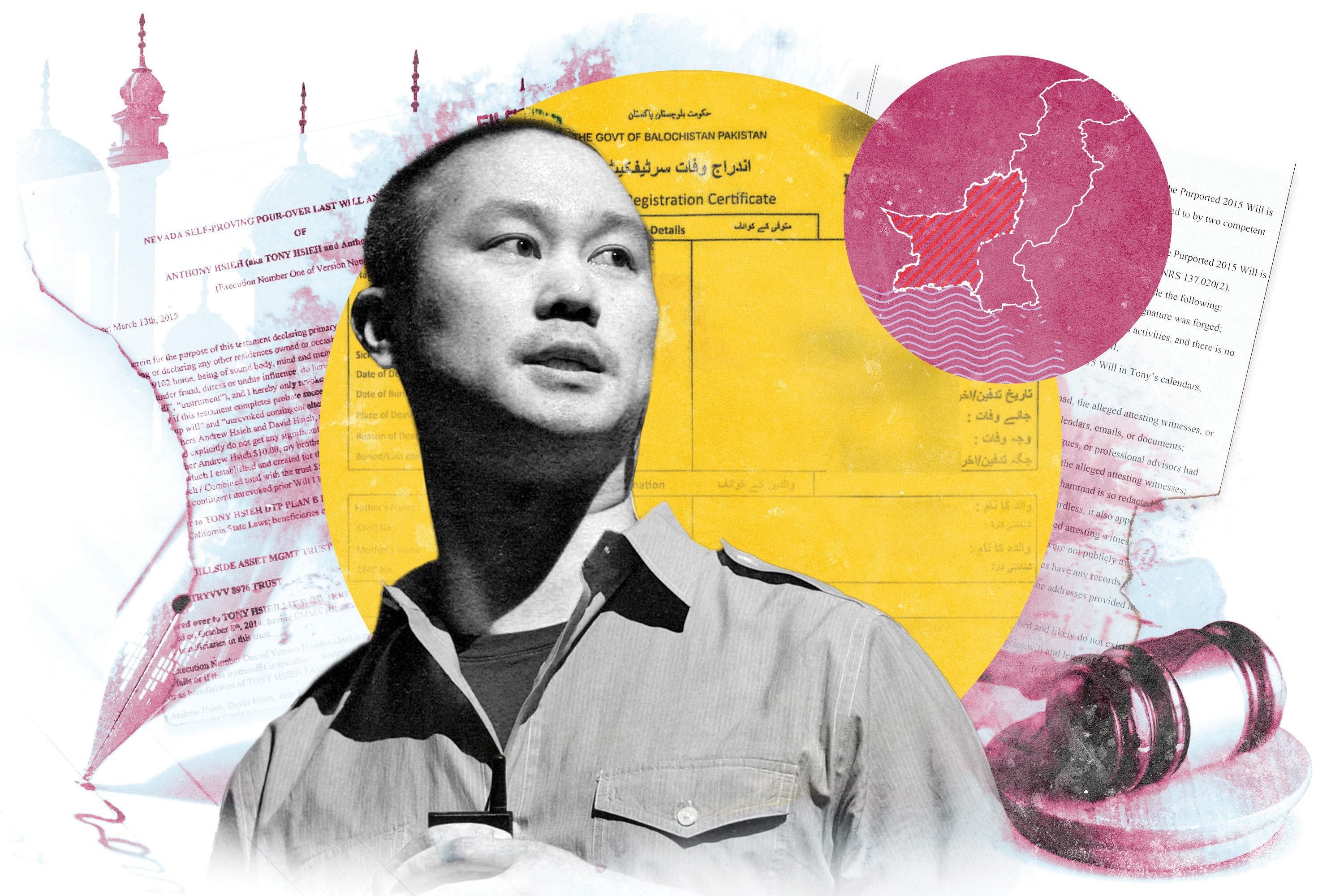
Its government also supposedly issued a death certificate for the mystery man at the center of the bizarre saga of Tony Hsieh’s will. And lawyers for the late Las Vegas mogul’s estate not only claim the will is a forgery, but that the heavily redacted death certificate appears bogus, too.
Attorneys for Hsieh’s estate claimed in court papers last month that the former Zappos chief’s purported last will and testament — which was filed in Clark County District Court more than four years after his death — is fake. They said that his signature in the will was forged, that none of his family, friends or colleagues had ever heard of key names in the document, and that the witnesses who signed it “likely do not exist.”
Lawyers Dara Goldsmith and Vivian Thoreen, who represent Hsieh’s father, the administrator of the estate, did not accuse anyone by name of orchestrating the alleged forgery.
But they said that whoever was “behind this scam went to extraordinary lengths to cover their tracks by creating a false trail.”
All told, the legal team said that the will was found by a “complete stranger, many years after Tony’s death, in the possession of the stranger’s deceased grandfather … a 91-year-old Pakistani man with no known ties to Tony.”
They also claimed the dead grandfather probably never existed, saying he appears to be a “fictional person fabricated for the purpose of committing this fraud.”
Mystery name
Hsieh, the former CEO of online shoe seller Zappos and face of downtown Las Vegas’ economic revival, died on Nov. 27, 2020, at age 46 from injuries suffered in a Connecticut house fire.
He was unmarried and died with a massive fortune, and his dad’s legal team stated multiple times in court filings that the younger Hsieh died without a will.
However, law firms McDonald Carano and Greenberg Traurig teamed up to file court papers last April with a copy of Hsieh’s seven-page last will and testament — dated March 13, 2015 — and a letter describing how it was found. The firms were representing named executors in the will.
The will was found last February in the personal belongings of the late Pir Muhammad, according to the letter, which stated Muhammad had suffered from Alzheimer’s disease and was not aware Hsieh had died.
The letter did not say when Muhammad died or where he lived, nor did it provide any details about his career or his association with Hsieh.
As outlined in the will, Hsieh had named Muhammad an executor and gave him “exclusive possession” of the original, in part to prevent anyone from destroying the document.
But several people who knew Hsieh told the Las Vegas Review-Journal that they never heard of Pir Muhammad.
The Review-Journal also checked property records, court records, business-entity registrations, online phone directories, search engines and other databases but found nothing that linked the name to Southern Nevada or confirmed who he was.
“No one knows who he is,” a source previously said.
Redacted death certificate
Last June, McDonald Carano and Greenberg Traurig filed court papers in Hsieh’s probate case that included a copy of Muhammad’s death certificate. The document was written in both English and Urdu, and as shown at the top, it was issued by the government of Balochistan.
But much of it was redacted, including Muhammad’s cause of death; place of death; address; and parents’ names.
Based on all the evidence and lack of verifiable records, Pir Muhammad appears to be a fictional person fabricated for the purpose of committing this fraud.
It still showed Muhammad’s name; nationality (Pakistani); date of birth (shown only as 1931); gender (male); and religion (Islam).
It also included his date of death, shown only as October 2022 — which meant that Muhammad died more than two years before Hsieh’s will was supposedly found in his possessions.
The attorneys who filed the document in court did not explain who redacted it, nor did they initially disclose how they obtained it.
Georgetown University professor Aqil Shah, who has written about Pakistan and taught classes on South Asia, told the Review-Journal that he thinks it’s common for vital records in Pakistan to include both English and Urdu.
He also indicated that with an unredacted copy of the death certificate, its QR code can confirm the authenticity. The document filed in court apparently had a QR code at the bottom, but this was also blurred out.
The Review-Journal tried to obtain an unredacted copy of the death certificate from officials in Balochistan but came up empty.
‘No connections to anyone named Pir Muhammad’
Overall, the death certificate was “so redacted that critical information cannot be validated, and regardless, it also appears to be fake,” attorneys for Hsieh’s estate wrote in court papers last month.
As they described it, the document was “useless.”
Goldsmith, a shareholder with law firm Goldsmith & Guymon, and Thoreen, a partner with Holland & Knight, previously wrote in court papers that even if the document could be authenticated, it only showed that someone named Pir Muhammad died and did not show that it was the same Pir Muhammad who was named in the will.
The Review-Journal previously found more than 1,000 profiles on Facebook with the name Pir Muhammad. Many of them said they lived in Pakistan.
During a court hearing last summer, Goldsmith said that her team still didn’t know where exactly the will was found.
“We don’t know where in the world this document was located,” she said. “We have no idea.”
Tufts University history professor Ayesha Jalal, director of its Center for South Asian and Indian Ocean Studies, told the Review-Journal that Pir Muhammad is a “fairly common name in Pakistan.”
She also said that Balochistan is a “relatively undeveloped and politically marginalized” part of the country. It is rich in coal and gas, but its mineral resources are only now beginning to be tapped, she added.
According to the United Nations’ development agency, Balochistan is the largest and poorest province in Pakistan.
It covers 44 percent of Pakistan’s landmass but is only home to about 15 million of the country’s 240 million people, according to the Georgetown Journal of International Affairs.
“In reality, Tony had no connections to anyone named Pir Muhammad,” according to lawyers for Hsieh’s estate.
There were no records of, or references to, Pir Muhammad in Hsieh’s calendars or emails, and there was “not a single email communication” between Hsieh and the email address listed as Muhammad’s in the will.
The attorneys also stated that Muhammad’s email address is not a legitimate one, as multiple databases, including those with data-breach and dark-web information, showed no record of its existence.
“Based on all the evidence and lack of verifiable records, Pir Muhammad appears to be a fictional person fabricated for the purpose of committing this fraud,” the lawyers declared.
No answers
Pir Muhammad’s identity and death certificate are just two of the many mysteries swirling around Hsieh’s will.
Another key figure in the saga, Kashif Singh, wrote the letter explaining the will’s discovery. No contact information or details on Singh were provided in that filing. According to subsequent court papers, Singh was Muhammad’s grandson, and he also provided the redacted death certificate.
As part of an order for courthouse administrative records, the lawyers for Hsieh’s estate obtained a phone number and mailing address for Singh.
The phone number had a 307 area code, which covers Wyoming, and the mailing address was the same as a registered agent in Wyoming’s capital, Cheyenne. Such businesses handle incorporation filings and other corporate paperwork.
The call went straight to voicemail, which was a computerized or electronic voice, and Singh did not call back. The attorneys also sent him a letter, but he did not reply to that either.
Moreover, the will was signed by several witnesses, three of whom had a Las Vegas address listed with their name and signature in the document.
But property managers could not find any records that the witnesses had lived there, court records show.
‘Scams come in all shapes and sizes’
According to lawyers for Hsieh’s estate, none of the witnesses have been located and likely do not exist, and none of the trusts, or their respective trustees, named in the will can be located and likely do not exist, either.
Also, there was no record in Hsieh’s calendars that he signed the will; there was no record that he had any contact with people named in it; and an expert in counterfeit-document detection found it “virtually certain” that Hsieh’s signatures in the will were forged, according to the legal team.
Plus, University of Cambridge linguistics professor Bert Vaux, who was retained by Thoreen’s law firm to analyze the will, concluded with a high degree of confidence that Hsieh neither authored nor edited the will and that the people who drafted it were likely non-native speakers of English, court records show.
As he described it, the will had a mix of formulaic legalese and “non-native patterns,” along with numerous grammatical errors, ambiguities and irregularities that were “markedly inconsistent” with Hsieh’s known formal writing and speaking style.
He figured the authors were likely from India or Pakistan, court records indicate.
“Scams come in all shapes and sizes,” Goldsmith and Thoreen wrote in court papers last month, adding that much like other scams, the more you dig, “the more flaws appear in the story.”
Contact Eli Segall at esegall@reviewjournal.com or 702-383-0342.