Grape Expectations continues tradition of making memorable vintages




Charlie Peters passed away suddenly in September at age 58, but his dream continues to ferment.
That wouldn't be such a good thing had Charlie Peters been, say, a roofer. But he was a winemaker - CWO, or chief wine officer, of Grape Expectations in Henderson. At the time of his death he was expanding the 6-year-old company, despite the still-sluggish economy. The push carries on under the direction of his widow, Patty, and staff.
"He was a very, very special man," said Julie Jackson, who's in her fifth year of making wine with the company. "He was the heart and soul of the place - although I don't want to give the impression that it won't work without him, because it will. But he loved what he did, and it showed every day."
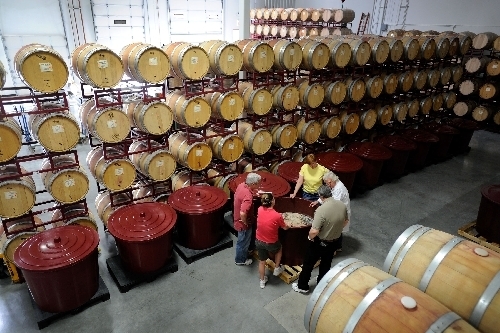
In the spirit of Charlie Peters' grand dream, it's quite an expansion - from 3,500 square feet to 11,500. A loft in the old place was used for storage; the one in the new location is used for parties. Although the participants in that first adventure produced 78 barrels of wine, this year's efforts will produce 150 to 160 barrels, with 2,000 people involved as part of groups of various sizes.
But while the new quarters offer more amenities as well as more space - four restrooms ("And we're very proud of that," quipped "professor of yeastology" K.J. Howe), plus kitchen, classroom, more offices and more winemaking space - the mission of Charlie Peters, a winemaker and registered sommelier, remains the same.
At its heart: "We try to keep the snobbishness out," Howe said, "and teach them the important elements."
David Lucchese has been a Grape Expectations winemaker since the beginning. That first year, his group made one barrel of wine. That expanded over the years to as many as eight, produced by about 30 couples, a mixture of family, friends, co-workers and friends of friends.
"We made it so people could just buy in, in case lots, so more people could experience the education and have fun with it as well," Lucchese said.
And Lucchese said the element of fun is an important part of the formula.
"Every step of the way is a fun process," he said. "They're so easy to work with, very good about helping people understand the process."
Jackson said, "There's nothing I don't like about it. I like the gathering of the people - the socializing - I like being able to learn about making wine. I'm a very visual learner, very tactile.
"With all of the wine classes I've taken, I've learned more by doing this hands-on. And I've met lots of really, really nice people."
Typically, Howe said, the groups cover a wide spectrum. Some are families. Some are participating in team-building exercises, or are more loosely constructed groups of co-workers. They're required to be on-site only at four points during the nine-month process, but some are in much more frequently.
"We use any excuse we have to get our people in here," Howe said.
Parties are thrown at various stages, there's group participation in the annual St. Patrick's Day parade in Henderson (complete with Bacchus on a golden throne and a marching band composed of "musicians" who better define the term "rookie") and impromptu visits.
"They get to come in and taste their babies whenever they want, and visit the nursery," Patty Peters said.
But while all of the fun is going on - as partly personified by the wisecracking, lab-coated Howe, who brings to mind the professor in the "Back to the Future" movies - the winemaking is serious, as Charlie Peters intended. Winemaking studios have cropped up across the country in the past decade or two, but few of them do it his way, which combines a traditional structure with a lot of individuality.
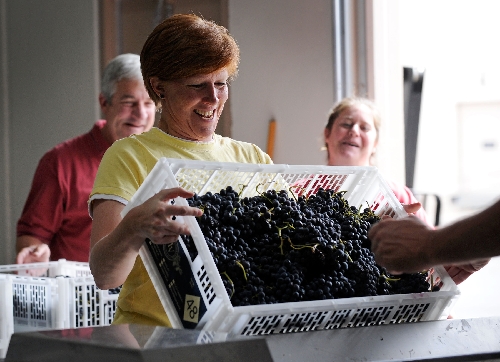
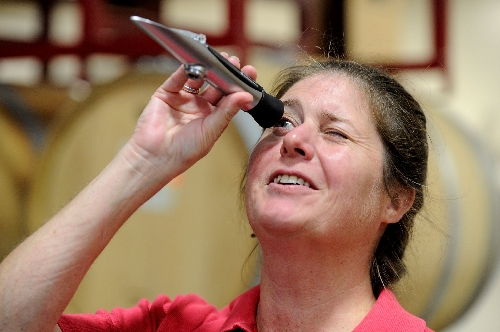
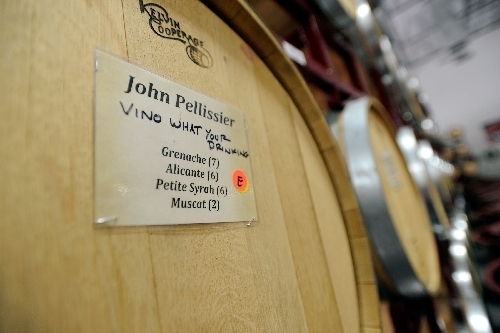
This year's class got started this month. First came the grapes, imported from California growers, handpicked and delivered on 36-pound palettes. Each team gets to decide what type of wine it will make, choosing from 18 varietals. That process can be rather difficult among the teams that have more people, and hence more opinions, production manager Larry Lucian said. Teams that have been through the process more than once tend to be a little more adventurous, with some concocting blends of up to seven varietals, Howe said.
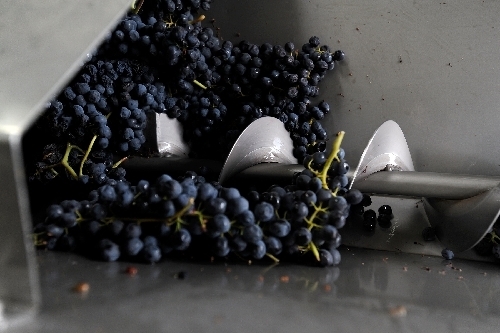
The delivery of the grapes is immediately followed by the beginning of winemaking, starting with dumping the fruit into what Howe calls "the Ferrari of crushers and stemmers." The machine churns. The larger stems shoot out the side to be discarded, while the must - the grape juice, skins, pits and little pieces of stems - are piped into a fermentation tub. Yeast is added, along with vitamin B1 (which Howe calls the "Viagra" of the process) and diammonium phosphate, which he said removes a naturally occurring sulfuric odor.
The yeast attacks the sugar in the grapes, producing alcohol and carbon dioxide, and the latter forces the skins to the surface. That's not a good thing; red wines take their color and flavor from the skins. So, four times a day, the mixture must be attacked with a big wine plunger.
Sometimes, Howe said, the teams take turns plunging. Sometimes the staff helps. And, believe it or not, there also are volunteers.
"We have wine junkies who just enjoy being part of the process," Howe said.
A week later, the juice is pumped into a 53-gallon barrel, the must dumped into a wine press so that as much juice as possible is extracted.
And then comes the wait - and many of the impromptu visits. Howe said that while commercial wineries age wines six to nine months in the barrel and a year in the bottle before releasing them, Grape Expectations' winemakers usually don't wait that long (although it's encouraged; more on that later).
Sometime in late January or early February, the wine is racked, which means it's pumped into a stainless-steel tank and the sediment in the barrel is rinsed out. The wine goes back into the barrel and the wait continues until May.
Then it's bottling time, the wine going into the bottles via a gravity-fed system. They add the cork and capsule, also known as the foil thingie that goes over the cork. Each barrel yields 240 bottles of wine, to be divided however the group members see fit.
Oh, and the labels. There's a lot of creativity, a lot of competition. Labels are judged separately from the wines, and each year's collection of labels is displayed in the classroom.
Wait, the wines are judged? Yup, two bottles from each barrel go to the American Wine Society, which judges them in 10 categories. Winning winemakers are awarded gold, silver and bronze medals at the annual Bacchus Awards dinner.
By that point, some of the winemakers already have started drinking their wine.
"They get the cases right away, with the hope that they will lay it down and store it properly," Howe said, which prompted Lucian to recount a story of a young woman who drank nearly all of her wine, disliking it greatly, until discovering that the few remaining bottles had improved exponentially.
"In the end, it's worth the wait," Patty Peters said.
Contact reporter Heidi Knapp Rinella at hrinella@reviewjournal.com or 702-383-0474.
JOIN THE CRUSH
Teams already have started this year's winemaking process at Grape Expectations, but the company signs people up and provides information throughout the year.
The fee for each barrel of wine this year was $2,600- or about $10.80 a bottle - which can be divided by the members of a team.
Grape Expectations is at 7360 Eastgate Road in Henderson. For more information, call 806-3383 or visit grapeexpectations lasvegas.com.