



History within Cabrera’s grasp
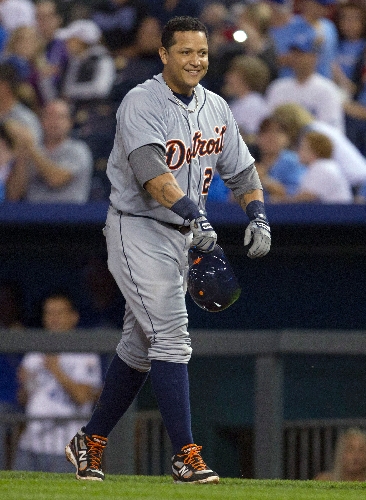


KANSAS CITY, Mo. - Miguel Cabrera sat in front of his locker in the corner of the visiting clubhouse at Kauffman Stadium on Tuesday, slinging Spanish banter at a table full of teammates.
No television cameras hovered over him. No microphones were stuck in his face. None of the commotion that could be expected surrounded the soft-spoken Detroit Tigers slugger closing in on baseball's first Triple Crown in 45 years.
"The entire baseball world should be here right now," said Justin Verlander, the reigning American League Most Valuable Player and Cy Young Award winner. "We've got, sorry to say, the regular guys.
"I think he's been relatively under the radar for what he's done, for what he's doing. It hasn't happened in 40-some years. It kind of annoys me. I don't know about anybody else. I don't know about him. It probably doesn't annoy him."
It certainly doesn't annoy Cabrera, who politely will answer just about any question posed to him but just as soon would spend his time hanging out with his buddies.
The perfect example came Monday, shortly after Cabrera had a home run among his four hits in a 6-3 win over the Royals that clinched the AL Central. He was asked about contributing so much to another division title, and Cabrera deflected the attention to his teammates.
"We got it done with the first one," he said quietly. "That was our goal."
Now, though, the spotlight shifts to the broad shoulders of Cabrera, who started at third base in Tuesday's 4-2 loss at Kansas City. He had a pair of singles and drove in two runs in his first two at-bats before flying out to right and leaving the game in the fifth inning.
Cabrera leads the American League in batting average (.331), homers (44) and RBIs (139) - the Triple Crown, last achieved by Boston's Carl Yastrzemski in 1967.
Angels rookie Mike Trout and Twins catcher Joe Mauer are giving chase for the batting title, which Cabrera won last year, while Rangers slugger Josh Hamilton trails him by a single home run.
Maybe the home run mark is why Cabrera was in the starting lineup.
Rather than sit on the bench and watch things play out - by doing so, likely locking up the batting title - Cabrera told manager Jim Leyland that he wanted to play. And he didn't want to be the designated hitter, either. He wanted to play just as he has all season.
"It's a big thing," Leyland said, "and it should be a big thing, and it really hasn't gotten away from what we're trying to accomplish, and now you feel more at ease talking about it."
Plenty of other people are willing to contribute to the conversation, even if Leyland and Verlander believe there should be more. Old-timers who never thought they'd see another Triple Crown winner have piped in, as have those who remain close to the game.
"It's just extremely difficult to do, to be the complete hitter, to be a run-producer in terms of RBIs, to be a power hitter in terms of home runs, and then lead the league in average," Royals manager Ned Yost said. "I don't know when the next time is we'll see it happen."
Tigers general manager Dave Dombrowski called Cabrera a "once-in-a-lifetime player" and recalled a conversation he had before Monday's game, when the seven-time All-Star admitted "the Triple Crown is important, but it's not the most important thing."
Cabrera wanted to win a championship, something Detroit has the chance to chase.
The same can't be said of Trout, his primary competition for AL MVP. Los Angeles was knocked out of playoff contention Monday when Oakland beat Texas, 4-3.
The MVP debate certainly slowly has started to boil.
On one hand, Cabrera is on the footstep of history, poised to join a club that counts 13 members, among them Mickey Mantle, Ted Williams, Lou Gehrig and Ty Cobb. He's dominated the statistical categories favored by traditionalists, the ones that count toward the Triple Crown.
On the other hand, Trout is being championed by new-school baseball thought, number crunchers who rely on more obscure measures such as WAR (Wins Above Replacement), a figure derived from several other statistics designed to judge a player's overall contribution to a team.
"For whatever reason, and I don't understand it, this WAR and sabermetric stuff seems to not focus much on RBIs. That blows my mind," Leyland said. "That's why (Cabrera) is the MVP. He plates the runners. He scores them. That's what the game's about, score some runs."


