Tesla brings elegance to electric vehicles




Elegant simplicity. Those words best describe the power train and suspension platform for Tesla Motors' 2012 Model S and the 2014 Model X electric cars.
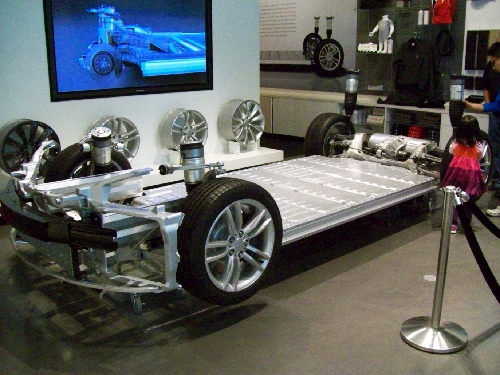
The liquid-cooled battery pack for this platform is sandwiched into the vehicle's floor. The whole floorboard unit, including the cooling fluid connections, can be interchanged onto the vehicle relatively quickly. Inside the floorboard "sandwich" are thousands of small, cylindrical lithium-ion cells that are joined together as one big energy storage module that can provide enough electric power to propel a traction motor swiftly with a lot of torque for a long time.
Viewed from the rear, the platform looks like a skateboard. An integrated drive system is positioned sideways between the rear two wheels of the platform. Its power train consists of an alternating current induction motor on the left, coupled to a gear reduction module in the center, and an electronics control unit on the right side. The electronics module contains an inverter that changes the direct current from the battery pack into alternating current to efficiently drive the electric induction motor.
The electronics module also enables regenerative braking whenever the "skateboard" is coasting to a stop or gliding downhill. When the driver lifts a foot off the accelerator pedal, free-spinning rear wheels continue to turn the electric motor magnetic fields so that the motor becomes a generator and creates its own electricity. The motor/generator's internal magnetic fields try to push the electric current back against the internal resistance of the battery pack, causing the motor/generator to turn more slowly while also slowing the wheels of the car at the same time.
Tesla Motors also is offering a Model S Performance version that features enhanced sports options. These add-ons include higher power flow through the inverter, as well as more efficient wheels and tires, air suspension and a tuned traction control system that together allow the Model S to accelerate from zero to 60 miles per hour in just 4.4 seconds.
There are several incremental prices to consider when sizing up the Model S options, including three different sizes of battery pack capacity that provide three different range capabilities.
The Model S base price starts at $57,400. It is equipped with a battery pack of 40 kilowatt-hours that allows the electric car to travel 160 miles before it needs to be recharged. The next price point of $67,400 upgrades to a 60 kilowatt-hour battery pack that gives the Model S a range of 230 miles. The third price point of $77,400 buys an 85 kilowatt-hour battery pack that allows the Model S to travel 300 miles. Model S Performance and Signature models add sport options and incremental features that can cost as much as $105,400. To mitigate this introductory price structure, there is a federal tax credit available for $7,500 through the end of 2012.
The Tesla Motors factory in Fremont, Calif., has begun ramping up its robots and employees to begin production this summer. Their goal is to produce 5,000 Model S electric cars by the end of 2012. The first premium sedans to roll off the assembly line will be delivered to some of the 8,300 awaiting customers who have already placed their deposits. During 2013 and beyond, the company plans to produce 20,000 Model S vehicles each successive year.
Because of the simplicity of the overall design, more of the Model S components can be stamped out, painted and manufactured within the Tesla Motors factory rather than outsourced from first-tier and second-tier suppliers.
In summer 2014, the Tesla Motors factory will begin production of its follow-up Model X crossover, with a goal to manufacture 20,000 vehicles each year during 2015 and beyond.
Battery capacity and range options for the Model X will be limited to just two product lines. A 60 kilowatt-hour and 80 kilowatt-hour battery pack will enable a 230-mile range and 300-mile range, respectively.
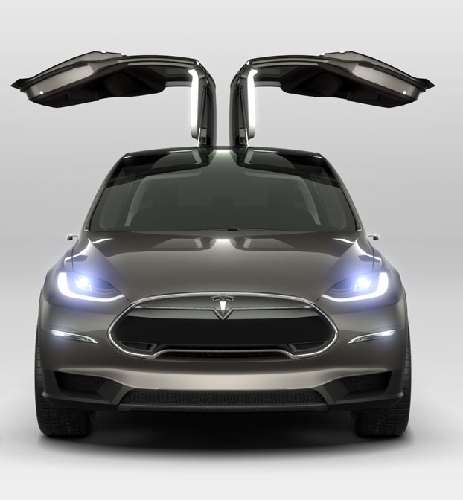
One eye-catching feature of the Model X is falcon wings that swing upward to allow easier passenger entry to the rear seats compared with traditional side-opening car doors.
The Model X also will be offered with an optional dual motor all-wheel drive. This configuration will employ two separate electric motor drive systems, with one drive unit located between the two rear wheels and a second one between the two front wheels.
The Model X Performance also will be offered as a higher end sports version.
For more information about the Tesla Motors Model S and Model X, visit the company's website at: www.teslamotors.com.
Stan Hanel has worked in the electronics industry for more than 30 years and is a long-time member of the Electric Auto Association and the Las Vegas Electric Vehicle Association. Hanel writes and edits for EAA's "Current Events" and LVEVA's "Watts Happening" newsletters. Contact him at stanhanel@aol.com.